|
–Geoff-Hart.com:–Editing, Writing, and Translation —Home —Services —Books —Articles —Resources —Fiction —Contact me —Français |
You are here: Home (fiction) --> Travel --> Wales 2025
Vous êtes ici : Accueil (fiction) -->Travel --> Wales 2025
Our first week was chosen to follow the itinerary and curated hike designed by On Foot Holidays, our well-loved travel planning company. We can't recommend them highly enough if you want to tour by yourself (i.e., without a guide), with a LOT of hiking each day, but would prefer to have someone else deal with the logistics. They have very good taste in finding itineraries both on and off the beaten path so that you're not up to your armpits in tourists. Specifically, our goal was to follow their "Offa's Dyke and the Marches" itinerary, which is a lovely stretch of hilly country that defines the border between Wales and England. Our second week was self-guided and we chose destinations to focus on the Atlantic coast of Wales.
A quote to inspire me (and thee) before we go: "When you're traveling, you are what you are right there and then. People don't have your past to hold against you. No yesterdays on the road."—William Least Heat-Moon
And a cartoon that seemed very appropriate after many, many mountain ascents and descents.
Direct links, by date:
This is our first long-distance trip from our new home in Kingston, where we've lived for about 2.5 years now. We were spoiled living 15 minutes from an international airport when we lived in Montreal. From Kingston, any airplane travel entails significant travel just to get to the airplane—a 3-hour train trip to Toronto or a 2.5-hour train trip to Dorval, Québec, on the western edge of Montreal. Both followed by a shuttle from the train station to the airport.
Weeks of preparation, and we were pretty much ready to go. We'll find out what we left behind when we reach Wales and unpack. Brought all the perishable foods that wouldn't last until our return to our neighbors (thanks, Kurt and RitaSue!), and got a lift to the train station by a local friend. (Thanks, Beckett!) Made it to the train with plenty of time to spare, and while we waited for the shuttle, had a good chat with a fellow who was also going to Montreal, but to fly to spend time with his son in Milan. He'd mentioned to his travel companion that some musician from a favorite band had recently died, and since he was looking at me, I laughed and observed that we were both at the age when it became possible to date yourself based on the musicians you grew up with who were no longer with us. We riffed on that topic a while until the train arrived.
The train trip was quick and efficient, as they finally seem to have finished track repairs that have been going on all summer. Getting from the train station to the airport is much easier now that they have a courtesy shuttle specifically for that purpose. We waited less than 10 minutes, then climbed aboard and were at the terminal in 5 minutes, as the shuttle got to bypass the usual crazy lineups getting from the highway to the arrivals floor. I was stuck in line more than 45 minutes once.
Madame and I are still not eating (thus, unmasked) in enclosed spaces, but we had a dodge for that: leave our checked bags to be scanned and routed into the queue for our flight, grab some dinner to go, and take it outside. It was raining hard, so we couldn't sit, but the parking garage was open-air and dry, so we had a pleasant standing dinner: a decent bowl with chicken strips, rice, romaine, corn, tomato, fried onions, and purple onions. Not particularly elegant, but romantic in its own way.
Dinner done, then back to the airport. Security has improved amazingly since our last international flight (6 years ago): no whole-body scanner, and no emptying your luggage for piecemeal inspection, with a futuristic scanner that resembled a jet engine that the luggage passed through. Much, much faster and presumably about as safe as the old methods.
By the time we were through security, our flight had been delayed for an hour by bad weather. This will complicate connections when we get to London, but fortunately, we allowed planty of extra time to get through Heathrow tomorrow morning. Wandered about the terminal for a bit, paused to share a beer (a pint of Smithwick) because it was quite warm in the terminal—and because it's a vacation, dammit! Now waiting for our gate to open so we can lurk, there prior to boarding.
Heathrow is one of the busiest airports in Europe, so you can imagine it gets quite crowded. Fortunately, the managers have done several things that can make your trip much more efficient. First, they've divided passport holders into one group for UK and EU citizens, who get fast-tracked, and another group for "others". As an other, you can apply online for an electronic travel authorization (ETA) from the U.K. government in place of a visa if you meet certain conditions (including being a member of the Commonwealth). It apparently lets you walk right through Customs and Immigration. We didn't have to interact with officials at all. I have no idea how this system works, but all it took to walk into the U.K. was to scan our passport (now linked to the ETA) and our face. The entry hall was packed with wall to wall visitors waiting in line, but we walked right past them all.
Of course, then we had to reclaim our checked baggage, which resulted in a prolonged sprint across the airport to reach the baggage return conveyors. We needed to move fast because our plane arrived an hour late due to bad weather, and that delay ate into the safety margin we'd allotted to let us coordinate multiple transportation modes. As in the John Candy movie of the same name, we would need planes, trains, and automobiles to get to Wales. (Next time, we may reconsider flying into Cardiff, but this time around, it didn't work out for various reasons, including price. I can't imagine we would have managed to retrieve the bags quickly had we been any older or less fit; while we had the luggage caddies it wasn't so bad, but when we descended into the bowels of the train system, I ended up carrying 100+ pounds of luggage, following in Shoshanna's wake.
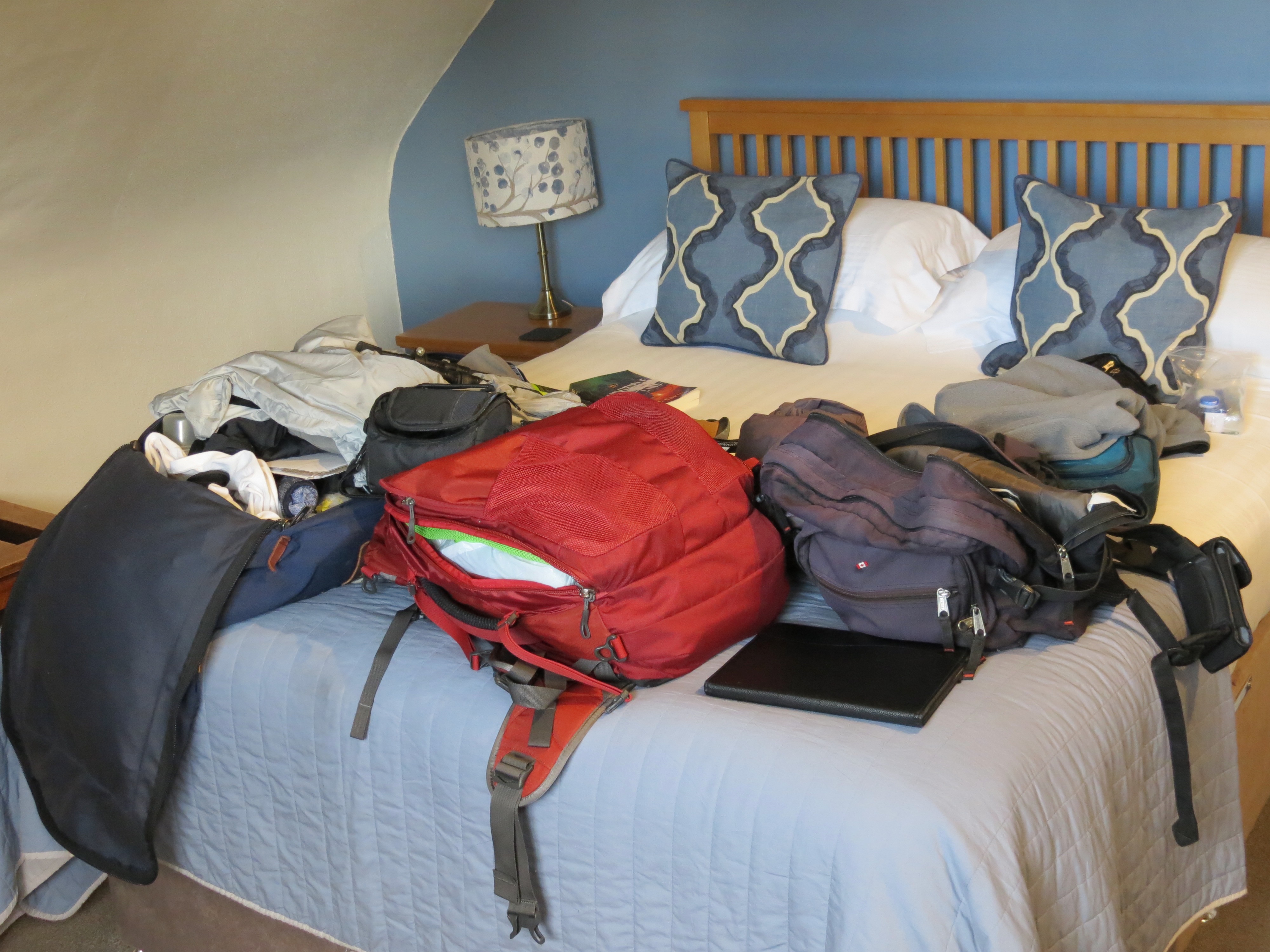
After eventually extricating ourselves from Heathrow airport itself, we took an express train to Paddington Station, which then connected us to the Transport for Wales (TfW) network, which dumped us at the Craven Arms station, where we were met by a taxi arranged by On Foot. Allan, our taxi driver, brought us to the town of Bishop's Castle, where we valiantly fought to stay awake long enough to get our bodies on the local time schedule. Unpacking was a work in progress:
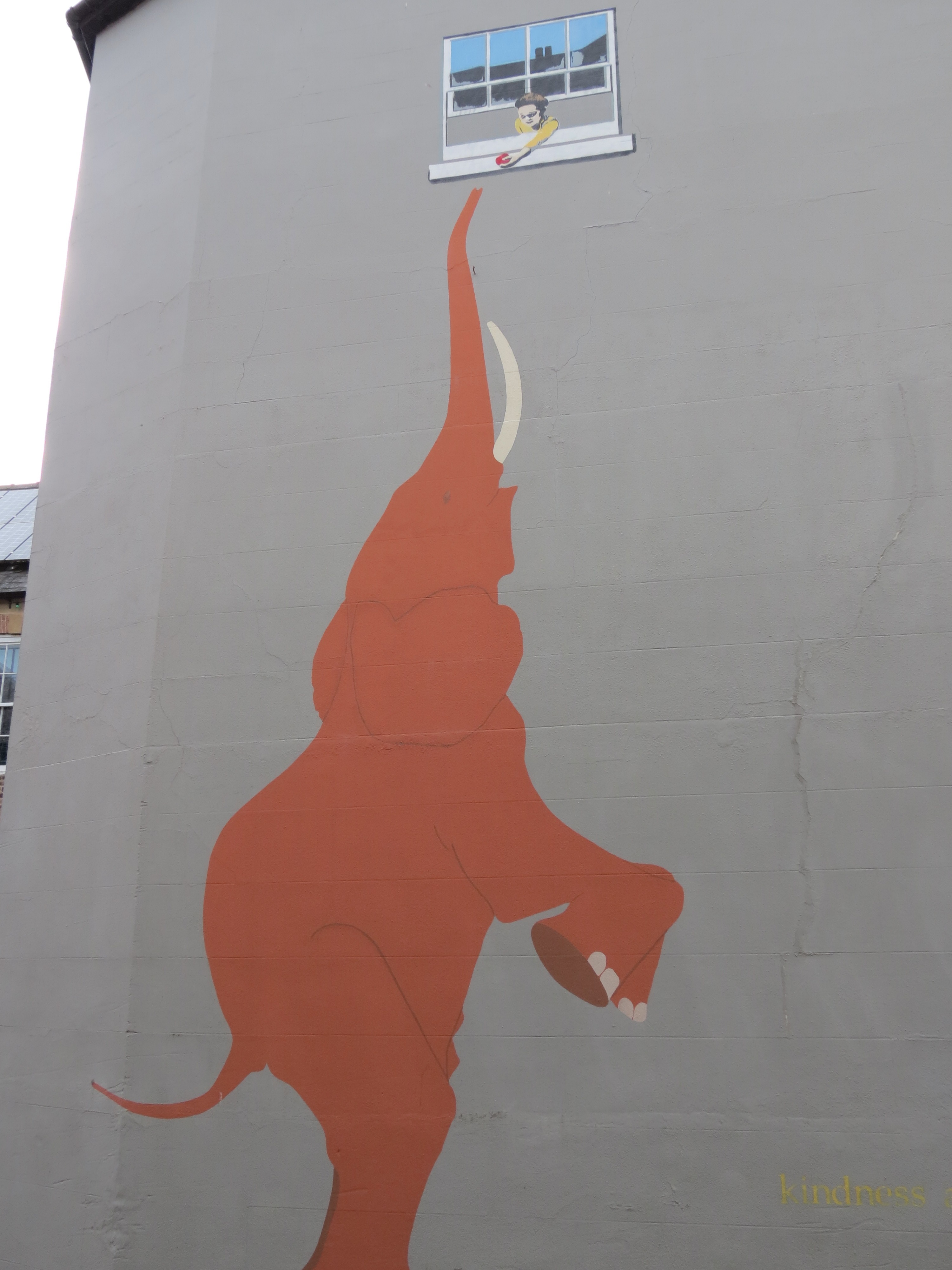
Part of that involved forcing us to walk around a bit before dinner. There are a lot of elephant paintings/murals, as the British apparently liberated their zoo elephants in London to save them from the Blitz during World War II, and they were kept safe at Bishop's Castle. Typical elephant art:
Met lots of friendly folk along the way, including an older woman whose family owns the large farm across the valley from the hotel where we were staying. But the winner for pure entertainment value was a group of eight young men, mostly in their late 20s and early 30s, enthusiastically discussing a weekend in Wales to do we're not quite sure what. From the chaotic discussions among them, which reminded me of those nights at the Hart dining table in which everyone participated simultanously in multiple conversations, it wasn't clear whether they were going to a sales conference or organizing a bachelor's party for a friend or just going on a "Roman holiday". They all clearly knew each other very well, since they exchanged anecdotes about past exploits at parties and strip clubs at machine-gun speeds and knew exactly what barbs were most effective. Though they were all drinking lots of beer, they were perfectly well behaved and good natured—just loud enough it was hard to hear the train announcements and not very good at self-censoring. Most interesting for me was the leader of the group, who was the only one able to get all the others to shut up and listen—something he achieved through a combination of charm, knowledge, and knowing all the other men's history.
Runner up was a couple of women in the table next to us at dinner, loudly discussing the charms and failings of the many men in their lives, punctuated liberally with f-bombs and much wild laughter. Not quite the "restrained" British of the cliché!
The hotel is a charming and charmingly creaky old pile of brick, and we're enjoying it so far. We'd be staying two nights at the Castle Hotel. Our first dinner (bacon cheeseburger for me, lentil shepherd's pie for Shoshanna) was delicious enough we'll be returning tomorrow.
The plan for our first full day in Wales was to wake up our legs with a hike through the area around Stiperstones hill circuit. Then we spent a second night in town before heading off on the next leg of out itinerary. It sort of mostly worked out. Sort of.
Breakfast was a decent buffet of cereals, fruits, etc. to keep us busy while we waited for a hot meal. I opted for the full breakfast (taters, sausage, bacon, kippered herring, and a large mushroom); Shoshanna went for avocado toast. Never tried kippers before, but they were salty and not too fishy. The rest of the breakfast was yummy and very filling. Enough so that the picnic lunches we'd ordered the night before, which were LARGE (thick sandwiches, chocolate brownies, a bag of crisps = chips, and an apple and pear), were sadly neglected while we hiked. The pub attached to our hotel allows well-behaved dogs inside and even lets owers order food for them. We'll probably leave the lunch leftovers at the pub for distribution to the local dogs, or at least for composting, with apologies to the chef. Dinner tonight will definitely be at the hotel restaurant, but tomorrow we'll share a single lunch or skip lunch altogether and focus on breakfast.
The day's hike was supposed to start at a specific location between bus stops (an unused bus shelter beside a red phone booth), which we discussed with the driver when we boarded the bus. He knew what we were talking about, and promised to drop us off there. Which he did, but only as the bus vanished around a corner did we realize it probably wasn't the right place: no phone booth! Either we missed the location and it was earlier along the bus route, or one or more stops further along in that direction. We spent about 10 minutes trying to figure out exactly where we were (poor to non-existent phone signals making this complicated because we couldn't use GPS and Google Maps to figure out where we were), but after discussion, Shoshanna made a persuasive case that the driver had dropped us off early (she'd been watching carefully and hadn't seen any bus shelter with a phone booth), and that we should just continue the way the bus had been going.
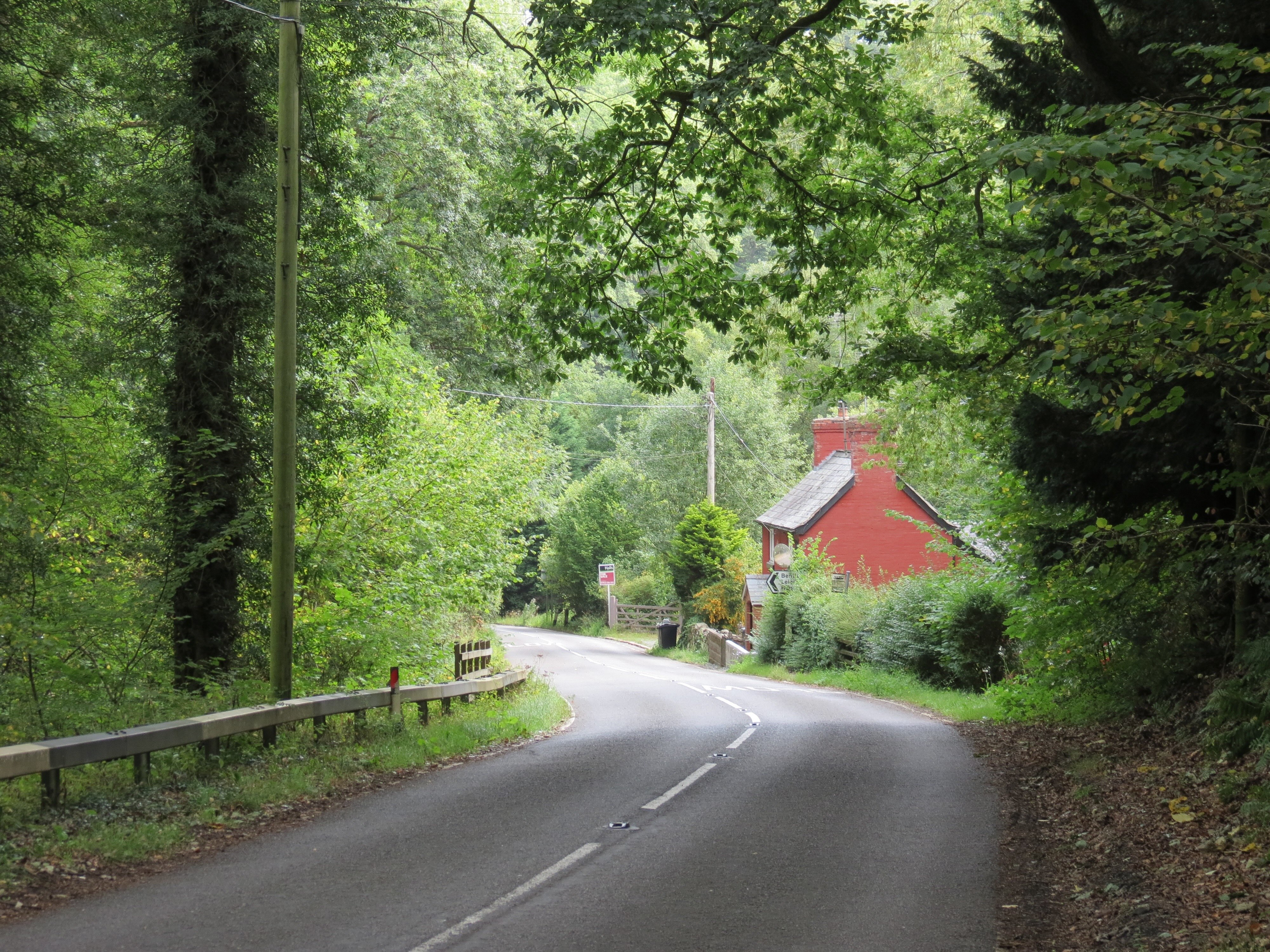
Which turned out to be the wrong direction, as the correct dropoff place turned out to be half a stop back along the road we'd already traveled when we finally used the bus stop name to figure out where we were. It took about an hour of walking along the road before we realized what was wrong and retraced our steps. Walking along rural highways can be a bit scary, as they're narrow, have only small shoulders (if any), are surrounded on both sides by high hedges that block vision, and drivers who bomb along them like rockets run amok. But so long as you take your time, walk facing traffic, walk in single file, and listen for cars so you can step off the road, it's not horribly dangerous. One trick is that when you come to a curve where you can't see around the corner, you can wave your hiking pole out into the lane so that an oncoming driver will see the motion and have a few seconds more to react. Not perfect, but well enough if you keep your wits about you. Typical rural road:
Pleasant though the scenery was, losing a couple hours of walking time meant that we wouldn't be able to complete the Stiperstones hike, so we decided we'd continue to a suitable turnaround site: the Bog Visitor Centre, which does public education about wetlands and lies just below the highest parts of the mountains. The path led steeply up rolling hills towards, mounting progressively higher. It passed through large fields, many with sheep or cattle. Getting between fields involved various combinations of climbing over metal gates, passing through "kissing gates" (imagine circular gates in which the door is hinged and rotates to form a circle; you enter, rotate the door, exit, then relatch the gate), and "styles" (imagine a stepladder placed over both sides of a fence so you can climb over but critters can't). Using the GPS application provideed by On Foot, which both provided instructions and warned us when we'd gone astray, we made it to the visitor center, which gave a good view of the Stiperstones and the long path downwards. A kissing gate:
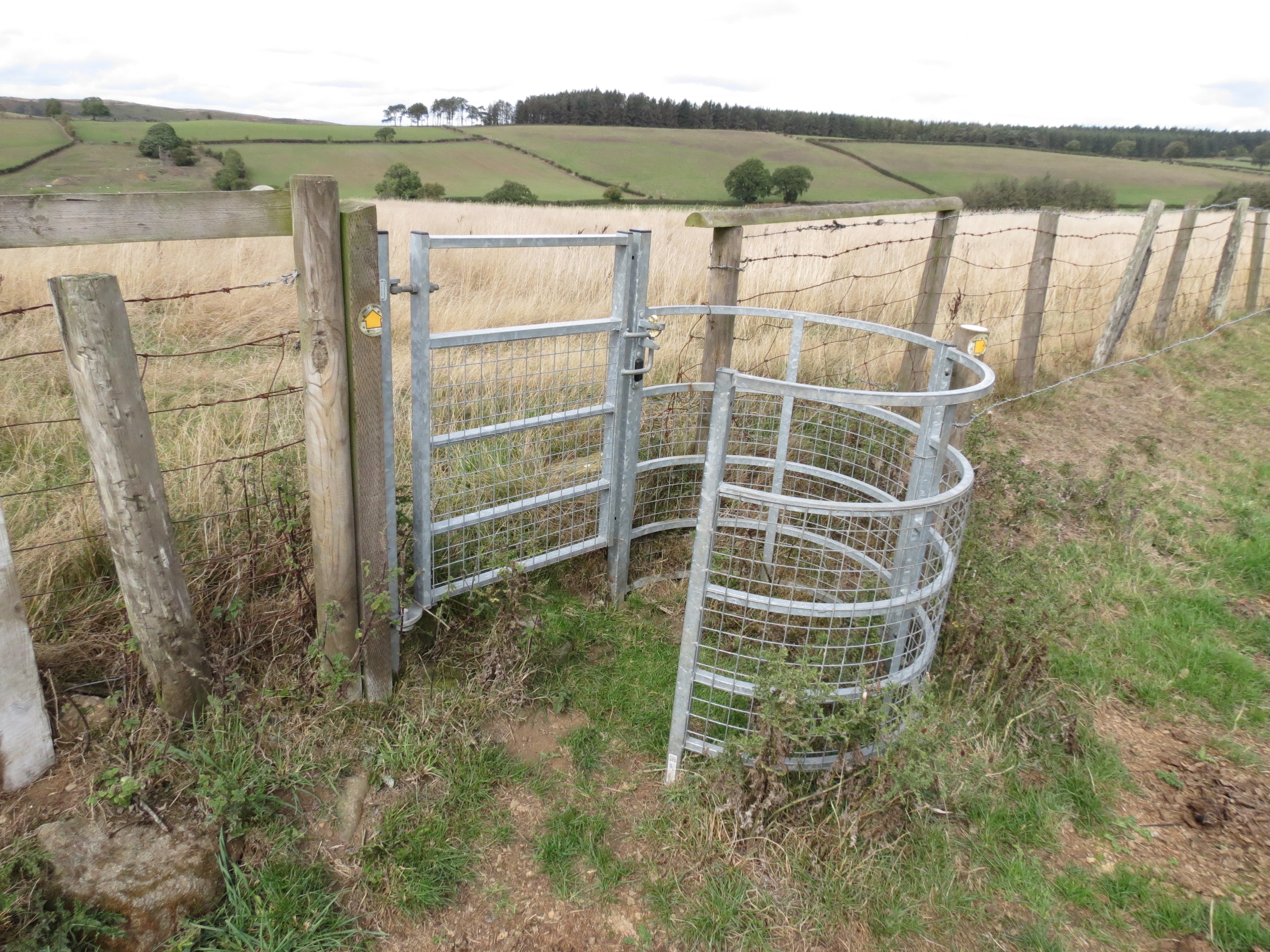
As close as we got to the Stiperstones:
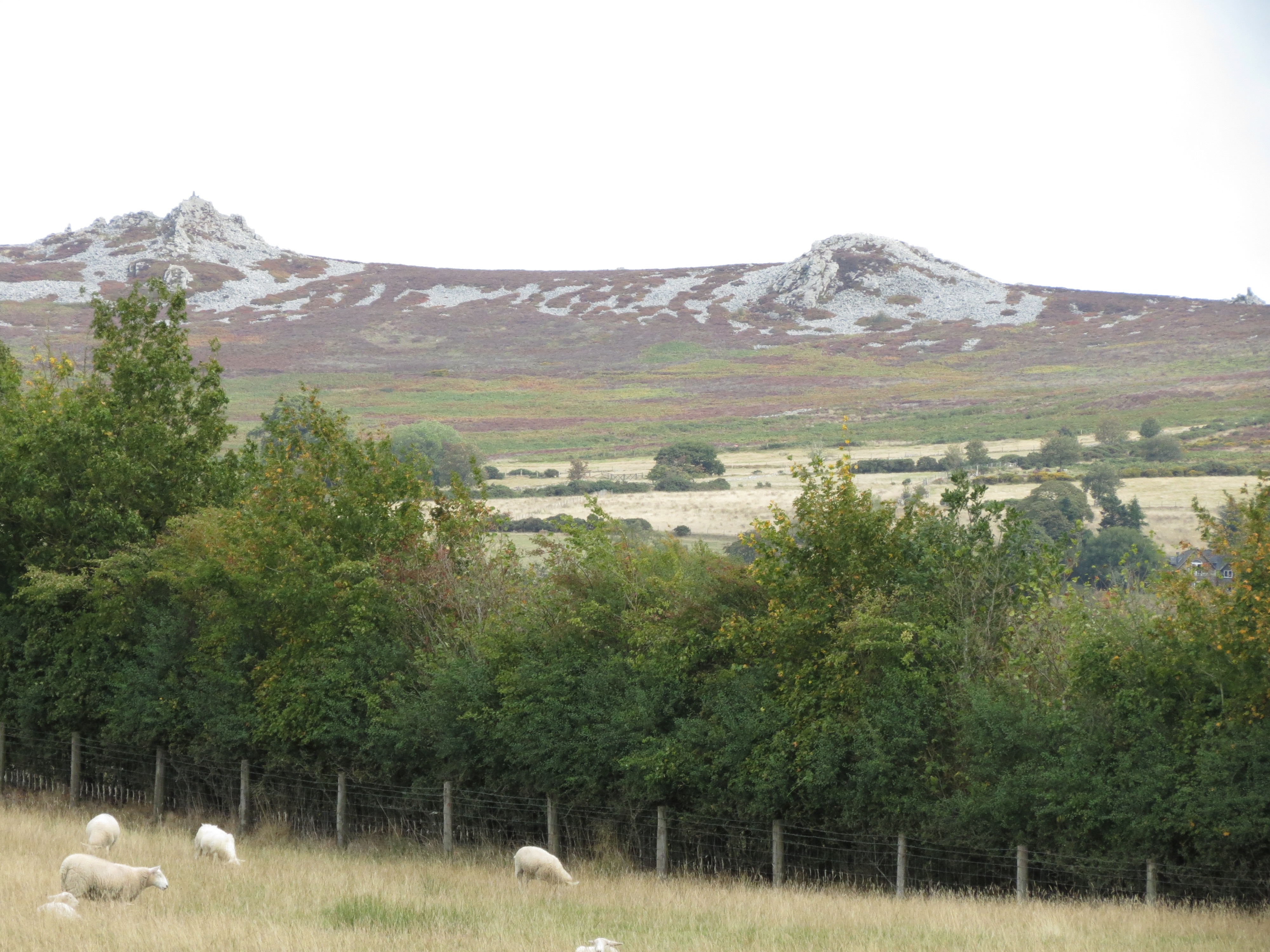
By this point my feet were hurting, and we had to decide whether to continue on foot or give up and seek transport home. Continuing on foot would have meant at least an hour downhill and than a wait of at least an hour for the next bus, and possibly 2 hours sitting beside the road. Given that tomorrow's hike was going to be one of the hardest on our trip, at about 6.5 hours and with lots of climbing, I didn't want to try the walk down to the highway and end up unable to do tomorrow's walk, so I proposed hiring a taxi instead. The problem was that the visitor centre was in the middle of nowhere, and the bus line that ran nearby (closer than the bus line we'd taken in the morning) didn't go back to Bishop's Castle or link with the bus line that did. So taxi won the vote, and we called Allan, the driver who'd brought us to Bishop's castle the previous day. Fortunately, he was working Saturday, and wiling to come get us. We would have had other taxi options, but decided to go with a known driver who we liked.
But how to find us in the middle of nowhere? There's a wonderful program called "what3words" that solves the problem by converting the GPS coordinates of your location (impossible to memorize) into easily remembered words that someone can enter into their GPS software and get precise directions to where you are. It's simple and is increasingly widely used. For example, our hotel in Bishop's Castle generates the location "pretty.needed.chill"; enter that into the software and it will funnel the actual numbers to your GPS software. Allan arrived about 45 minutes later. We had a lovely chat as he drove us home, and he pointed out ruins that were leftovers of old lead mines and a local lord's estate; when we passed the estate, their pack of fox-hunting dogs were being exercised in a field not far from our village. Lots of dogs! Anyway, an expensive way to end the day, but a good investment in tomorrow's hike I hope.
Forgot to mention yesterday (blame jetlag) the overnight bells from the local church, which chime the quarters of the hour and the hour, day and night, in the village we're staying in. Apparently some folk are bothered by the noise, and have tried to shut it down overnight, but they failed. We don't mind; the bells are pleasant, not too loud, and easily ignored. And they do add a bit of character to this small town.
From Bishop's Castle, the day's plan was to hike to the town of Clun, where we were planing to stay at the White Horse Inn. Despite a really good breakfast, the day did not start on an auspicious note: the forecast was for light intermittent rain all day, but what actually happened was 3 hours of solid downpour—my jacket soaked through, as did my boots, and Shoshanna's backpack cover soaked through, though her boots and jacket held up better than mine. The end of the hike actually fulfilled the morning's promise of light rain on and off, but included another 2 hours of solid rain in between the light rain. Fortunately, it was warm despite the brisk breeze. Anyway, I'm not one to complain about rain, because I generate large amounts of heat and overheating is more my problem.
The exertions required to complete the hike also kept us warm enough that both of us were comfortable. We heard thunder, but it never came near enough to be dangerous. Clouds descended to earth, but mostly downhill of where we walked and mostly they left us alone. (Hiking in a cloud is much like walking in the rain, but with the extra bonus of reduced visibility.) We hiked over a seemingly endless series of mountains, first ascending then descending, as we crossed Offa's Dyke and the surrounding hills. The dyke was a massive engineering product by Welsh King Offa to warn the English where the border of Wales lay and that they shouldn't cross it. (Historians point out the real story is more complex, but that's the gist of at least part of the history.)
Not many photos today, since 90% of the time it was raining too hard to take out the camera. For what it's worth, some hills en route to Clun:
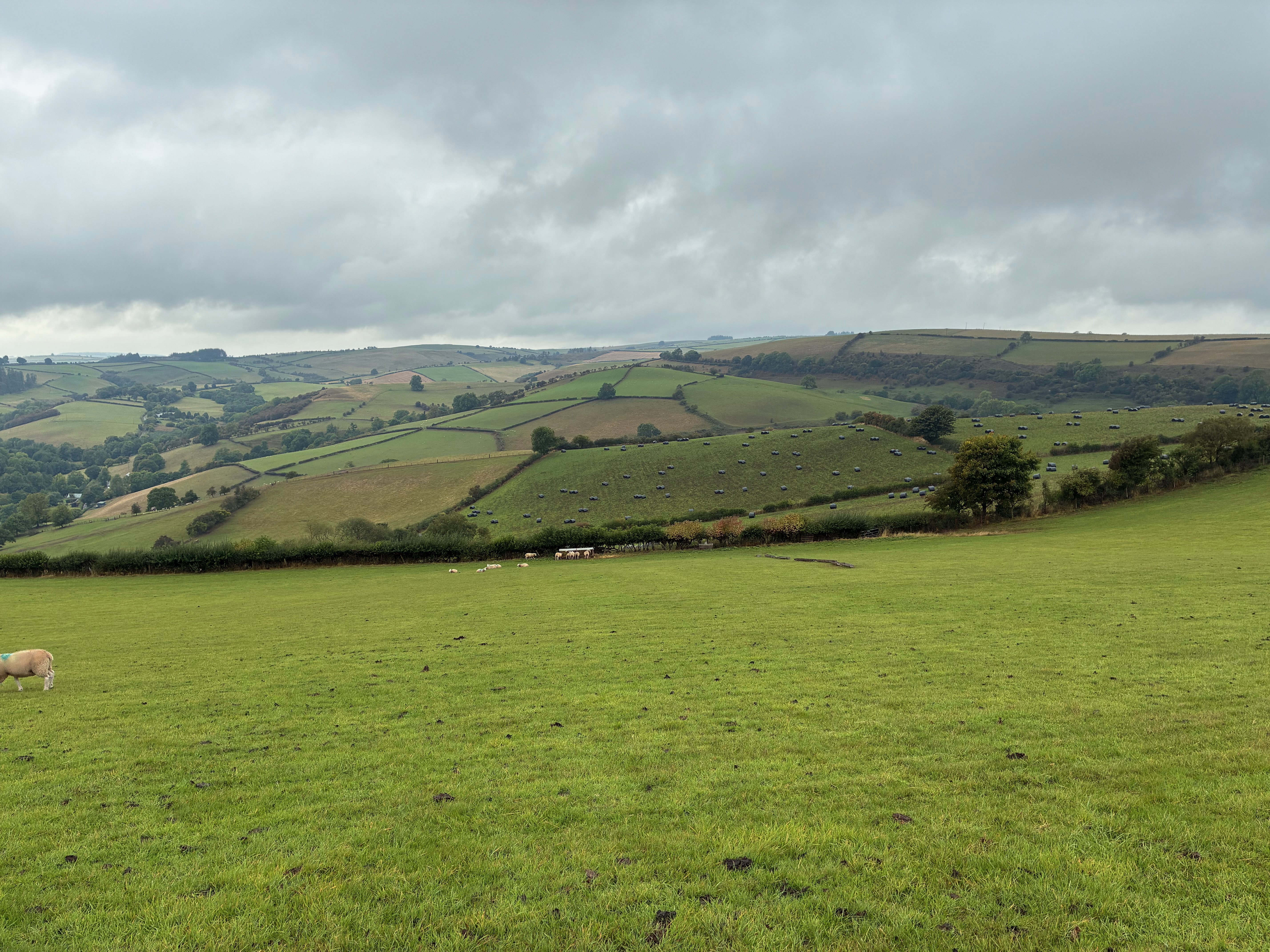
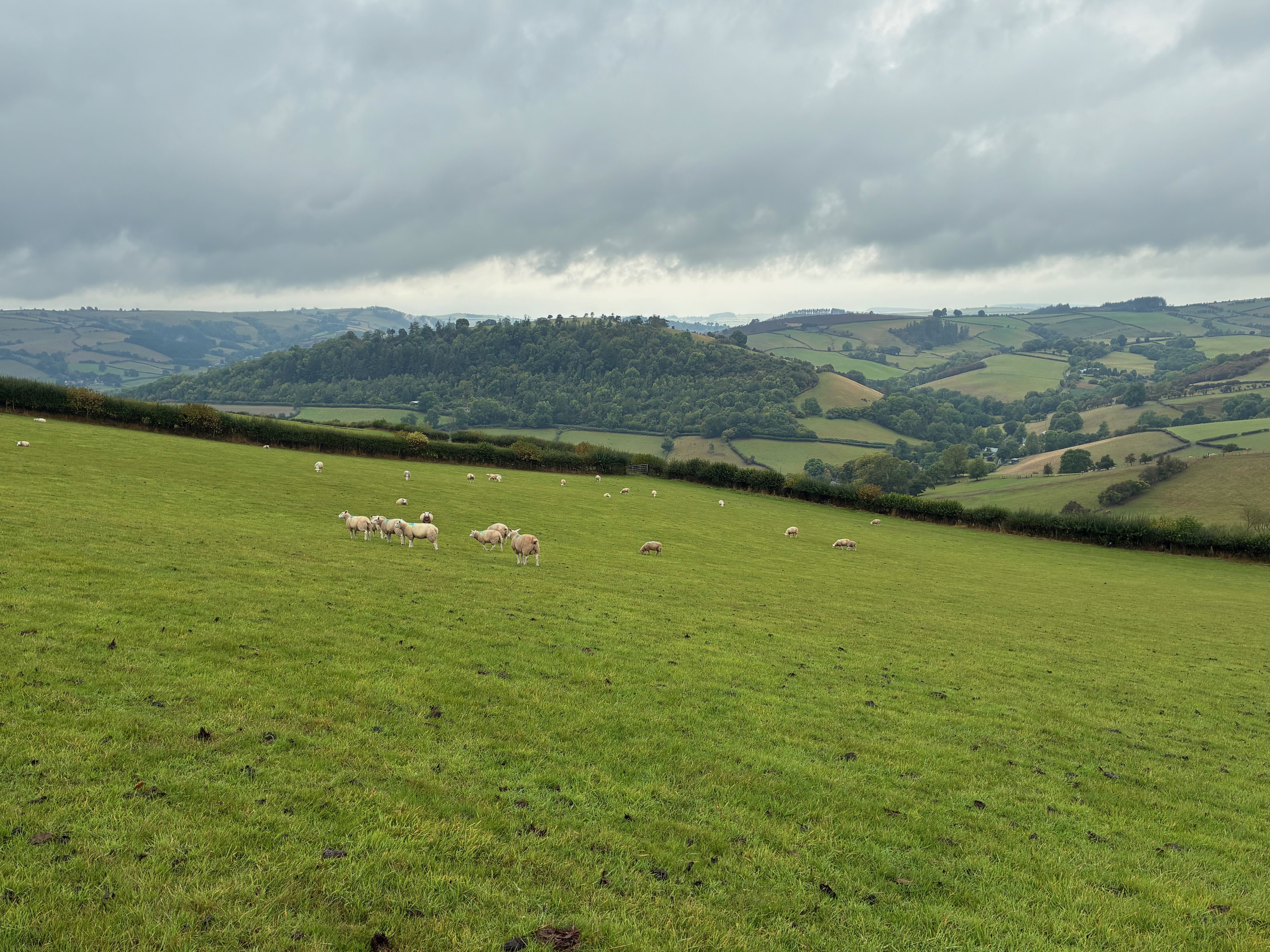
Although the paths selected by On Foot were mostly manageably difficult, some of the slopes were brutal. One particularly brutal slope was about 60° upward for about half a kilometer, which meant many pauses before we reached the top; we also descended a comparable slope that took forever because the surface was slick from rain and we needed to place each foot carefully to avoid a nasty slide. But the land is beautiful: when you could see through the rain, the world was filled horizon to horizon with gently rolling green fields full of sheep and cattle flung across the slopes like confetti. The land's all divided up into fields ranging from big to ginormous, all separated by barbed wire or living (i.e., shrub) hedges, so we spent much time climbing styles to get over the fences, plus a few ordinary gates and many kissing gates. Lots of thigh-muscle work! We both now have buns of steel.
Crossing the fields is generally not particularly dramatic. The sheep are no problem, since they flee as soon as you get anywhere near them, but the cattle are more of a challenge. Many of them are enormousby which I mean "5 feet tall at the shoulder" big. The cows can be quite protective of their calf if you get between them and many had full-grown calves. When there are just cows, all you have to do is walk around them, making sure you don't get between them and their calf. Give them plenty of space and everyone's happy: they're quite willing to let you pass through their fields, though they watch warily until you're gone.
Unfortunately, an occasional field had one or more bulls. Previously, we crossed one bull field where the bull was nowhere near and completely ignored us. Today we arrived at one of the fields we had to cross only to find the herd with a bull and a bunch of yearling males blocking the road, with no easy detour route. You have to be particularly careful with these big guys because they can get quite territorial and aggressive. But the problem today was that they were all camped out directly in our path, and showed no signs of being willing to leave. In this situation, all you can do is wait—which can take a loooong time.
We tried dad jokes: "Please moooove!" No luck. You can also try to explain to them why they should move. They weren't moved by our logic or our pleas to clear the road, so I fought dirty: I resorted to music. I can't say for sure that my voice alone was sufficient, as Shoshanna chipped in by banging her hiking stick on the fence. After 10 or 15 minutes of this aural abuse, the herd eventually got bored or offended and moved off, and we made haste to get up the hill and out of their field before they changed their mind. Not, I hasten to add, without casting repeated glances backwards to be sure the bull had no intention of following us.
One of the other fields we crossed had two lovely horses, a chestnut mare and a smaller white/grey mare. Very friendly and hopeful that we might have some food to share. Nope, but they were still happy to be petted and fussed over. Not so happy that the chestnut mare didn't try sticking its nose into Shoshanna's backpack in search of a treat.
We finally reached Clun, 7 hours after we set out, both of us running on dregs of our morning energy. We met a local resident, out for a walk with his dog, and chatted for a while. He'd taken a year off and toured the world, including Canada. He mentioned we might see him at dinner tonight, as the pub we're staying in apparently has some of the best food in town. We didn't see him, but the dinnner was really good. Madame had a pork in cider gravy with mixed veg, and I had a beef and mushroom pie in ale gravy; both were delicious. Shoshanna's beer was a "best bitter" (a common "real ale" style of beer served at many pubs) and I had an "Alpacalypse" stout, which was lovely. Sometimes you have to buy a beer just for the name, but this one was also delicious—refreshing and faintly sweet.
Unusually, we also met a few hikers, including one group that appeared to be two 20-something sons and their father coming the opposite direction from us. We had a good chat, and discovered that although we'd had more rain than they did, they had had hail. Glad we missed that! Shoshanna told them that I'd remarked how this kind of hiking tood a significant amount of masochism, which amused them. One of the boys said that they used a three-level hierarchy of "fun": type 1 is when you have fun while you're doing the activity, type 2 is when you dislike the doing but subsequently decide you enjoyed the experience, and type 3 is when you don't like the activity while doing it and don't like it in hindsight, but it still makes for great stories. We've had all three types of fun.
From Clun, we hiked to Knighton (town of knights), where we stayed at the Horse and Jockey Inn. Today's hike was to be beside a long stretch of Offa's dyke. The instructions described it as relatively easy at the start, concluding with a stiff climb up a steep slope (another 60°+ slope) that would be a "short sharp shock" before ending with a long descent into town. We met a surprising number of hikers coming from the opposite direction, most of whom were happy to pause for a quick chat.
The day's forecast had predicted a 40% chance of rain, which should have warned us. The day began with beautiful blue skies and mounds of mashed-potato cumulus clouds, only some of which had the tell-tale blueish hints that warned of possible rain. Since we were going to spend the day clambering over one particularly impressive (tall and steep) mountain, and mountain weather is infamously changeable, I kept an eye on the weather and watched the clouds gradually darken as the wind freshened. By the time we arrived at the foot of the mountain's slope, they were looking increasingly ominous and the horizon north of us (from whence we came) was a foreboding blueish-black, so we paused for a rest break and to put on our wet-weather gear and strap on the backpack covers.
Good timing, because it had begun raining lightly by the time we finished and started our ascent. Ominous clouds were now building to the west of us, but were initially crosswind of us and from watching their motion, it looked like the worst of them would pass us by. Which was good, because thunder and lightning began. I've seen worse thunderstorms before, and even walked in them—Shoshanna and I once went out foraging for dinner during a Japanese taiphoon. But I've never been halfway up the slope of a mountain while a storm descended, which adds a whole other frisson to the experience.
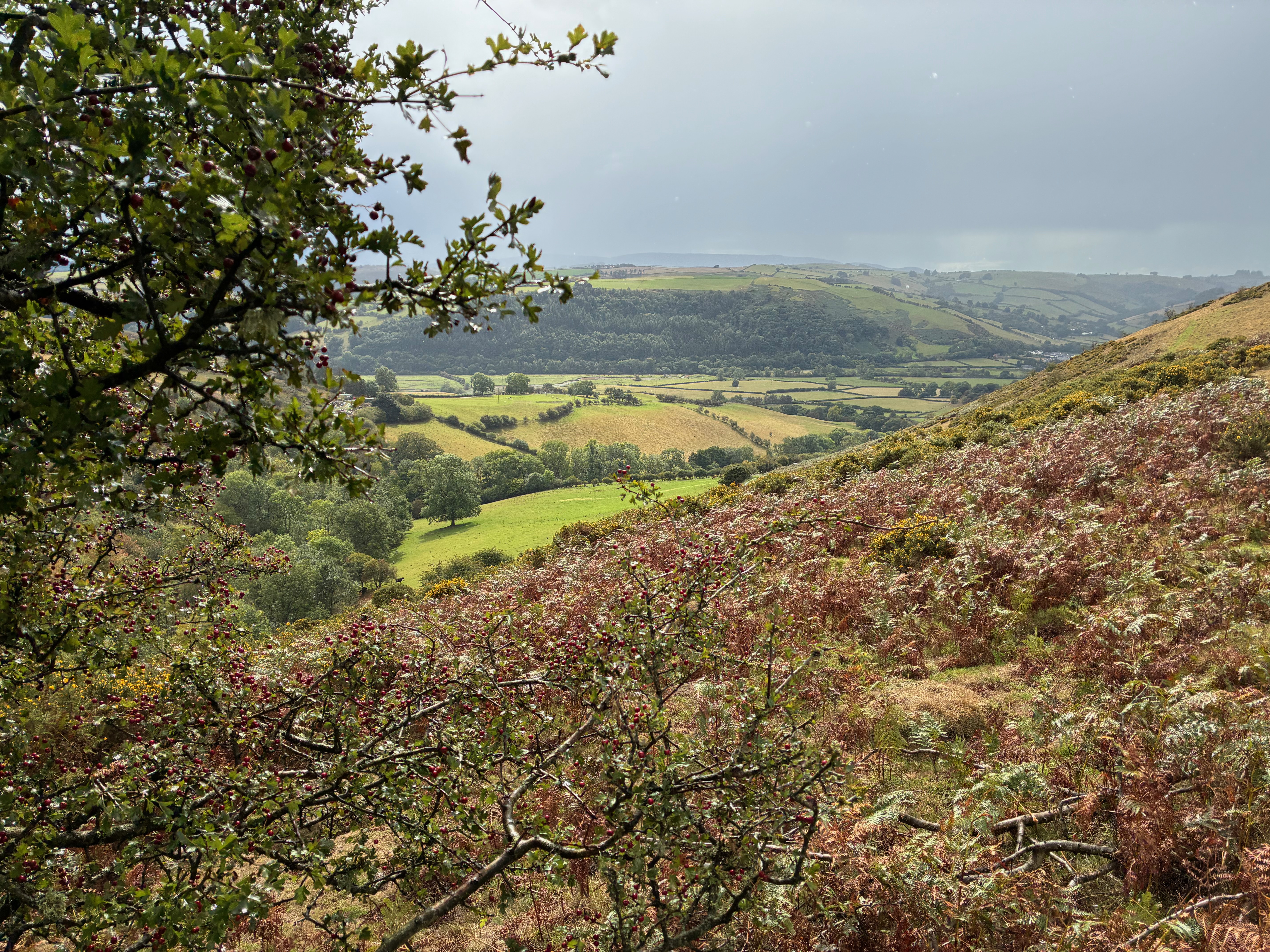
There wasn't much point trying to descend and return to our starting point, since continuing to climb looked to be shorter overall, so we kept moving. The rain fell heavier and heavier, and the sky did that weird thing it does when so much rain is falling the clouds turn white-grey instead of staying dark and the rain falls even harder. (You often see this during "sun showers" in the summer, particularly near the equator.) Seeing what was coming, I suggested we take cover under a large tree. (Note that this is generally not advised in a thunderstorm, but there were enough equally big or bigger trees around us that it didn't seem likely to be risky.) Our timing was pretty good, because the wind picked up and the water turned into horizontal hail. Large enough to sting when it hit exposed skin, but not so large to be dangerous.
Eventually, the rain slowed, though the wind was still gusting strongly, and I suggested we had two alternatives: sit for potentially an hour or more waiting for the storm to pass, or accept the likelihood that we could move towards the white-grey clouds and accept that the rain would come back with a vengeance for a time, but would eventually pass us by. Shoshanna accepted the latter, so we returned to our ascent. The rocks and trails were slippery, and the rain increased the difficulty. When you're high up the slopes of a very steep mountain, you don't want to take any chances, so we took our time and turned what would already have been a long ascent into more of a slog. I'd guessed right about the weather, and the rain picked up again, but fortunately not so badly it interred with seeing where we were putting our feet or keeping an eye on the trail so we wouldn't stray. By the time we reached the peak, the rain had tapered off to a light rain, but one that felt heavier because of the strong winds.
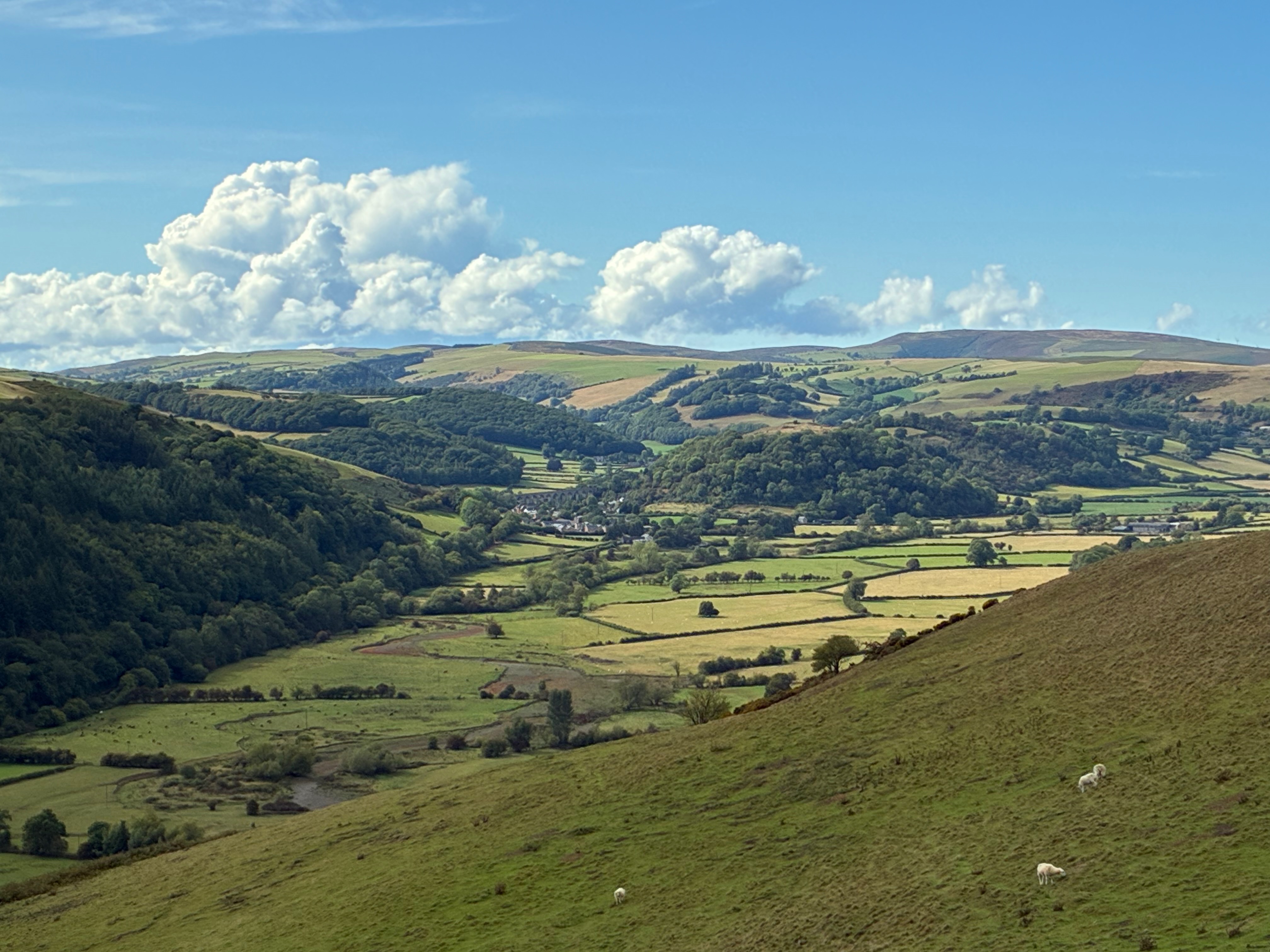
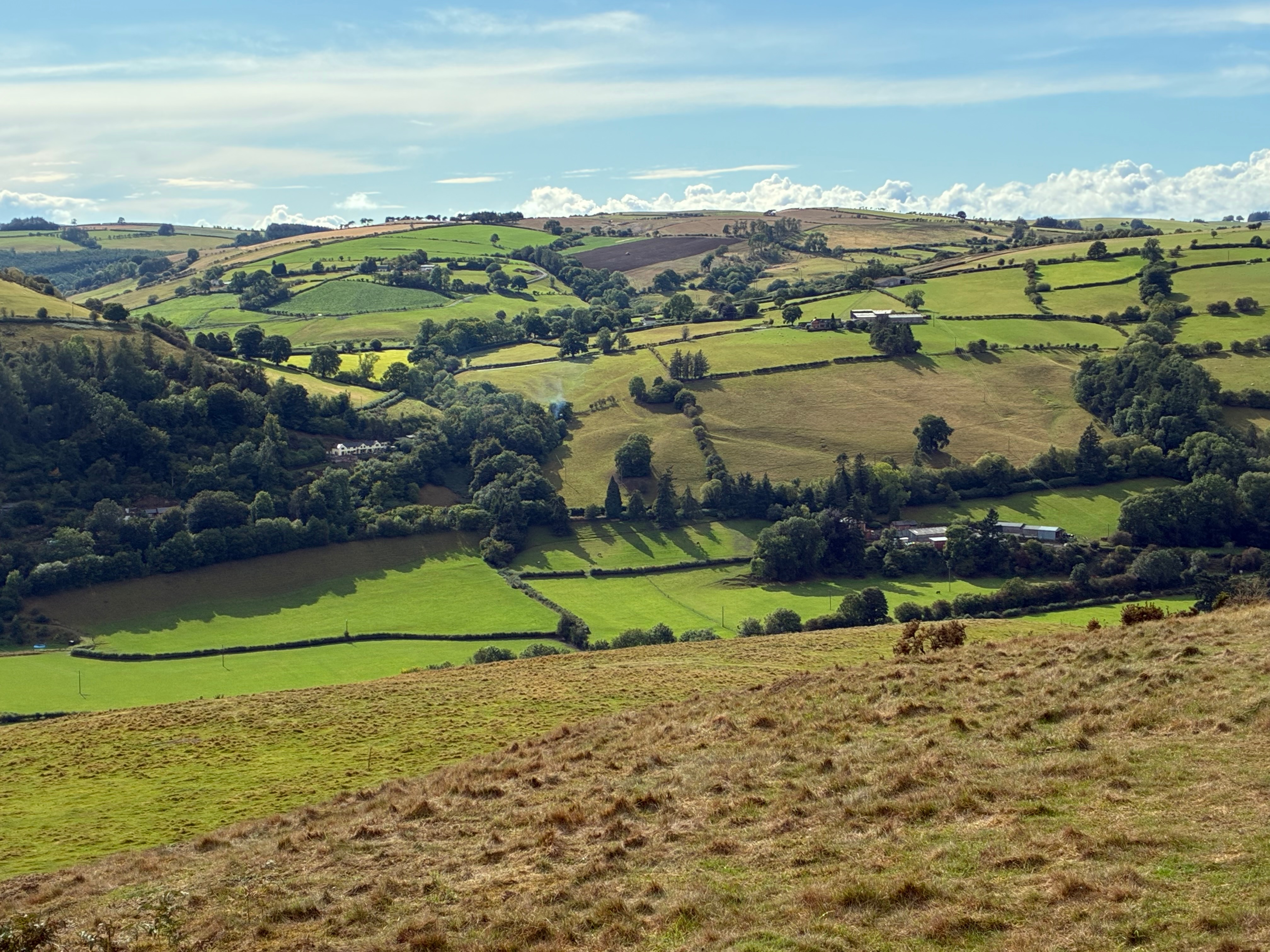
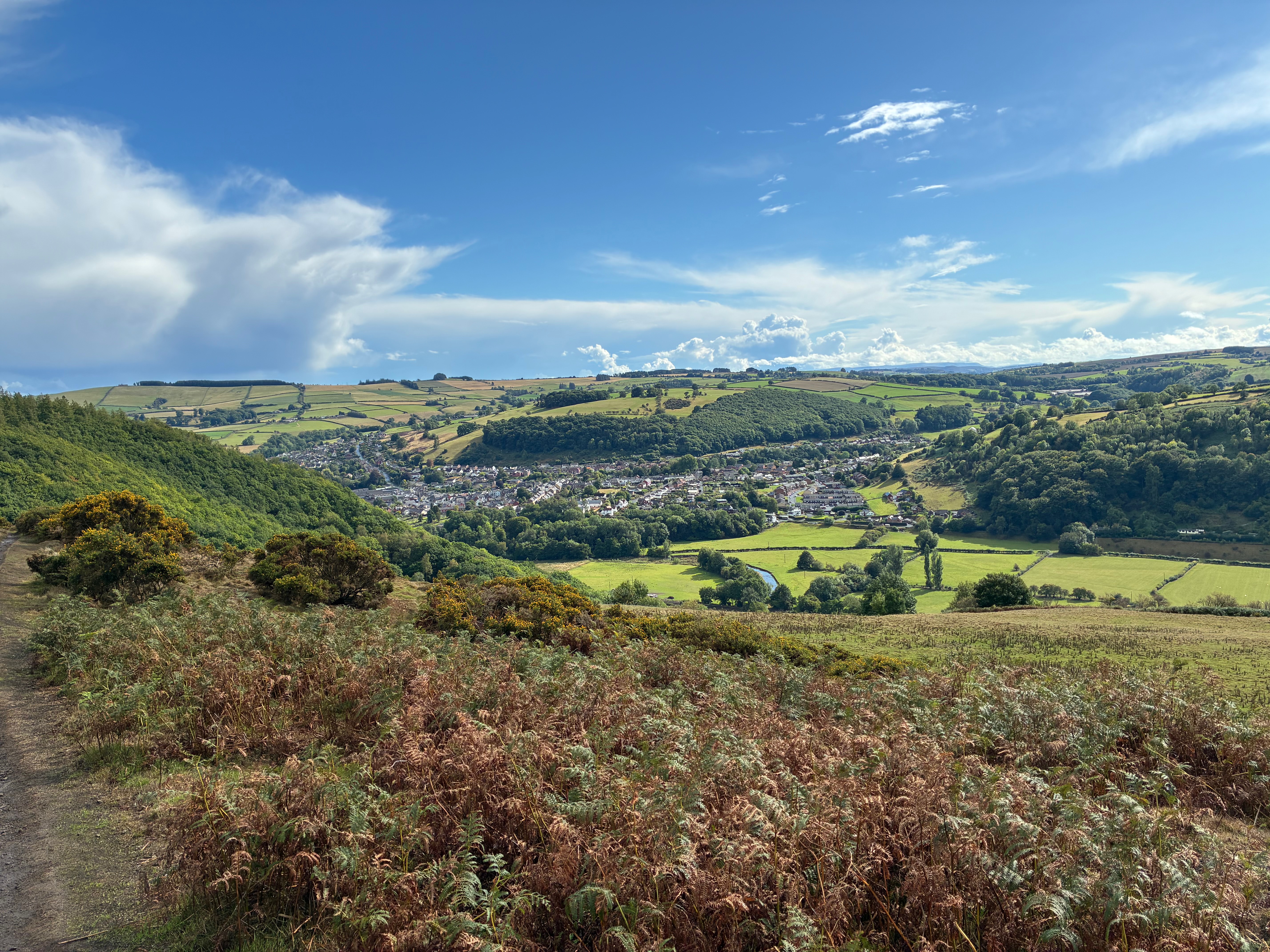
As I'd predicted, the skies lightened and we began to see gaps in the clouds. By the time we reached the southern end of the mountain ridge we'd been following, looking down on Knighton, the sun was out and drying us with pleasant warmth and weaker winds. It was actually very pleasant, particularly after the storm, and our reward for persevering was wide-screen views of the beautiful mountains and valleys that surrounded us. For example:
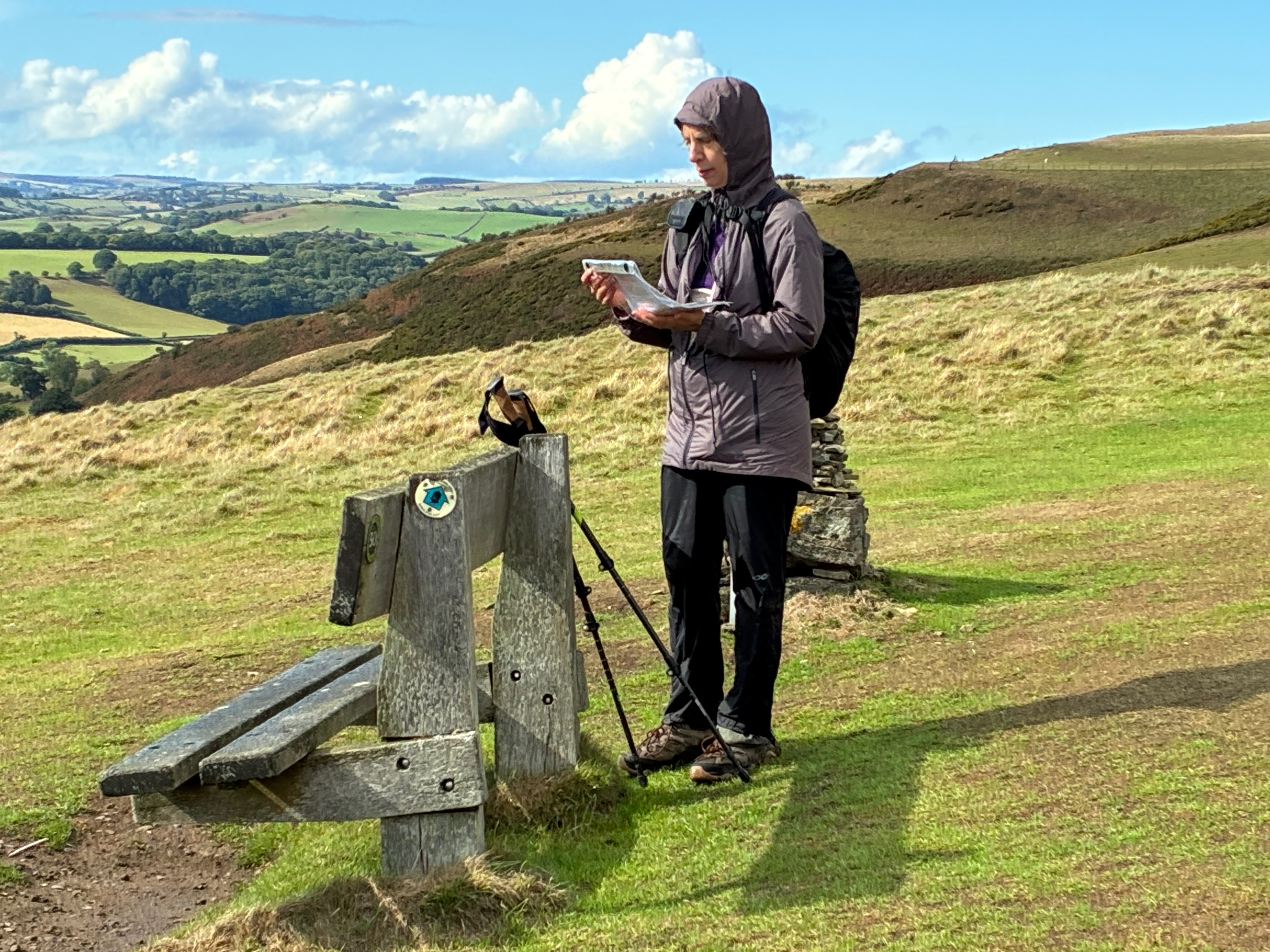
Since we haven't had many photos of Shoshanna, I offer Navigator in Chief Shoshanna:
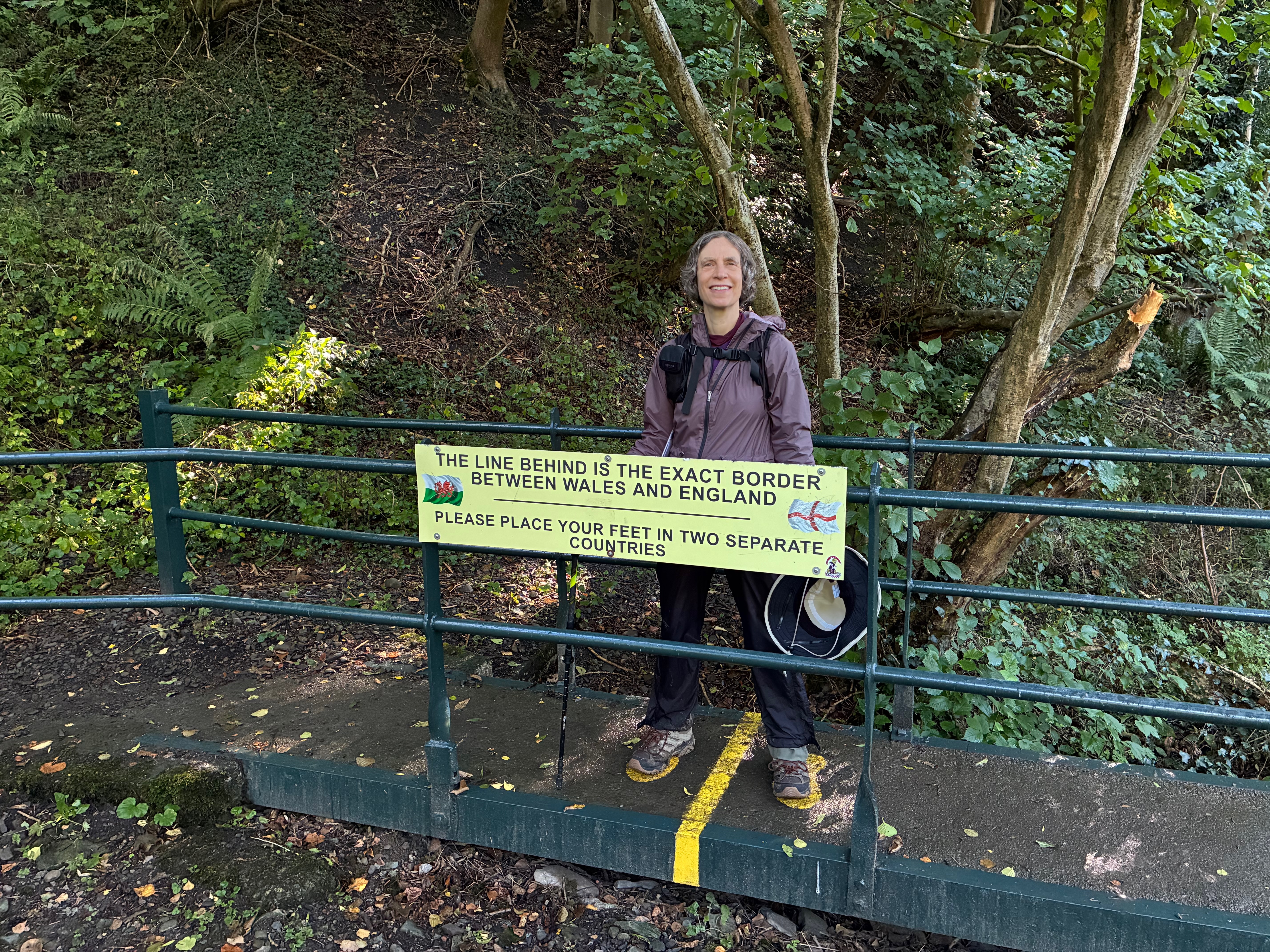
And nation-spanning Shoshanna:
Dinner was at the Horse and Jockey: a chicken stir-fry for Shoshanna and fish and chips for me, both excellent, and a refreshing pint of Butty Bach beer (Welsh for "little friend"), and we ended with a sticky toffee pudding with vanilla ice cream.
Moving up in the world from the town of mere knights, we continued onward to the King's town, Kington (not to be confused with Kingston, which is in Ontario). Here, wwe stayed at the Swan Hotel.
The full version of today's hike was planed to be 21.5 km, with a vertical component of 820 m. More than about 14 km or more than about 600 m of vertical movement indicates a tough hike, and maybe one beyond our capacity. On Foot hikes tend well towards the "tough" end of the spectrum—it typically takes us 25% or more longer than their predicted duration (based on their own walking of the trails) and their "allow X hours" prediction (which includes lunch breaks and other distractions).
The original treak would have been way too long and rigorous for us given the cumulative fatigue we've acquired after our previous days of hiking. One of the things we like about On Foot is that they offer shorter versions of their hikes, in which they let you catch a ride with the cab driver responsible for transporting your big bags between cities, so they can let you off midway along the course, thereby significantly shortening it. We chose that option for today, which Sharon (our taxi driver) said was fairly common in her experience. We've booked her for tomorrow's hike, which is also on the "are you kidding me?" end of the feasibility scale.
Sharon dropped us at an intermediate point that was located just after the first major chunk of climbing. That's not to say we didn't still work hard; the shortened itinerary was still 13 km and 600 m of vertical, with lots of ascending and descending time. Took us about 5.5 hours, which was actually good timing given the rugged terrain.
I always keep an eye on the weather when I hike, as mountain weather changes rapidly, making official forecasts not very useful. Yesterday's forecast had specified only a chance of rain, and did not mention thunder storms or hail at all, which is why we were wise to have prepared so well. Today, thunder and dark clourds followed us the whole day, but it didn't actually start pouring until we reached Kington—the exact opposite of yesterday's weather, with no hail but really strong winds. No idea what we'll face tomorrow on our last formal (planned by On Foot) hike, but it probably won't be boring.
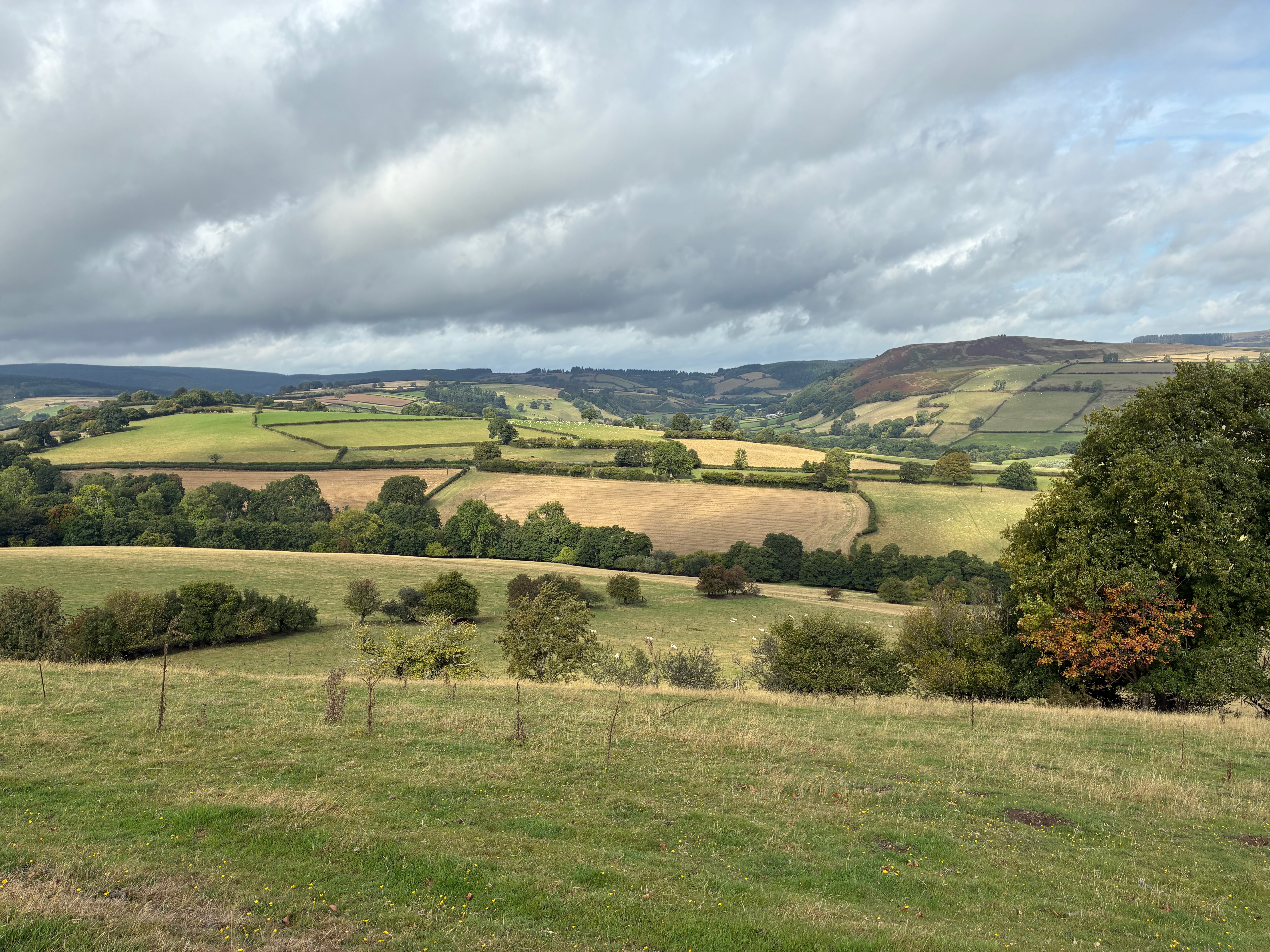
Threatening clouds:
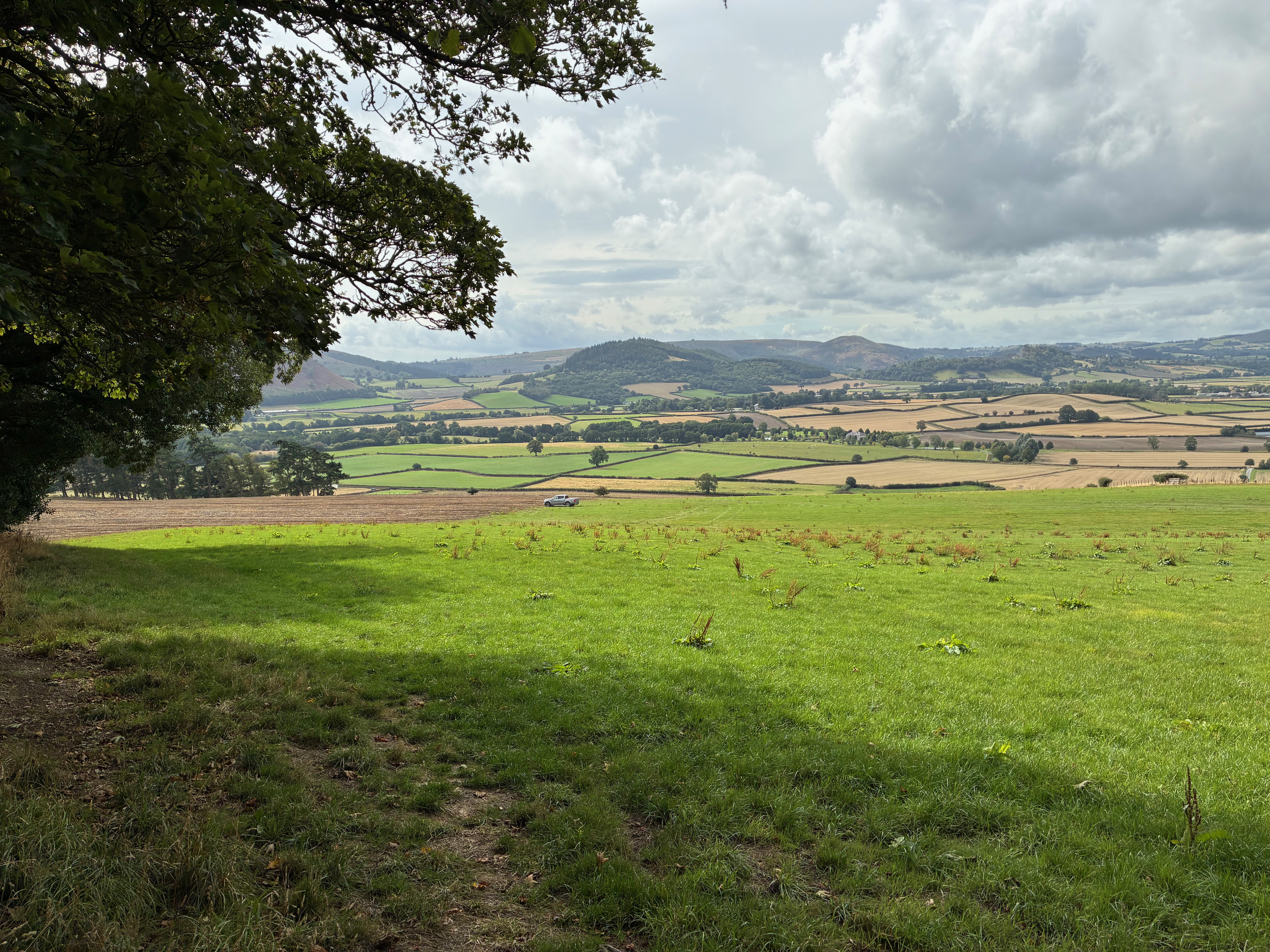
Today was more hiking along Offa's Dyke, where it ran high above the surrounding landscape, but getting there was a long and steady climb. Fortunately, not as steep or difficult as the two previous hikes. The nice thing about long climbs in mountainous areas is that the exhaustion is repaid by lovely vistas in all directions—vistas you really have to see in person, since photos can't do them justice. And when it isn't raining, you can actually take out your camera and bring home pictures to share with friends and family.
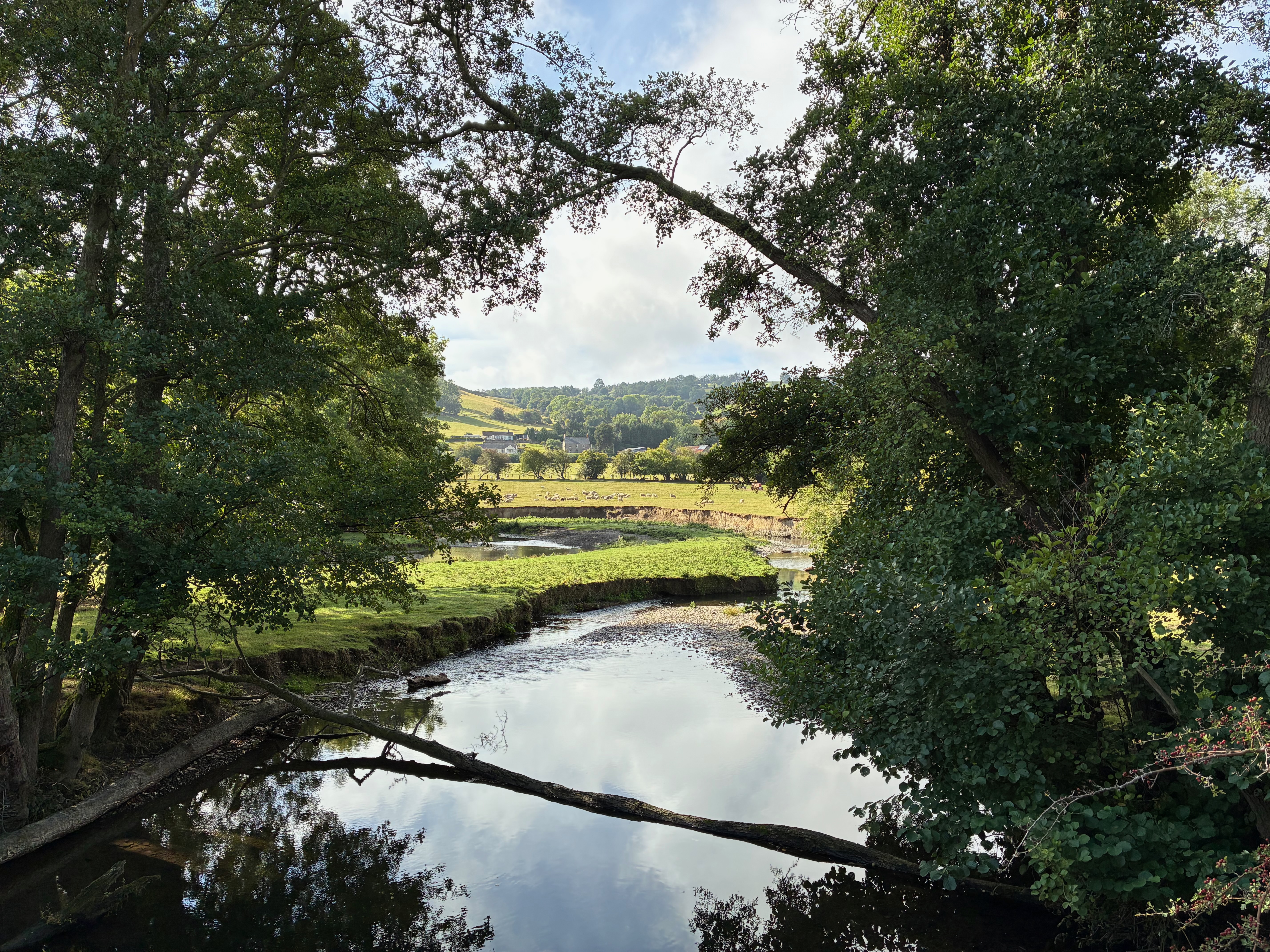
A lovely stream near the start of our hike and landscape near the end:
We made it to Kington in time to shower and then head down to the bar for a drink and snack early enough that we'd still have an appetite for dinner. Shoshanna had a nice large glass of Merlot wine and a hearty slice of local "Victoria Slice", which is a sponge cake with the icing spread between the top and bottom layers alongside a layer of jam. I had a cup of decaff coffee, which probably should have been caffeinated to sustain me as I write. (Yawns redacted.)
One cool thing I hadn't mentioned before: Wales and adjacent parts of England seem to be very dog-friendly. Several of the B&B restaurants we've been in allow dogs, at least in their pub space, and provide bowls of water and sometimes a sausage. The owner is required to keep their dog under control, and so far, there have been several dogs but no incidents. Hiking through farmland can be a bit scary at times if you run into overly protective dogs that haven't been restrained; occasionally you'll be attacked and maybe even bitten. But Welsh dogs seem much more chill. Also, they seem to know I'm a sucker for dogs, so I often end up being mugged for pats and "who's a good boy". This amuses Shoshanna greatly.
Dinner was both obvious and a difficult choice: We started with carrot soup, bu then had to decide between a luscious looking hoysin/honey duck and a lamb shank. Why choose? We got both and shared them. So good we ordered a bit of bread to sop up the gravy, which was too good to wash down the drain.
From Kington, we had originally planned (albeit with some trepidation) to follow On Foot's itinerary and hike the LONG road to Hay-on-Wye. Hay sits even higher in my ersatz feudal hierarchy than the King's town, Hay-on-Wye because of its number of book vendors. Books are power, reader: wealth and the sword are only shadows of power! Hay is also a significant market town, but food only feeds the body; books feed the soul!
Mostly used books and old treasures, but some new stuff too. Not your grandpa's Barnes and Noble; rather, the town offers a full range stores specializing in things such as obscure medieval manuscripts, and from antique maps and map reproductions to modern paperback fiction. We did NOT plan to stay overnight in a bookstore, despite the temptation, but instead spent two nights in the aptly named Rest for the Tired B&B, which just happens to sit above the owner's bookshop, the Broad Street Book Centre.
Unfortunately, even the option for a shorter hike that On Foot proposed was longer than we were feeling able to tackle: only about 510 m vertically, but still 17 km long (down from the implausible 25 km and 830 m spanned by the full hike). Apart from the formidable challenge of walking that far in rough terrrain, the weather forecast had been getting progressibely worse, with steady rain and high risk of thunderstorms all day. We agreed that this was not a hike we wanted to try, that we had nothing more to prove with respect to our hiking skills, and that hiking all day in soaking clothing was very much "been there, done that", and that we were due for a restful day at our appropriately named B&B. We called Sharon, our taxi driver from the previous day, to inquire whether she had room to bring us the whole way to Hay-on-Wye in the same car as our luggage instead of just hauling us partway and leaving us to die on the trail. (OK, so I probably exaggerate.)
The drive was uneventful, Sharon having already survived one flaming collision with an overly agressive motorcyclist some time back and presumably having used up her bad driving luck for the moment. But as we drove, we saw many clouds scraping across the tops of mountains, suggesting we made the right choice. We thanked her for her company, and she carried our heavy bags across the street and into the B&B, which sits above our host's bookstore. Our host, Mary, seems to be in her 80s (as her husband is 88) and we had a nice long chat with her about books and other things. She's a world traveller, and seemed a bit sad that it was becoming so hard for her and her husband (88 years old) to deal with the stresses of the air travel required to reach far-away places.
As she was a fellow book-lover, I bemoaned the fact that we'd had to give away so many books when we downsized to a smaller house because it had reached the "there's only room for them or us" stage. She grinned when I told her that books were like puppies (you can't just leave them out on the sidewalk and hope they'll be adopted) and grinned at my attitude that her choice of owning a bookshop was probably a more functional solution to the love of books.
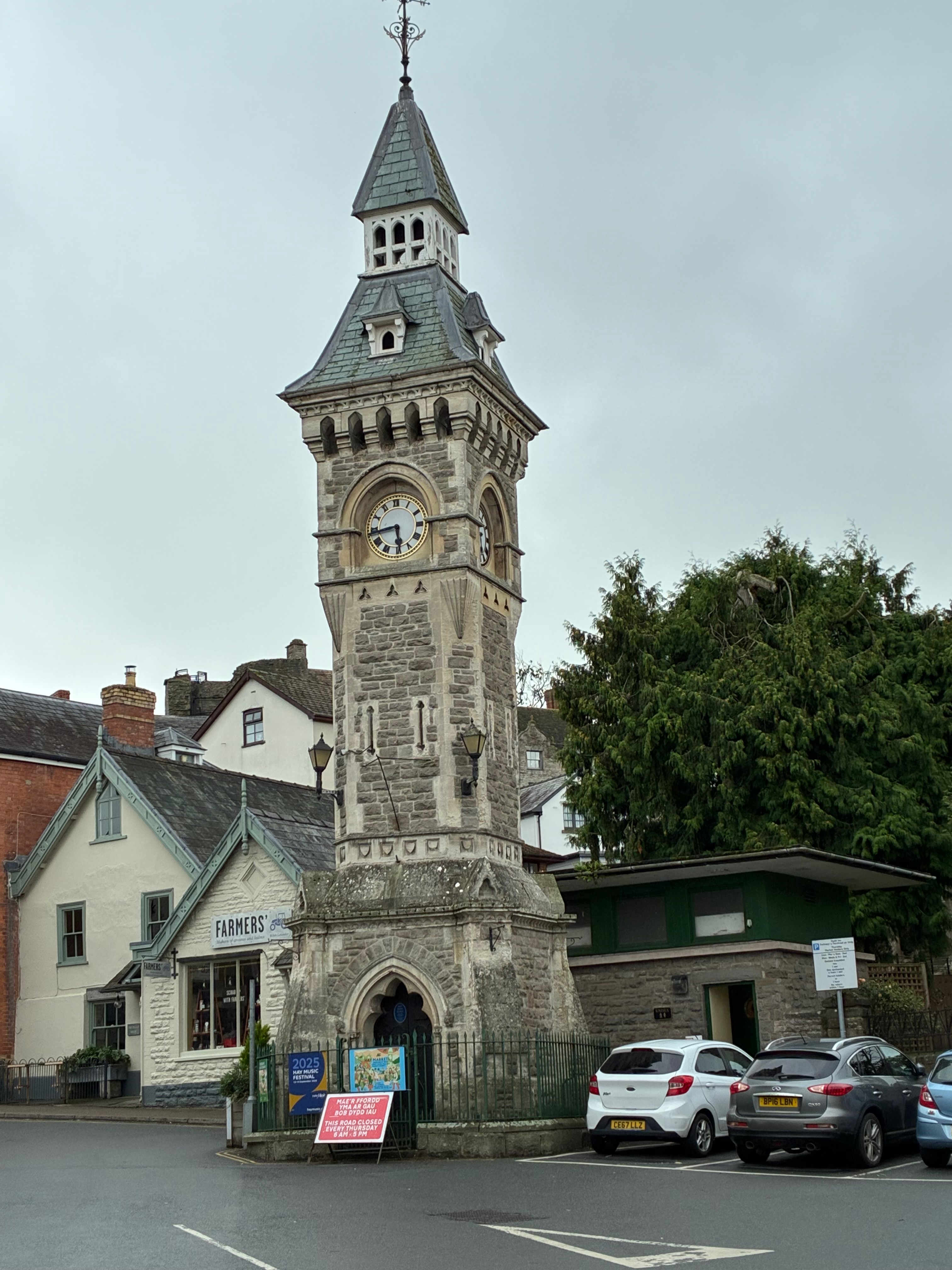
Clock tower just down the road from our B&B:
We've stayed in a couple old and creaky places, and Rest for the Tired followed that pattern. The Horse and Jockey, where we'd stayed two nights ago, gave us a room with a floor that sloped noticeably downward to the center of the room, with a head-height chest of drawers leaning alarmingly away from the wall and a plumber's nightmare of beams nominally holding up the ceiling but doing nothing for the floor. Everywhere you walked, the floor creaked and swayed. Rest for the Tired is in much better shape, but the ceiling is braced with beams low enough that I can hit my head in a couple places if I'm not careful, not to mention low-hanging doorframes. It has one of those ornamental radiators that nominally provides heat but in practice emits nothing and seems to be mostly for show.
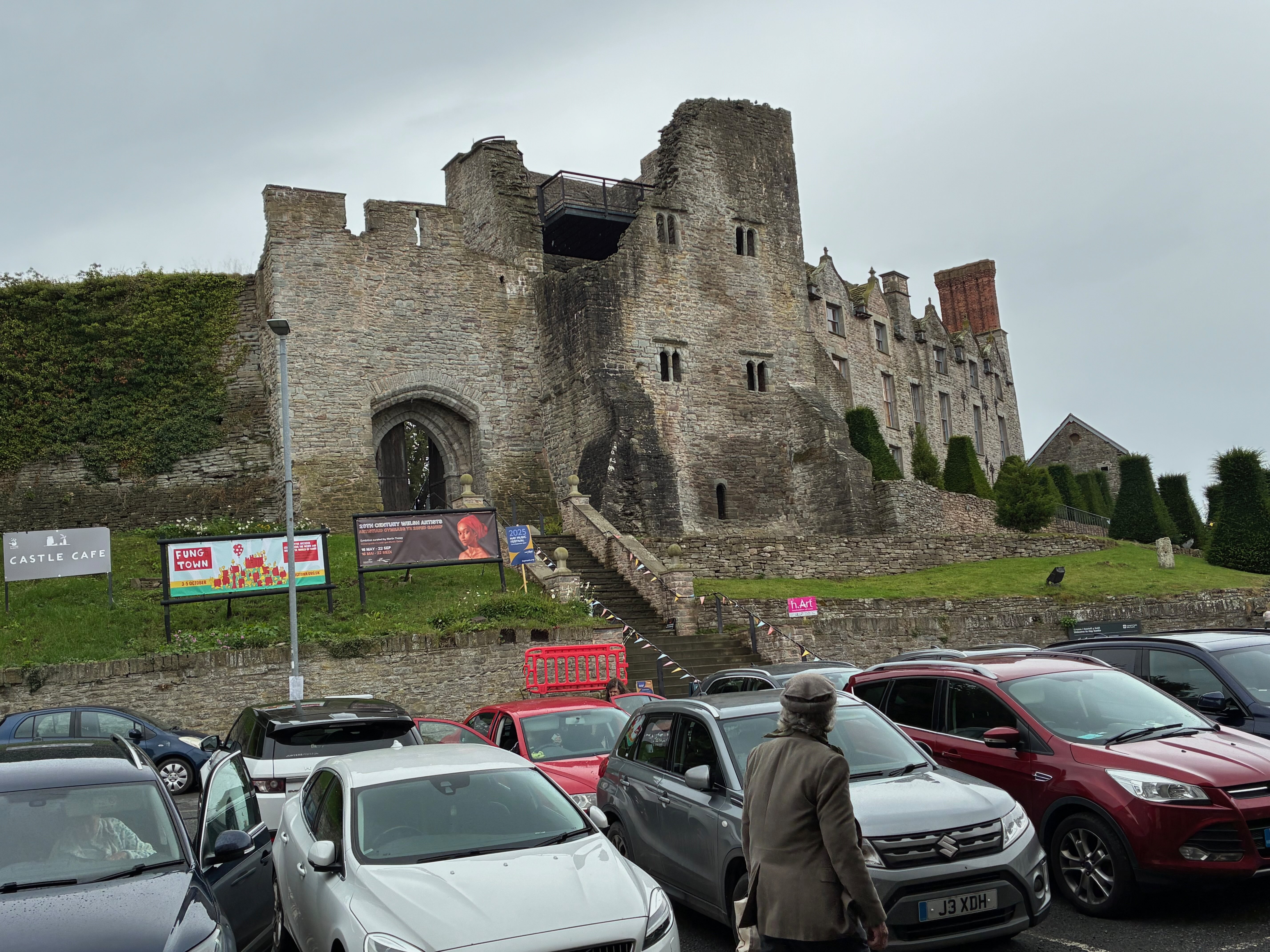
Safely installed in our room, we locked up and went for a stroll around town, which is much larger than the places we'd stayed previously. The city's famous for its number of bookstores (26, including related things like record stores and map shops), a gimmick that a fellow named Richard Booth proposed back in the 1960s as a way to bring tourist income to the town. It worked. Needless to say, there's a partially ruined castle at the center of town and a great many coffee shops, pubs, and restaurants have sprung up to cater to the tourist trade. (Including a Michelin-starred restaurant we're not going to visit. Pricey!)
Hay castle:
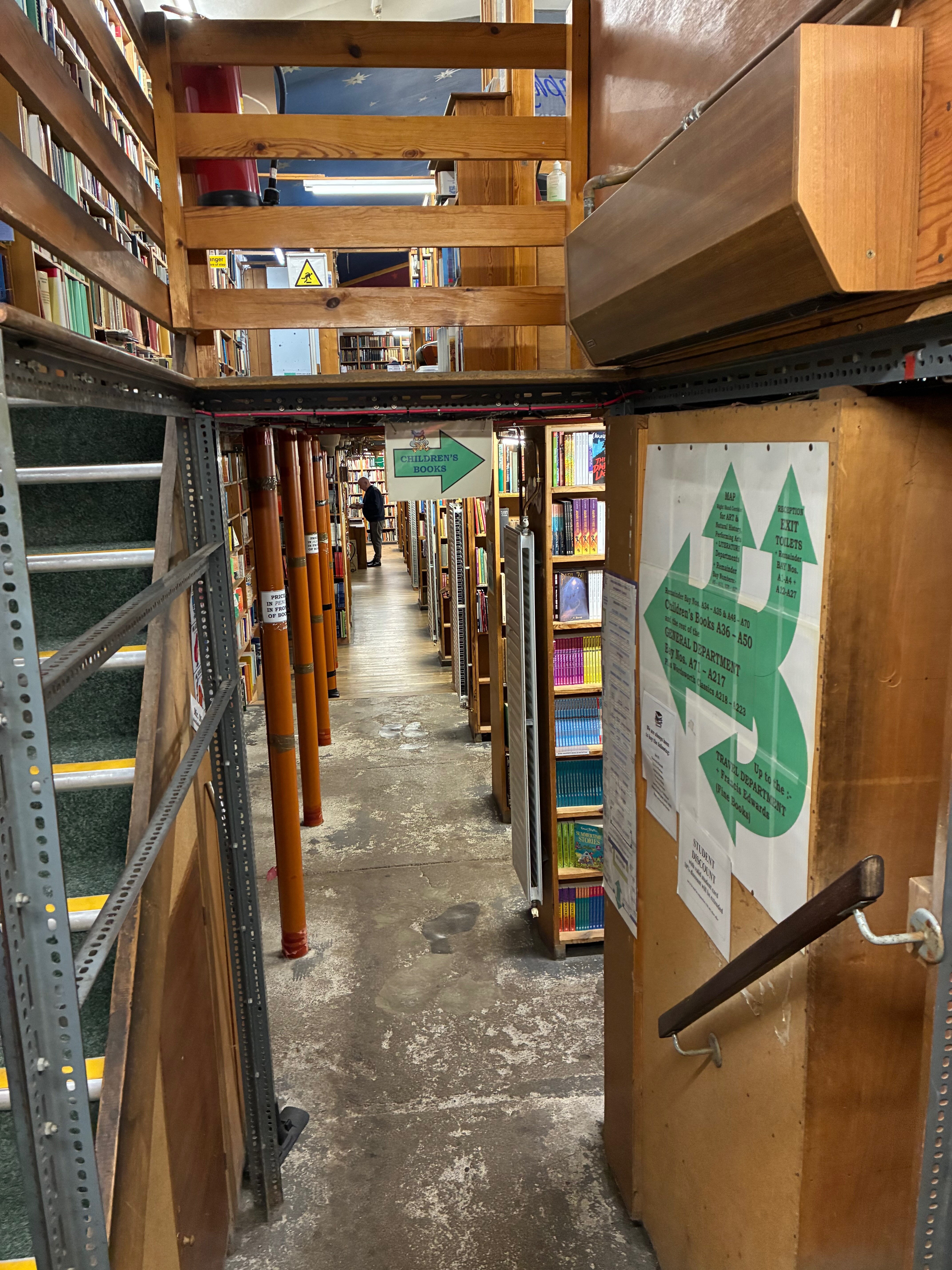
Among the places we stopped in to browse was the Hay Cinema Bookshop, which claims to have more than 200,000 books and was big enough inside to make that claim completely credible. They also have a collection of antique manuscripts, in a section of the store you can detect from a distance by the musty smell of old books—something, I suspect, you either love or hate. (Guess which camp I fall into?) We also browsed an alley which was lined with the overflow bookshelves from the main bookshop beside it, packed wall to wall over about 30 feet of alley with the books the owner wanted to get rid of for a pound apiece. The kind of place I routinely explored back in university. It was the kind of place where you could find treasures if you were willing to roll up your sleeves and make a determined effort to dig through the trash. Shoshanna found one book from 1959 Soviet Russia that predicted the glorious technological and social future under communism. Amusing and tempting, but we left it for some other bibliophile.
The the Hay Cinema Bookshop is my idea of a bookshop:
The Murder and Mayhem speciality bookshop (note cat mural at bottom right):
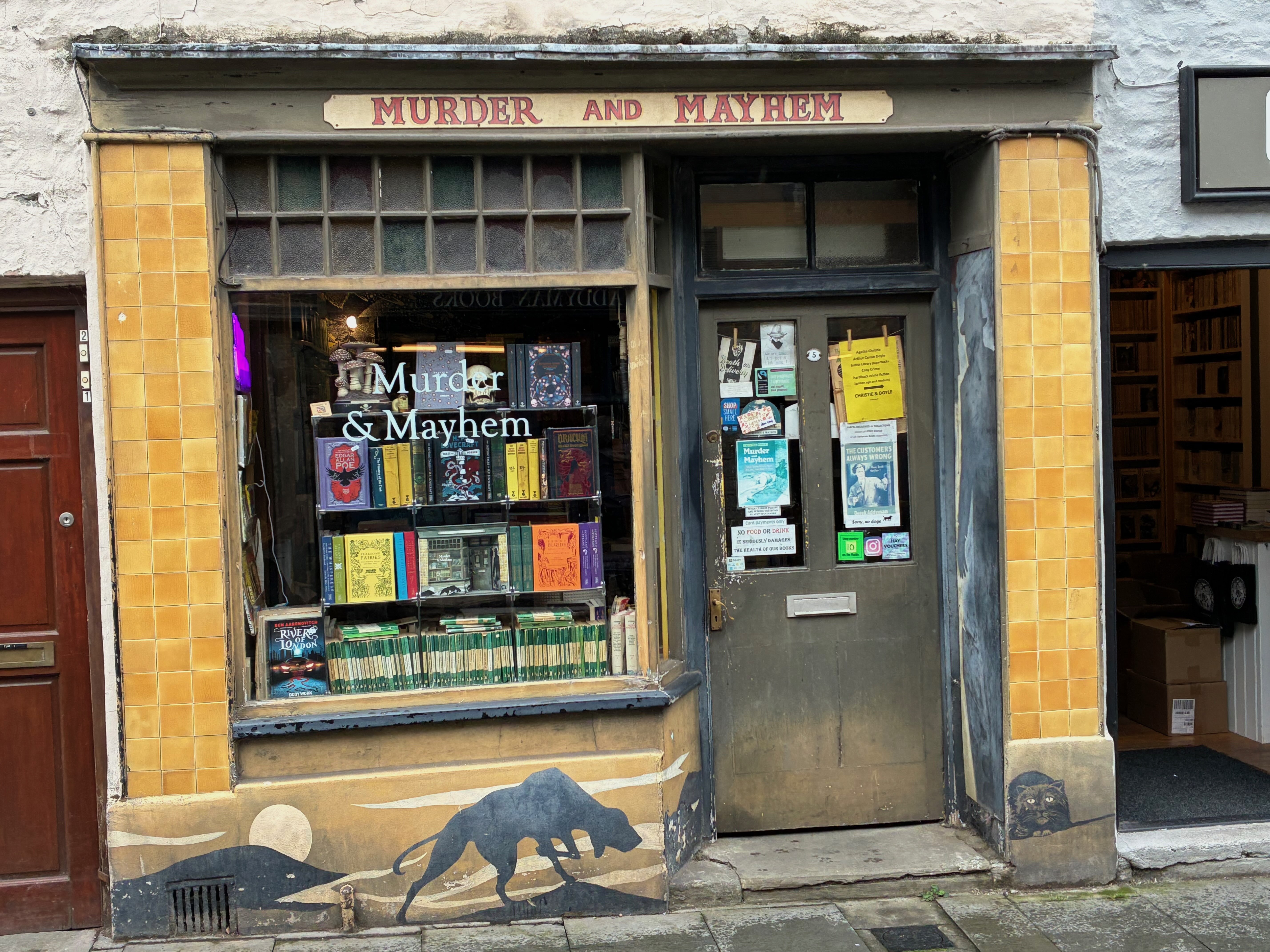
We wanted to change some euros we'd retained from a previous trip for pounds, since nobody seems to take euros for a purchase. (A post-Brexit thing?) None of the towns where we've stayed had banks and all the post offices we visited would not exchange euros for pounds. In Kington, we saw a poster recommending that everyone use cash instead of credit, since many people depend on cash because they have no easy access to banks and need to buy from people who can't afford to offer credit (like Allan, our taxi driver). That provided additional motivation to get pounds. Fortunately, the Hay post office was willing, so we are now possessors of local currency.
Hay village and mountains:
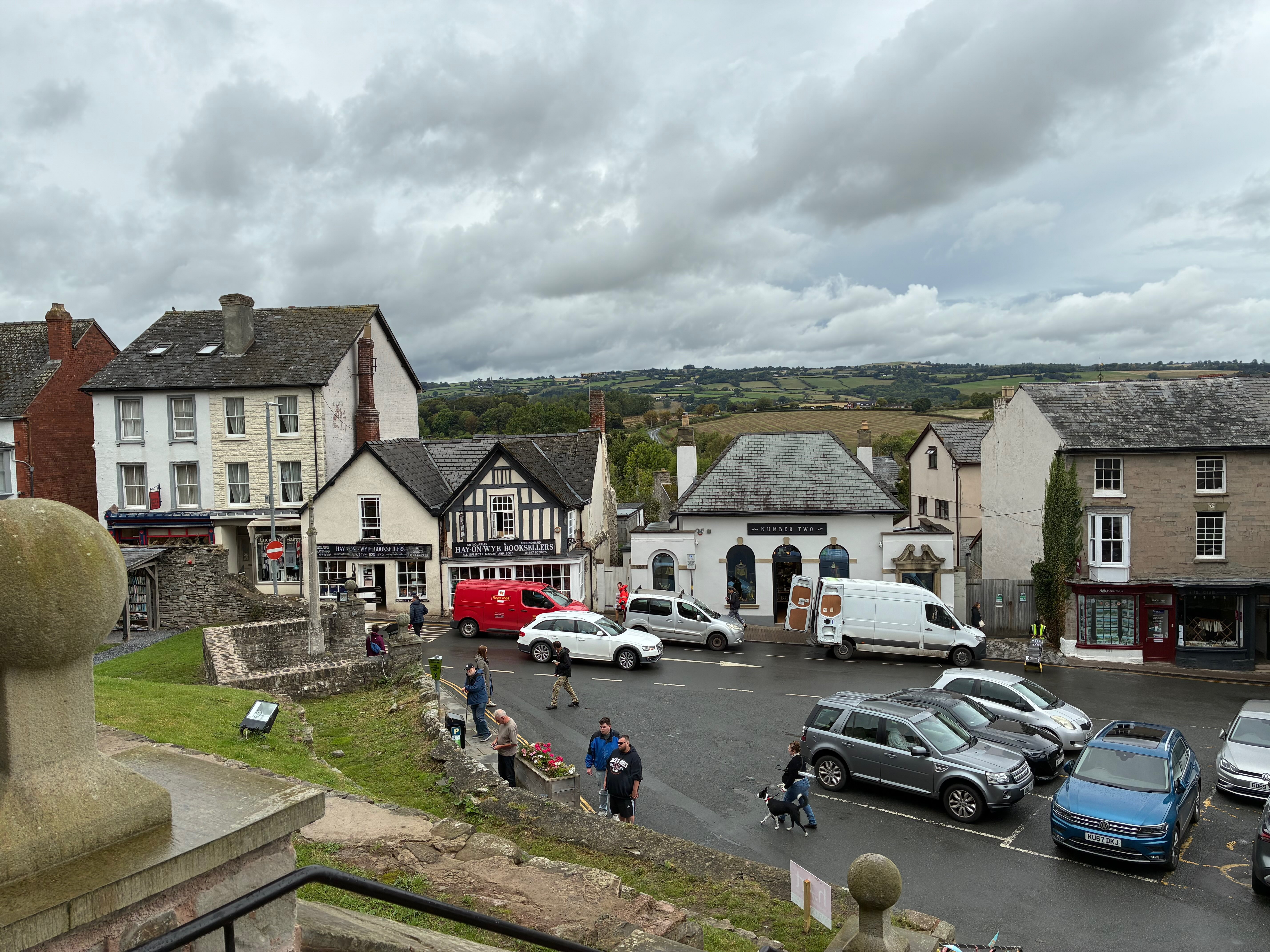
Our hosts don't serve dinner, but will be serving us breakfast both days. Tonight we'll be dining at the "Three Tuns", a tun being the term for large barrel and the restaurant being reputedly the oldest licensed brewery in the U.K. Dinner was a bit disappointing. I had a competent but unexceptional braised brisket and pancetta pasta dish, which could have benefited from more verve, and Shoshanna had a decent chili-oil and pepperoni pizza. No complaints there, but Three Tuns is supposed to be an artisinal brewer, and they only had a few beer choices. So we both opted for Butty Bach, which is good—but we'd already tried it. Hoping for better tomorrow.
Tomorrow is market day, with a section of street below the castle being closed off for farmers and related merchants such as cheesemakers. We love markets, and try to visit them whenever possible. Details in tomorrow's blog.
Today was specifically planned to be a relaxed "rest and recover" day, with some highly restrained bookstore browsing—since, with notable injustice, we now have to carry our own baggage to the next B&B. We planned to wander about the city and the surrounding countryside. It was also market day, and the market is right around the corner from our B&B—a literal scone's throw away.
We started with a standard English breakfast, which I haven't described before, so a concise summary: There's usually a cereal tray with four bad choices (usually variants of corn flakes) but sometimes alfalfa or granola. Unless you order a vegetarian option, it's usually heavy on the meat, with both Canadian ("back") bacon and sausage (and blood pudding if you dare), plus mushrooms and a baked tomato and toast. Usually baked beans, though our host Mary doesn't like them and didn't offer them. Potatoes are usually tater tots rather than homefries, and for additional carbs, you can get (most often white) toast and marmalade or jam. In evening meals, beans are frequently replaced by green peas, which seem to be a legal requirement given their ubiquity. I enjoy them too, but more diversity in veggies would be nice.
Eating a full breakfast was an amateur's mistake, as it was very filling and greatly limited the stomach space remaining for tasting the many yummy things available to nibble on at the market. We had a long discussion with a baker (Rex Gooch) who was showing off his many wares, each of which looked more delicious than the next (particularly the sourdough—our favorite—and the thick-crust "rustic" breads). If the market had been yesterday, we might have bought a loaf, then supplemented it with meat and cheese and veggies for a couple picnic lunches. Instead, I bought a "death by chocolate" croissant and Shoshanna bought a slice of focaccia plus cheese, which would be our lunch. I also picked up a chicken–leek handheld pie for lunch.
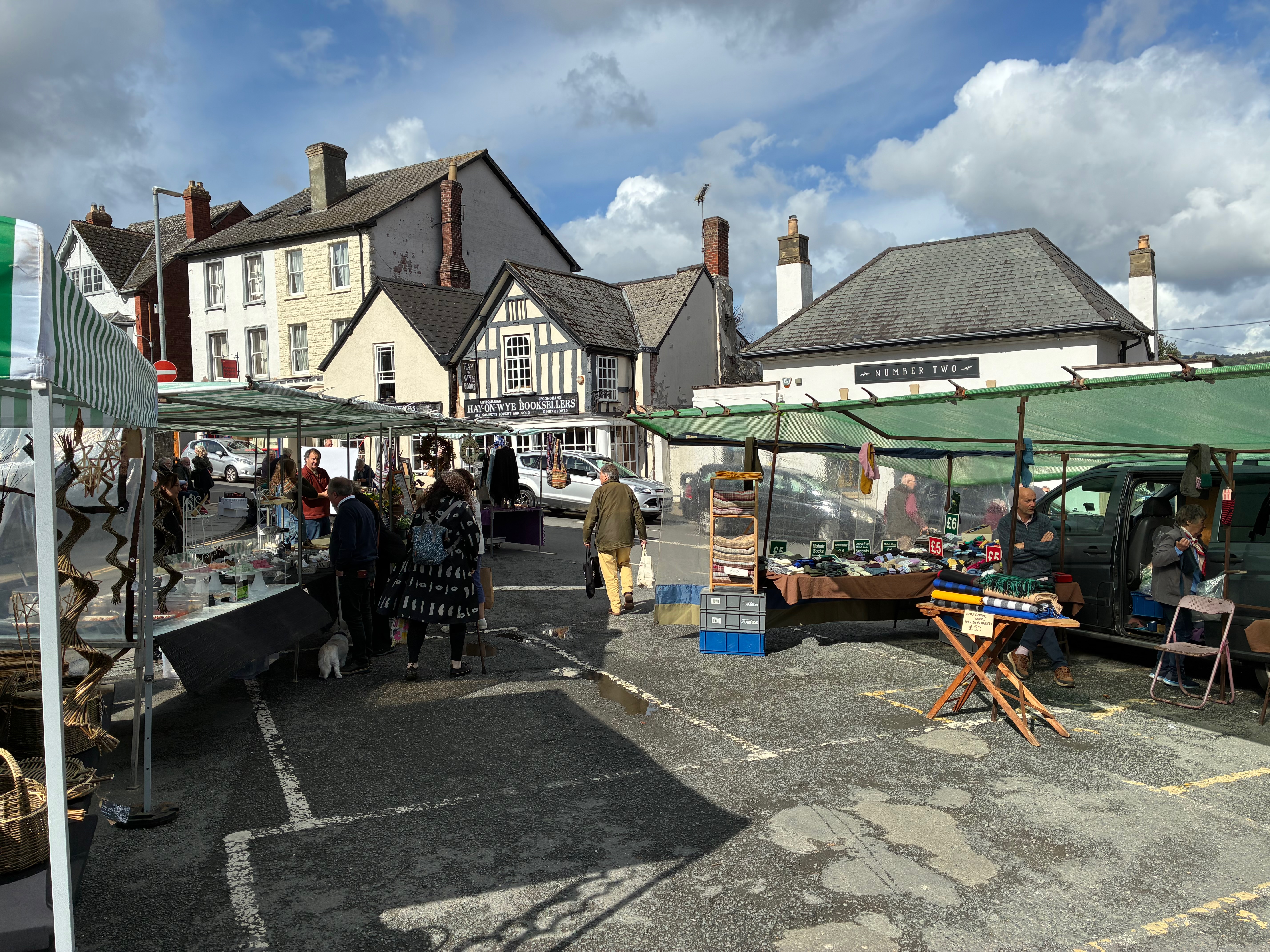
We spent about an hour browsing: lots of woolens, pottery, cheese, breads, baked sweets (e.g., baklava, the aforementioned croissant), antiques (tools, toy cars), fresh veggies and fruits, and beautiful mushrooms. Shoshanna added a peach to the haul for lunch. Who knew they grew peaches in the U.K.? (Misunderstanding on my part: peaches were imported, not local.) We also tasted a "cob nut", sort of a wild hazelnut, which was quite tasty, but required much work to open. We love markets and seek them out at every opportunity. This one was small but pleasant.
A corner of Hay-on-Wye market, with bookstore in the background (of course):
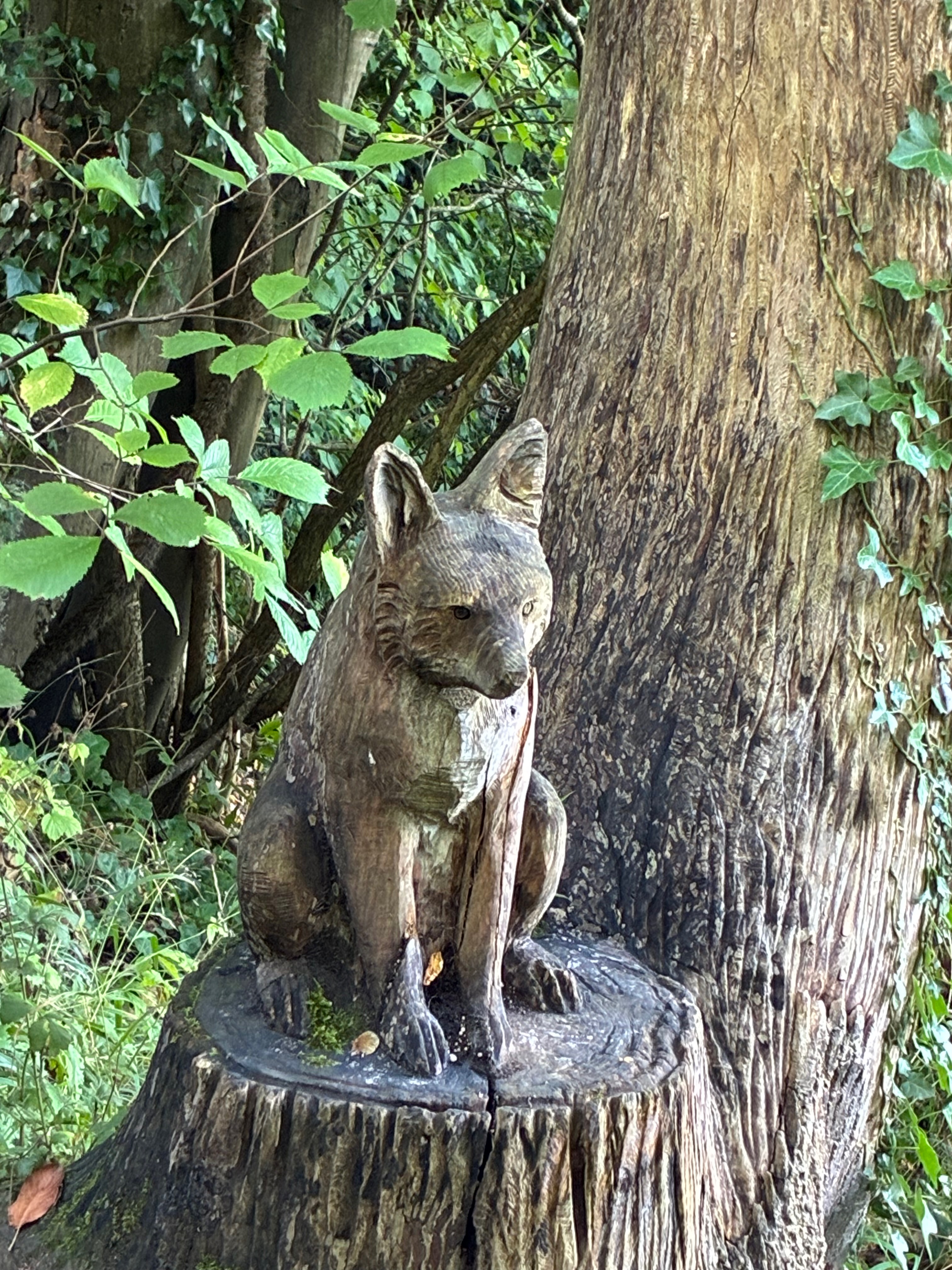
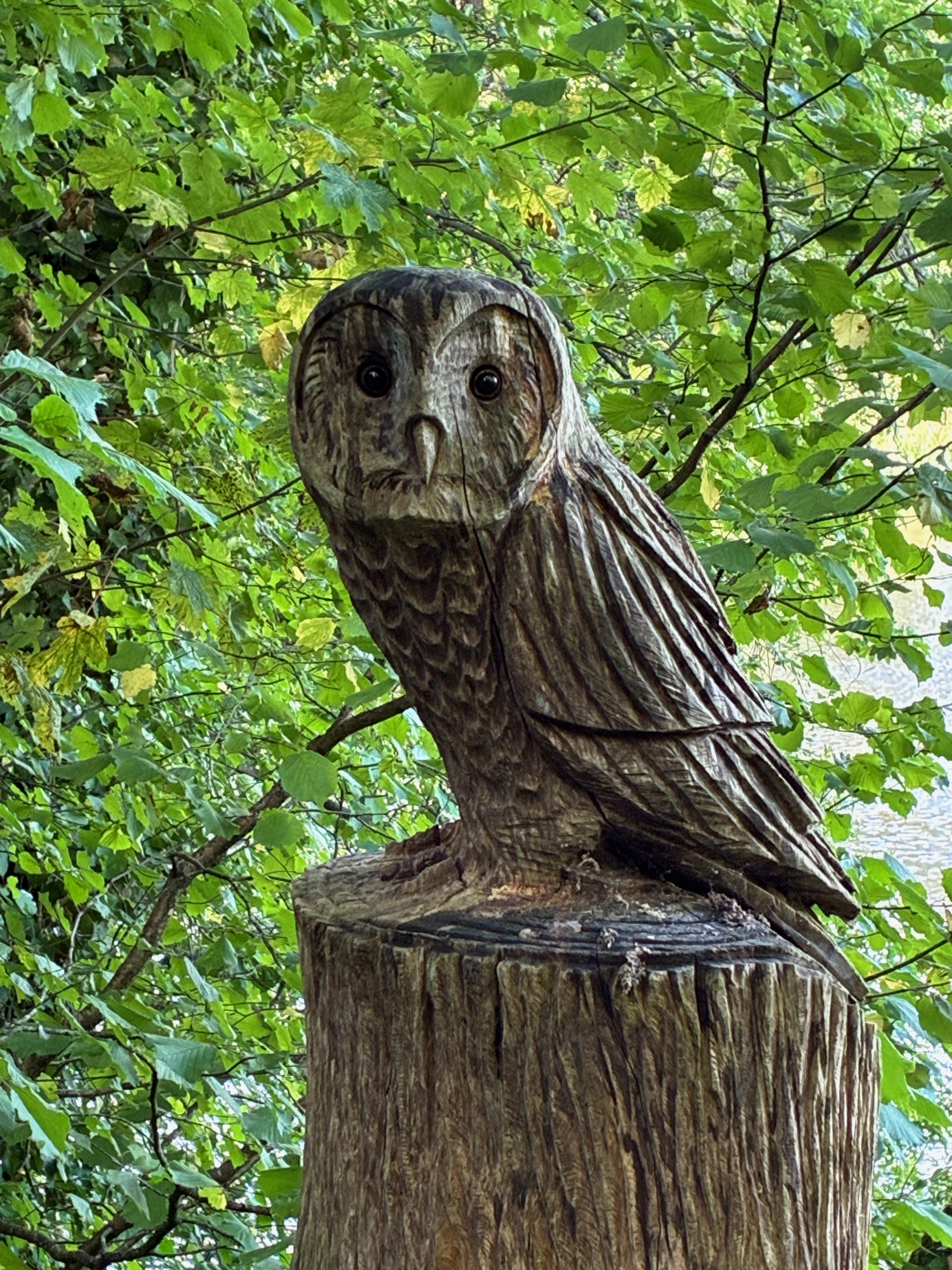
After finishing our shopping, we went for a walk along the Wye River that gives the town the last part of its name. It's a mostly flat but no-nonsense stream, achieving a good rate of flow and some pretty but small rapids. About 100 feet wide in most places. We walked out along the river, initially in the open but soon moving along a woodland trail, pausing for wildlife viewing but not seeing much other than a small white stork and a trio of ducks that "ducked" under the water near the rapids and emerged upstream, popping up like little brown penguins. However, there were some excellent wildlife sculptures that we stopped to admire.
The Fox Not In Sox and The Owl Not A-prowl:
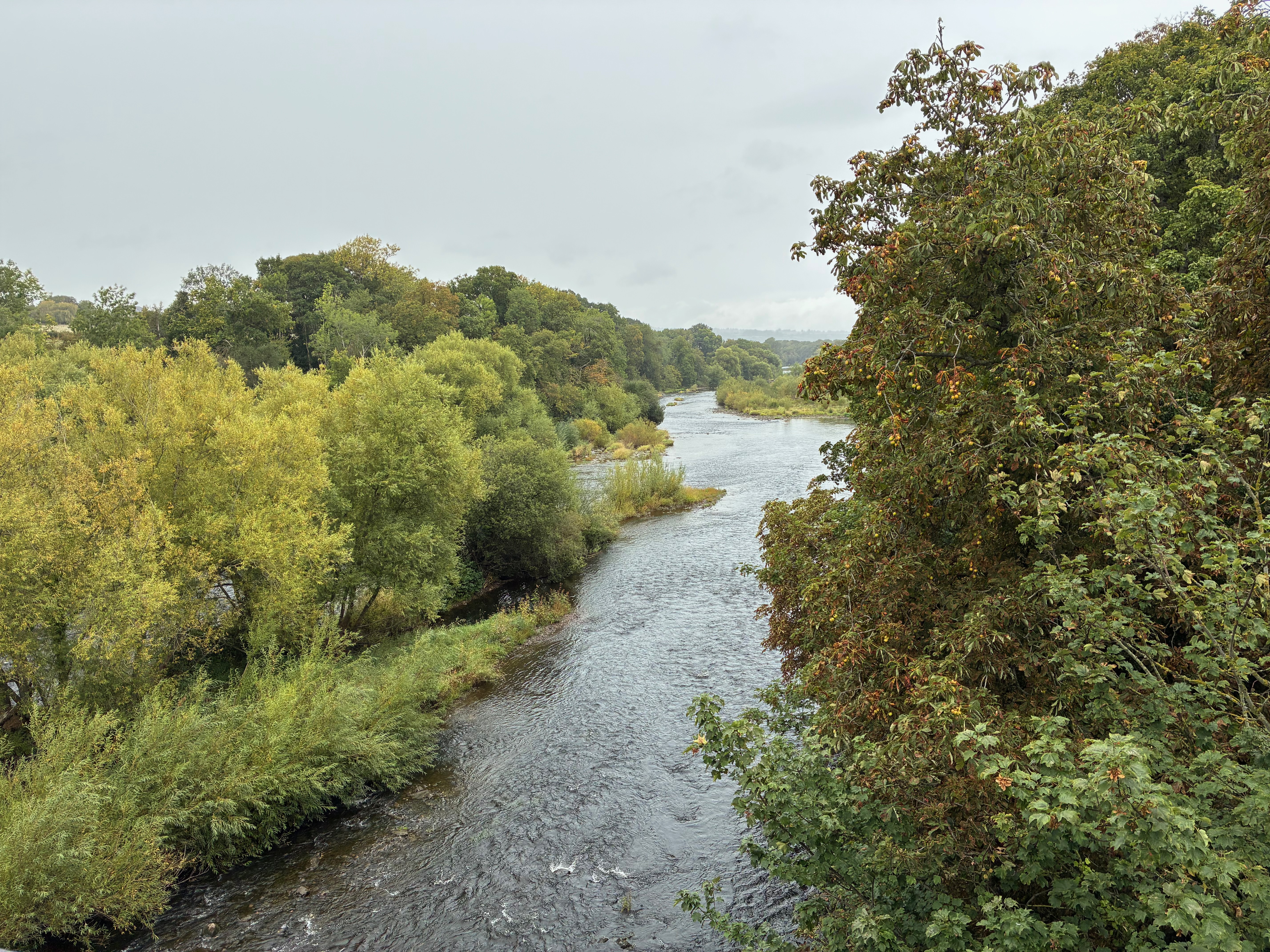
Wye River seen from the bridge:
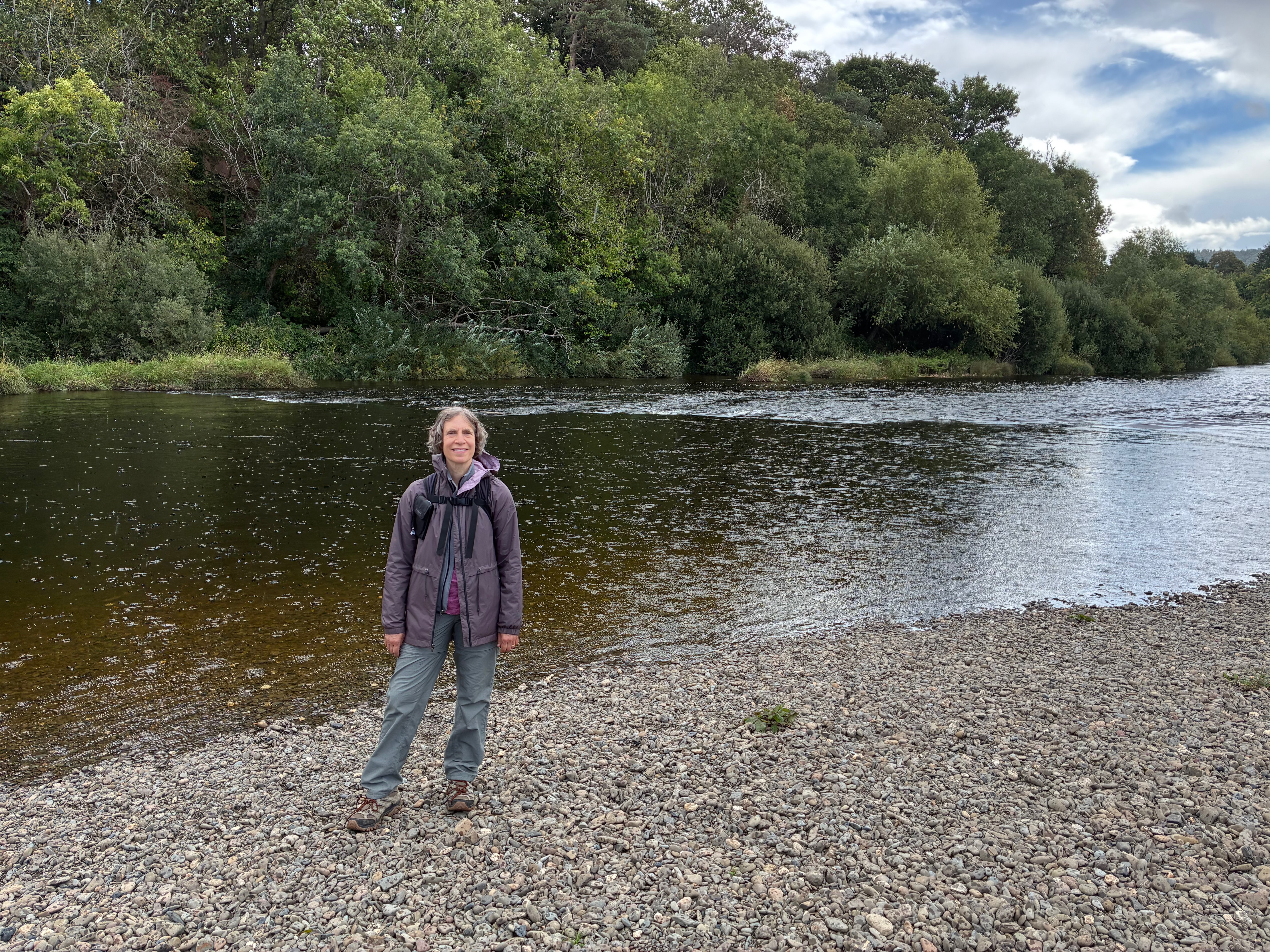
Wye Shoshanna? Wye not?
When we reached the end of the woods, we continued into a large meadow that seems to have been set aside as a privately owned conservation area that was open to the public, as a surprising amount of the U.K.'s land seems to be. We looped around until we found a perfect lunch spot: a bench atop a long grassy slope with a nice view of a bend in the river, serenaded by what looked and sounded like annoyed mourning doves. Shoshanna made herself a sandwich with her bread and "Ticklemore" cheese, while I devoured my pie and made a good dent in the croissant. Sunny and beautiful, and warm enough for Shoshana despite a light breeze that freshened slowly as we ate.
Needless to say, as we turned our path back towards town, the ominous black clouds that had been scudding by south of us began turning in our direction. We packed up and made haste back towards town, leaving the meadow and entering the woods as heavy rain began to fall. (Note to future travelers: in U.K. weather forecasts, "light" seems to mean moderate and "moderate" seems to mean heavy. We haven't heard "heavy" yet, but it probably means "build an ark".)
We were still under the trees, thus somewhat sheltered, particularly when we came to a churchyard wall, so we only got damp rather than drenched, but we stayed even drier because Shoshanna had a clever idea: look for drier patchs along the path (i.e., areas where the trees most effectively blocked the rain) and shelter there. Which we did, and indeed stayed much drier than might otherwise be the case. I used a similar observational technique to figure out where NOT to stand while watching Icelandic geysers. Tourists who stood in the wet patches got drenched if they didn't move fast. (A kinder, gentler me might have taken a few moments to warn them—and definitely so had the water presented any danger—but I believe in experiential learning, so...)
The rain eased up after about 15 minutes, so we started walking again. Made it back home by around 2 PM, by which time (predictably) it had stopped raining. Had a nice nap before dinner. We didn't see any restaurant that really excited us, except a vegetarian restaurant that wasn't open for dinner. We've made a reservation at Three Tuns again, as they're close (literally across the street) and had acceptable food at a reasonable price. Briefly considered the Rose and Crown, but it's a sports bar with five screens, so it seemed likely to be a bit noisy. Dinner was decent: I had a vegetarian pizza with the pub's one "best bitter" beer and Shoshanna had nduja (a kind of sausage) pizza with a big glass of Merlot, with a couple scoops of ice cream for dessert.
Today was mostly an "our feet have labored heroically and deserve a rest" travel day, during which we parked our collective butt and let someone else carry us onward. In this part of the trip, we headed for Fishguard, a village on the western coast of Wales, so named because of its Nordic roots in a word that means (basically) a place where you catch fish.
We started our day with the usual enormous breakfast and a conversation with Mary about Covid in Wales. Shoshanna had been reluctant to ask; I, on the other hand, have no shame. From what Mary told us, Wales didn't suffer too badly because it's much lower density than most other countries; for example, the farmers and herders live on large, remote farms (like the ones we'd hiked through previously) and may not see another human for weeks on end. Also because they have a very community-centered ethos, in which everyone pitched in to look after seniors and displaced people during lockdown. Possible a lesson we need to learn back in Canada.
Travel began at around 9 with us hiking our heavy backpacks up past the castle to the inter-city bus stop. The nice thing about well-designed backpacks is how well they distribute the weight: it hardly feels like you're carrying a load—until you go uphill, when the frame still works well but can't actually negate gravity. The next bus would take quite a while to arrive, so we wanted to get to the bus about 20 minutes early to be sure we didn't miss it if it came early and that it wasn't already full. Good thing we were near the start of the line, as many people climbed aboard both at our stop and at subsequent stops. Took us about an hour to get to the train station in Hereford, and it was a full bus by then.
We arrived at Hereford station in plenty of time for our train, which took about 4 hours to carry us to Fishguard and gave us plenty of time to watch the beautiful countryside without having to walk all that distance or drive. (Driving is a nightmare: there are only two lanes in most rural areas, with barely enough room for buses and other large vehicles to pass, so the driver glues his outer wheels to the edge of the paved surface and whizzes down the road with his mirror brushing the 10-foot hedges that line the road. I've no idea how they manage without driving off the road or colliding with other vehicles.)
This sounds like a lot of travel—and it is—but it's the result of us choosing where we wanted to go before figuring out how to get there and whether it's feasible. We did cut a few locations from our wish list simply because getting to them didn't repay the effort of travel. The alternative method is to use "getting there easily" as one of the most important criteria, as we did several years ago in France. In France, we chose a hub city such as Avignon and did day trips from that city into the surrounding area by hopping on the TGV. We'll probably consider ease of access more strongly as a criterion for our next long trip.
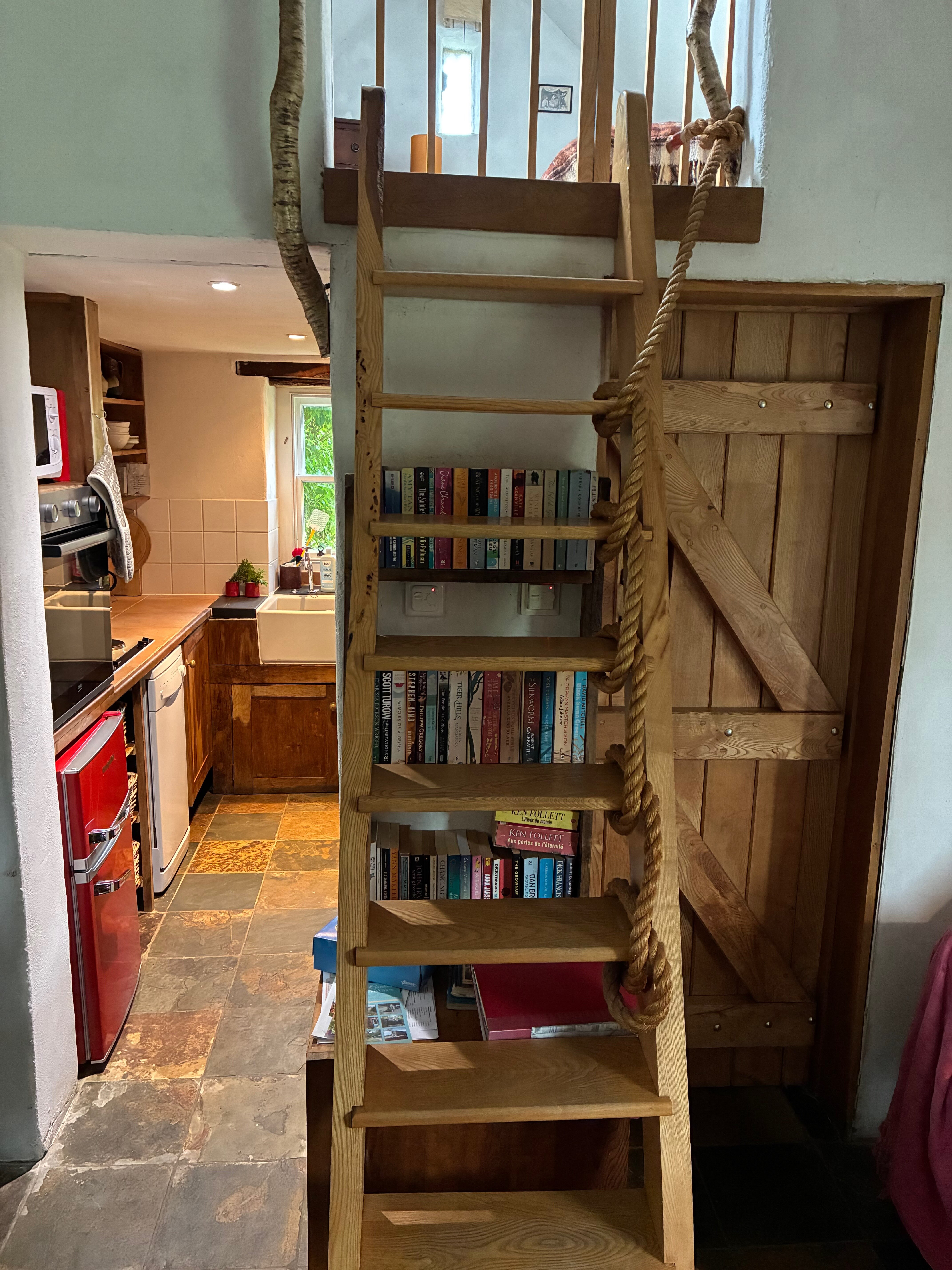
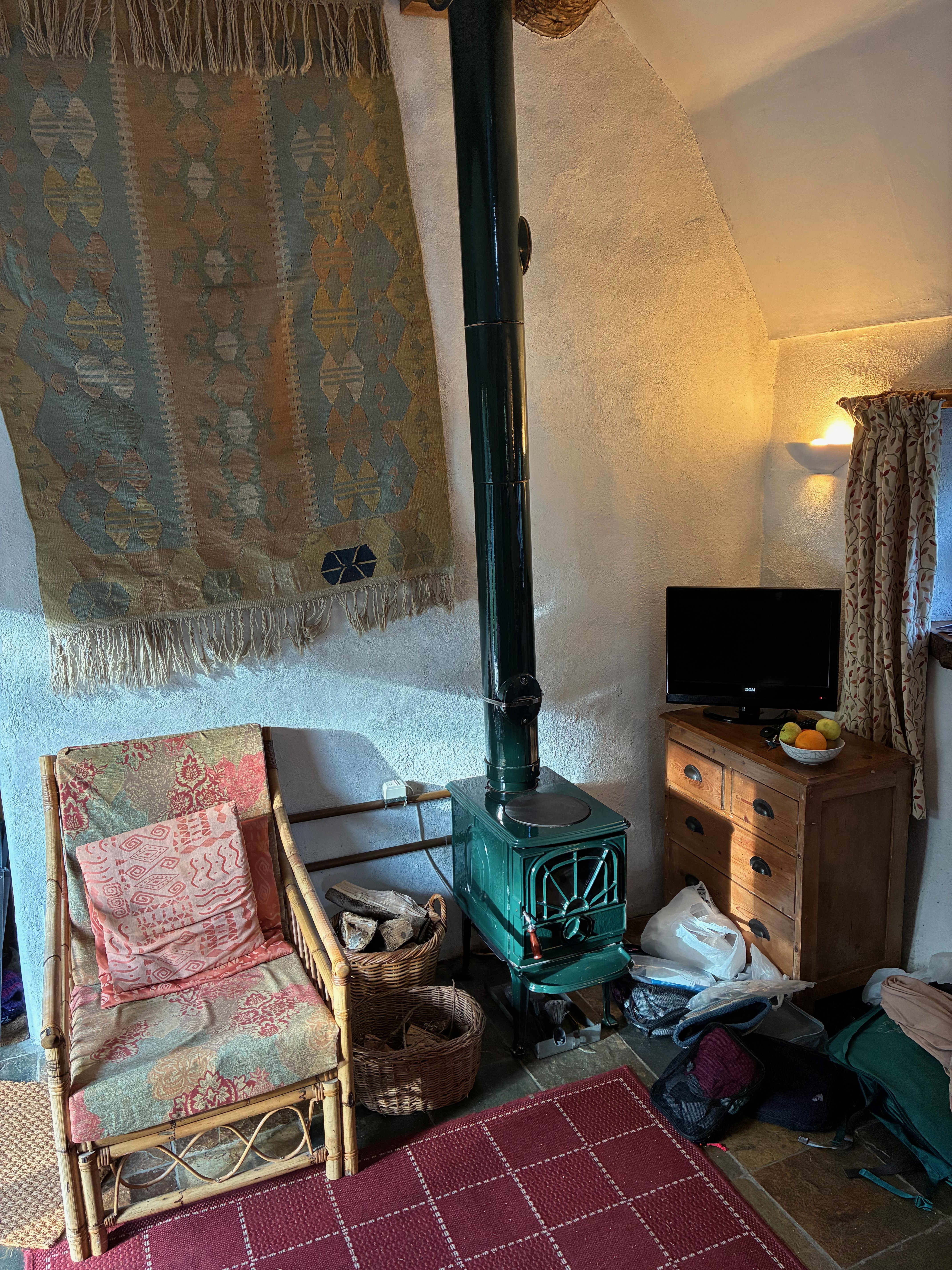
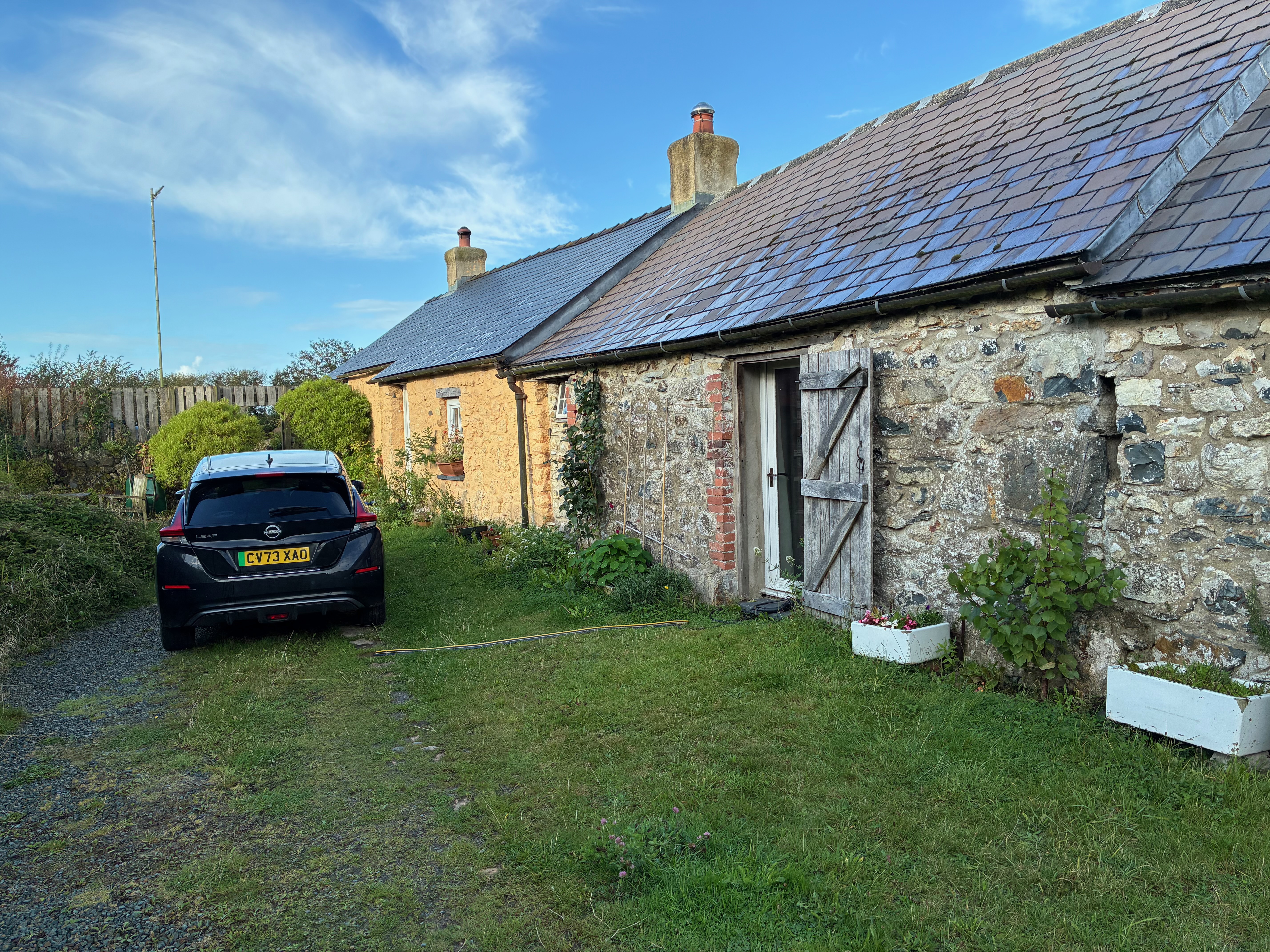
In Fishguard, we stayed at The Cwtsh at Ffynnon Clun, a working farm. The Cwtsh part of the name means "cozy" or "homely" and the rest refers to the multiple springs that feed the local farms. That's a good choice of name. Our room (the only one) is actually a cozy little renovated 12th-century cow shed that's been upgraded into a tiny cottage, about 10 m x 15, with a galley kitchen on one side, a bathroom/launderette on the other, and a tiny sitting room that connects the two. Our bedroom is in a loft upstairs, with access gained by a ladder and security while climbing provided by a large rope that provides handholds at the bottom and two large branches embedded in the ceiling as handholds at the top. No socks allowed, as the ladder's polished oak wood is quite slippery. Midnight bathroom visits are going to be interesting. (Update: There were no casualties despite multiple visits to the loo.)
Inside our cottage:
The farmhouse, with our cottage on the right end:
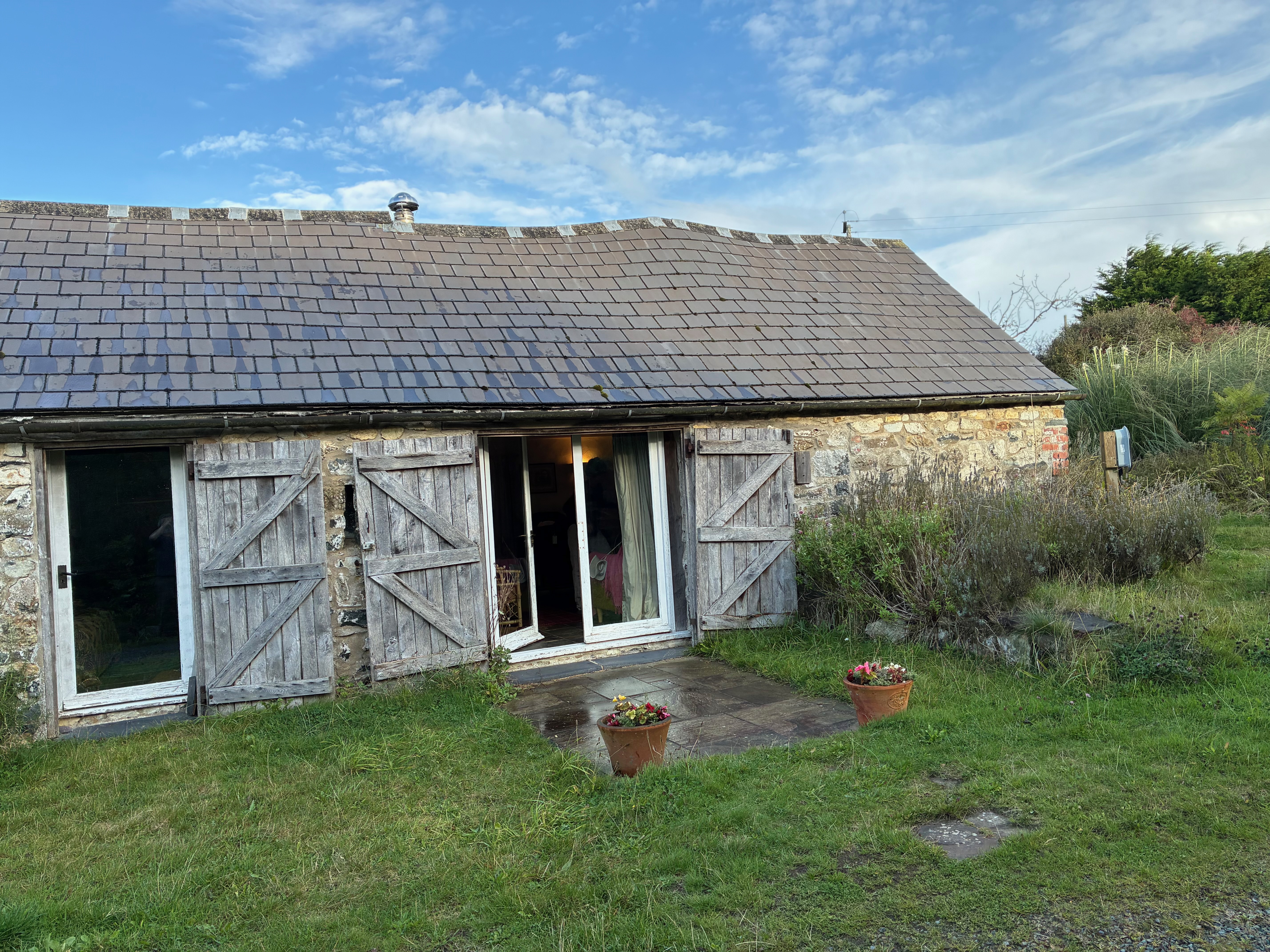
Our hosts Mike and Christine are environmentalists (most or all of the kitchen supplies are "organic" or "local" or both). They seem to be about our age, and they are running an organic farm and using solar energy and spring water (treated to ensure that it's safe to drink) as much as possible. I'm hoping for a tour of the place on Sunday, when it's looking to be too wet (continuous rain) and windy (gusting up to 40 km/h) for hiking. Saturday (tomorrow) will start out wet, but the weather should become really nice for a coastal walk by afternoon, though with scattered periods of rain. In short, typical Welsh (coastal) weather.
Mike offered to drive us into town for dinner, as he had to pick up his son, Aneurin, who was coming for a visit but whose train had been cancelled. This forced him to take a cab (at the railway's expense) to get to Fishguard. But apparently only to the station, not to his parents' home there? In the first draft of this day's blog, I wrote that based on the framed painting in our cottage, Aneurin was a gifted illustrator Unfortunately. it's a different guy with the same rare name.
Plans changed again before Mike drove us into town. It became possible for Mike to both bring us into town and pick us up on his way home from collecting his son instead of hiring a cab. So we got a nice chauffeured drive both into town and back again. While we waited for dinner time to come around, we did a couple loads of laundry, which should be enough to bring us home again. It's pretty damp, so Mike suggested we hang the clothing in his shed, which has a translucent roof and receives enough sunlight to warm up. He will let us use their dryer if the clothes are still damp tomorrow.
Dinner was at the Royal Oak, a pub famous for being the place where the leaders of a failed French invasion of Wales (the last French invasion of the U.K., in 1797) signed a treaty after being defeated. I had a roasted duck breast with smashed potatoes and yummy, gravy; Shoshanna had a "fish" pie, which was really a seafood pie covered in a layer of melted cheese, but did have some fish. I tried a Double Dragon beer, commemorating the dragon on the Welsh flag, but found it too bitter. We settled on Jemima's Trident, a tolerably bitter golden ale, which accompanied dinner well. We finished just as Mike called to report that he was on his way to get us.
A quick drive home, and off to bed. We'll probably sleep in tomorrow, unless the rain and thunder wake us. Unlike the true B&Bs and hotels we'd stayed in thus far, Cwtsh is self-catering, so although our hosts provide suitable foodstuffs in the fridge, we have to cook and prepare them ourselves. There's bacon and eggs, the latter from their farm, but will have to wait to tomorrow to see what else is available. Stay tuned!
Footnote: The one bit of homework we didn't do very well was figuring out exactly where the B&B is with respect to town. It's about a 30-minute walk to the foot of the 300-foot rise on which the B&B is located, so not as convenient to town and shore as we'd hoped. Oh well!
Geographical clarification: Although I've been using "Fishguard" as shorthand for the whole area we're staying in, the B&B is actually in the adjacent municipality of Goodwick, and today's hike was actually in Goodwick.
Breakfast was simpler and probably much healthier than the many fried "full breakfast" meat feasts of previous days: coffee from a French press, supplemented by homemade multi-grain bread crusted with sunflower seeds and slathered in butter and/or homemade grape–strawberry jelly. We had whole non-homogenized milk for the coffee, produced by a neighbor; apparently, homogenization is no longer a thing in the U.K. Finished breakfast with two orange chocolate truffles for desert. Delish! One of the advantages of being partnered is that you get to trade bites of food, which is a particular pleasure if you each want the same two different meals and you can simply split them. Shoshanns usually gets the best of this deal, since there are some things like seafood that she loves and I'm not interested in, but for sweets, I usually get both shares.
Our goal today was to spend the day hiking along the coast, weather permitting. The original forecast had been for intermittent and random downpours all day, with a risk of thunderstorms, but improving slightly in the afternoon. Since we'll be staying here two more nights, we're not horribly worried about wet clothing (our hosts will let us use their dryer if necessary), and since we won't be far from rescue (the hikes are all near the town) and will be walking a well-marked trail, we weren't worried about getting wet or lost and rescue taking an unacceptable amount of time to reach us, so we only brought Shoshanna's light backpack and didn't fill it with stuff. With rougher and longer and more remote hikes, I usually bring several pounds of useful stuff like a first aid kit, my ankle brace, and a change of clothing. Not today!
We waited until around 12, when the last downpour ended and the weather radar showed very little rainfall upwind of Fishguard. So we put on our waterproof coats and pants, crossed our fingers, and set out.
Après la déluge: mildy menacing clouds
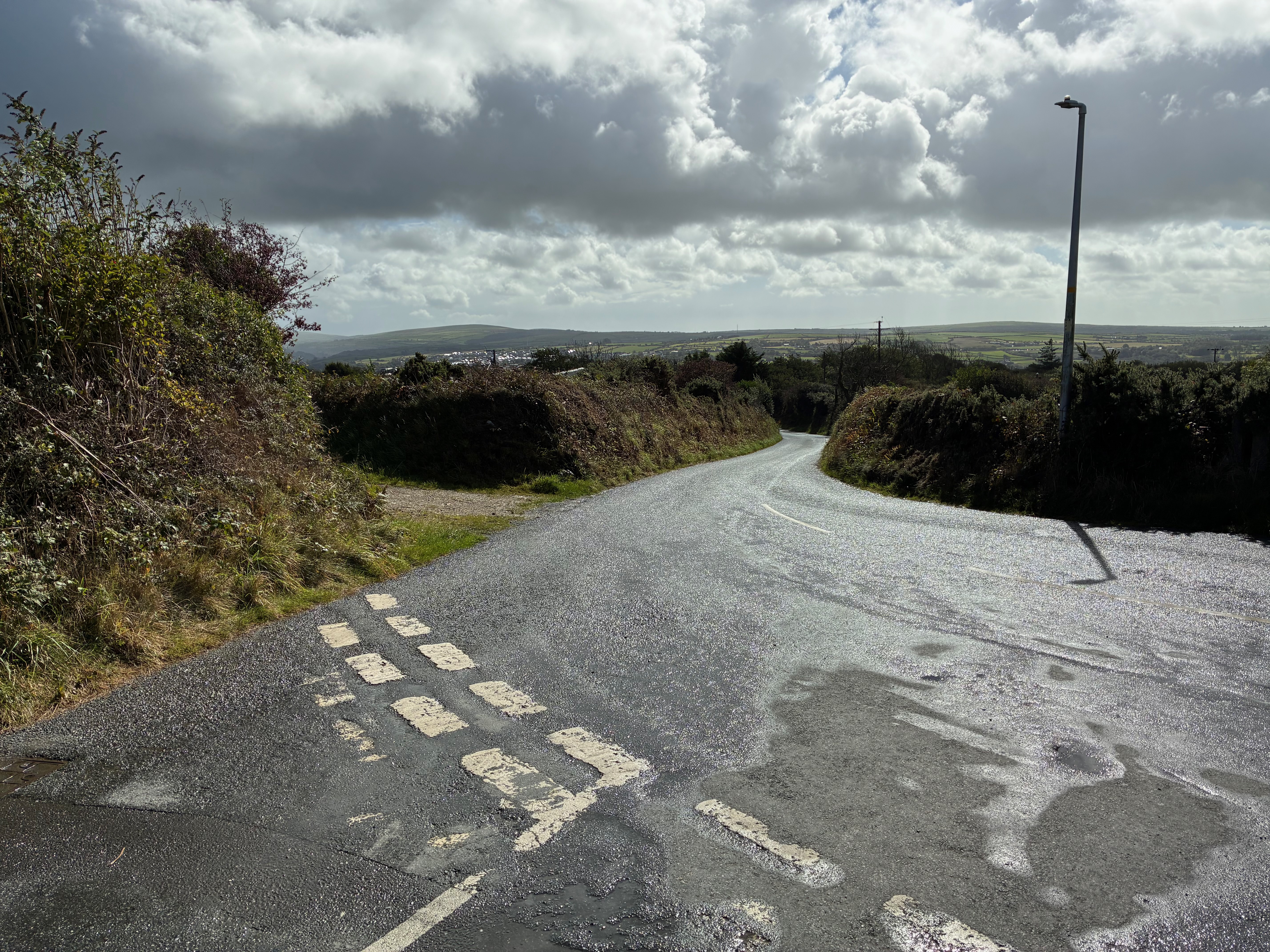
It turned out to be a perfect day, with mostly blue skies dotted with big fluffy cumulonimbus clouds. The temperature wasn't bad (I'd say around 16°C?) and the wind blew strongly (20+ km/h?), so we never got too warm. On the contrary, Shoshanna put on her woolen hat to keep the wind out of her ears, which makes her quite uncomfortable. And, miraculously, it never rained after that initial downpour.
The ultimate destination was to reach Fishguard Bay and gaze across at Dinna's Head (the distant long body of land in the background):
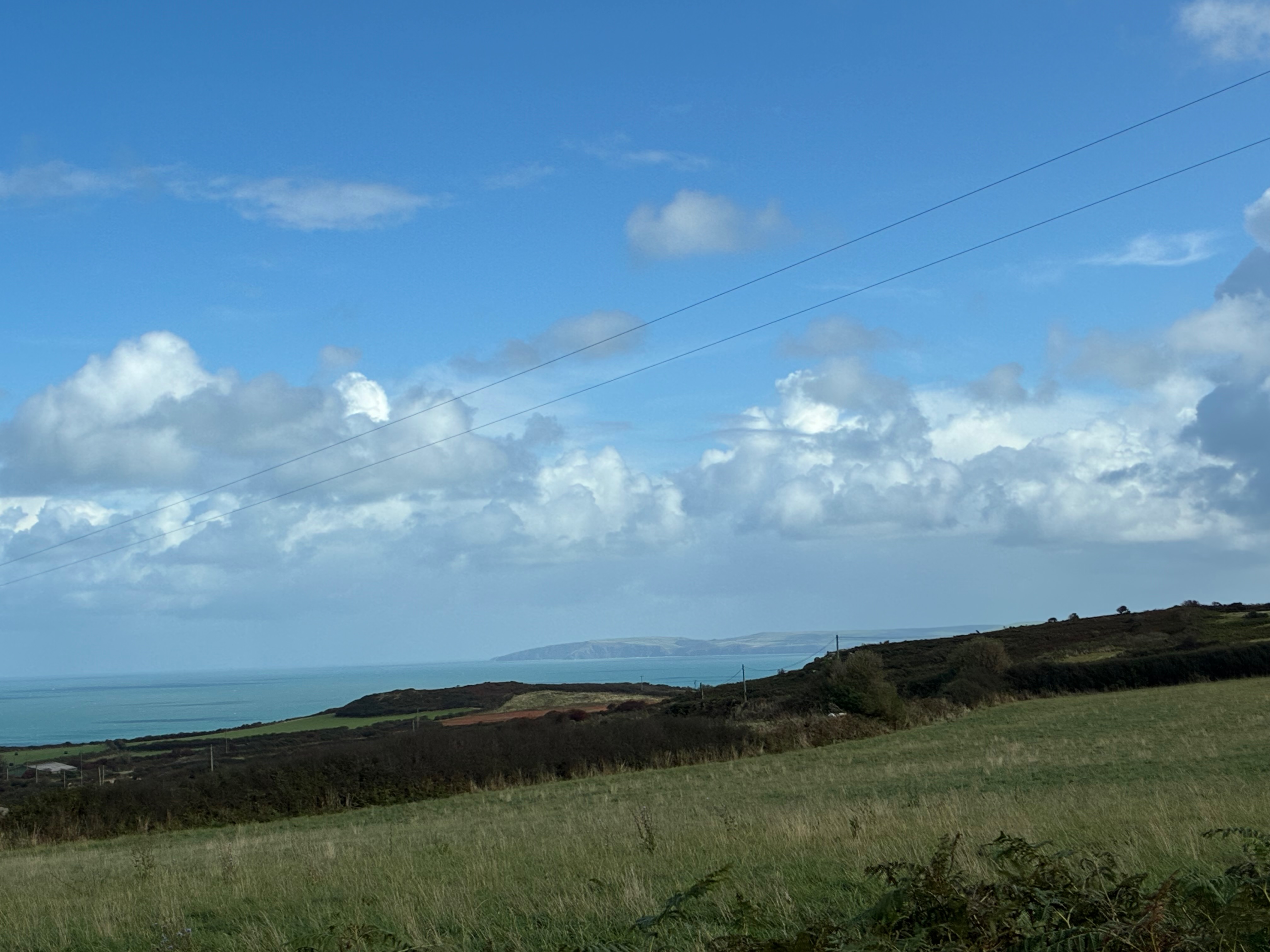
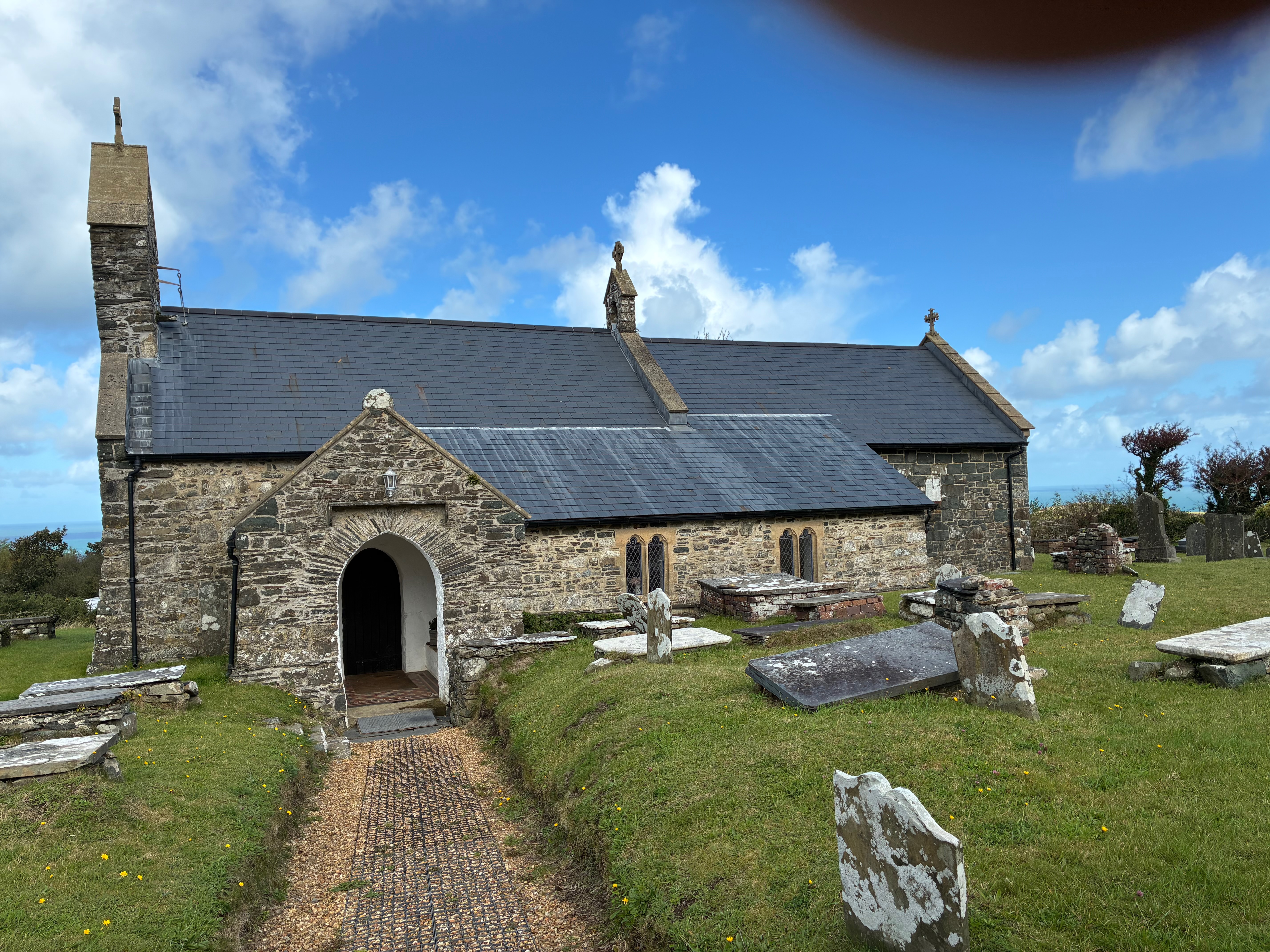
From the B&B, we walked northwest, stopping in at the old stone church the French had tried to burn down during their invasion (still intact and still in use) until we reached the Pembrokeshire Coastal Trail.
The unburned church:
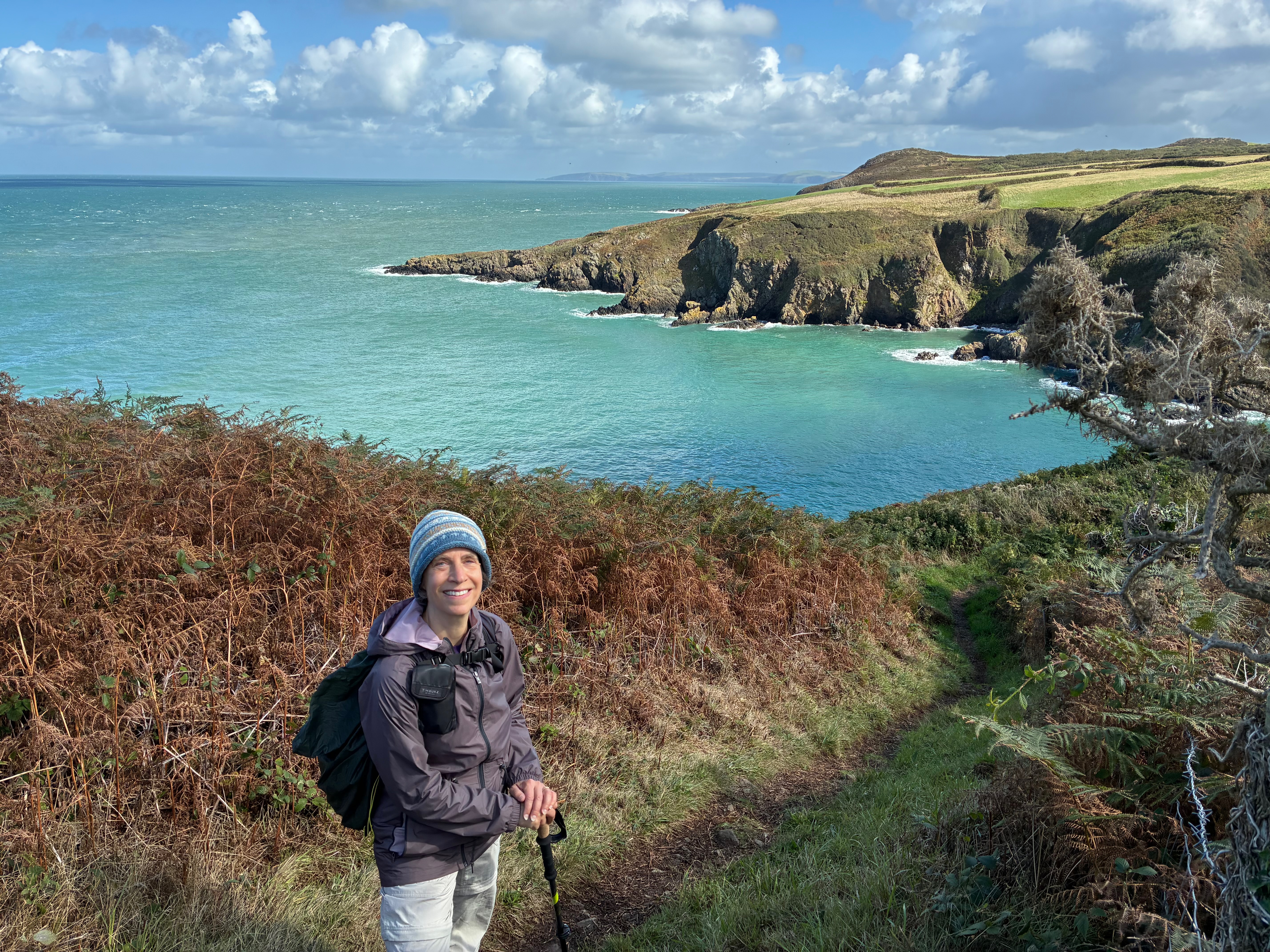
The full trail runs along most of the western coast of Wales, and we walked the section from near the western tip back to Fishguard, and arrived in Goodwick town, which shares the bay with Fishguard, around 3ish (so about 3 hours on the trail, followed by a couple hours in town, so about 5 hours in total). Shoshanna had been craving fish and chips for a while, but hadn't had the opportunity because until then, tastier things had been available to distract her. I proposed that now would be a perfect time, since it would eliminate the need to figure out what to do about dinner later, and she agreed. So walked down to the town's shoreline of Fishguard Harbour, figuring there was bound to be a fish and chips place to serve beachgoers.
Shoshanna fears no cliff:
Dinna's head draws closer:
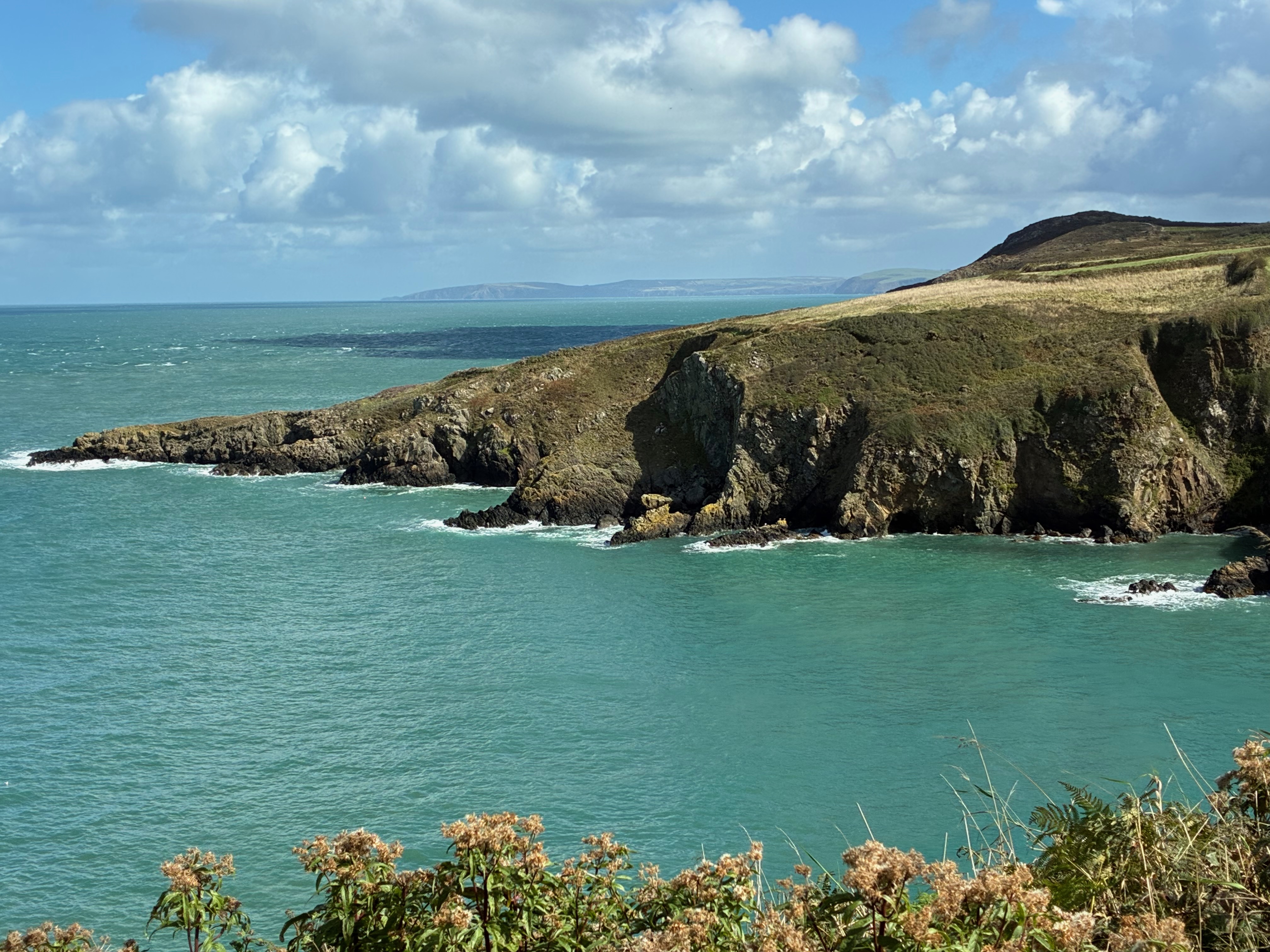
Looking back whence we came (the more distant peninsula):
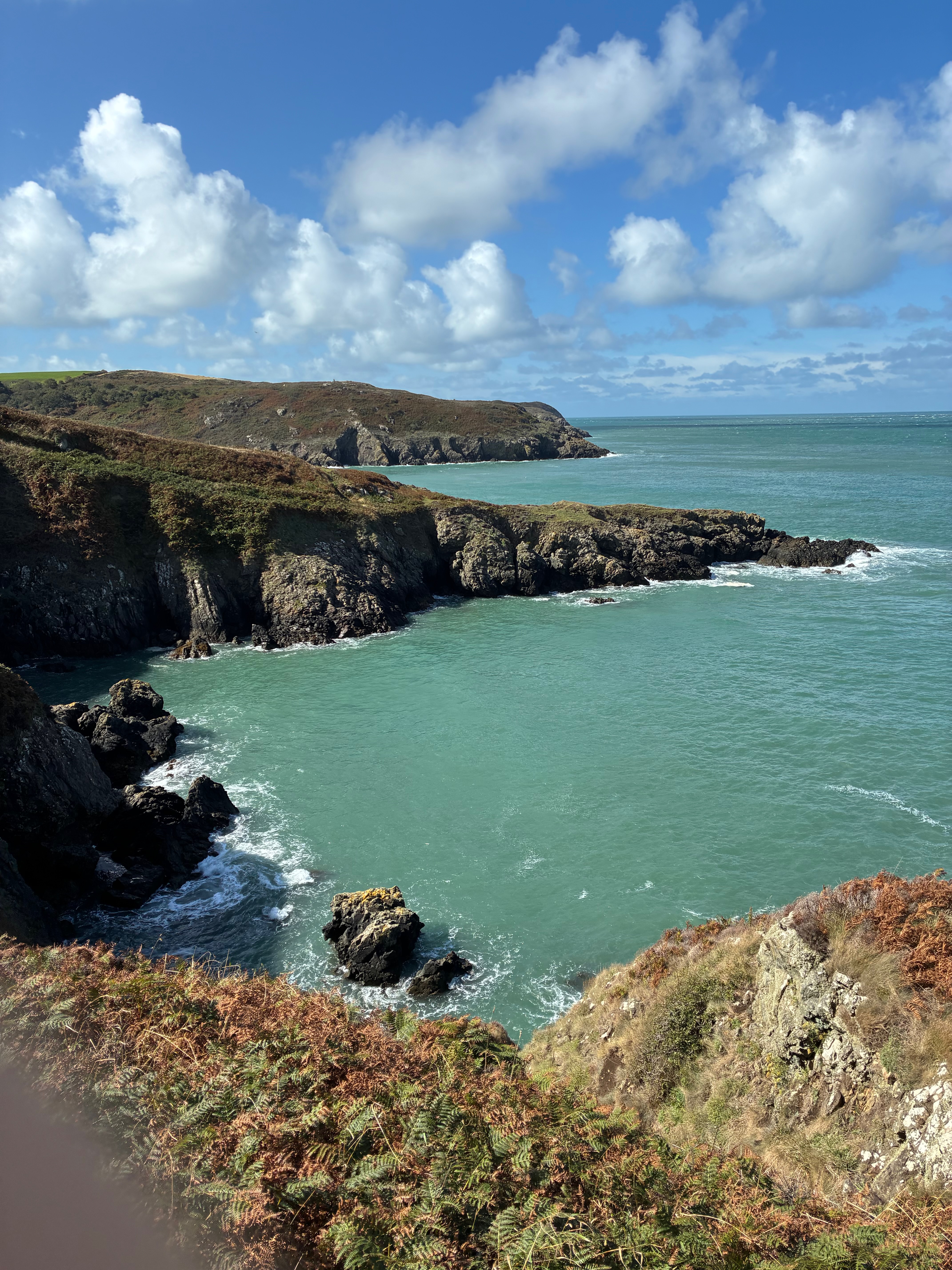
Fishguard Bay draws closer:
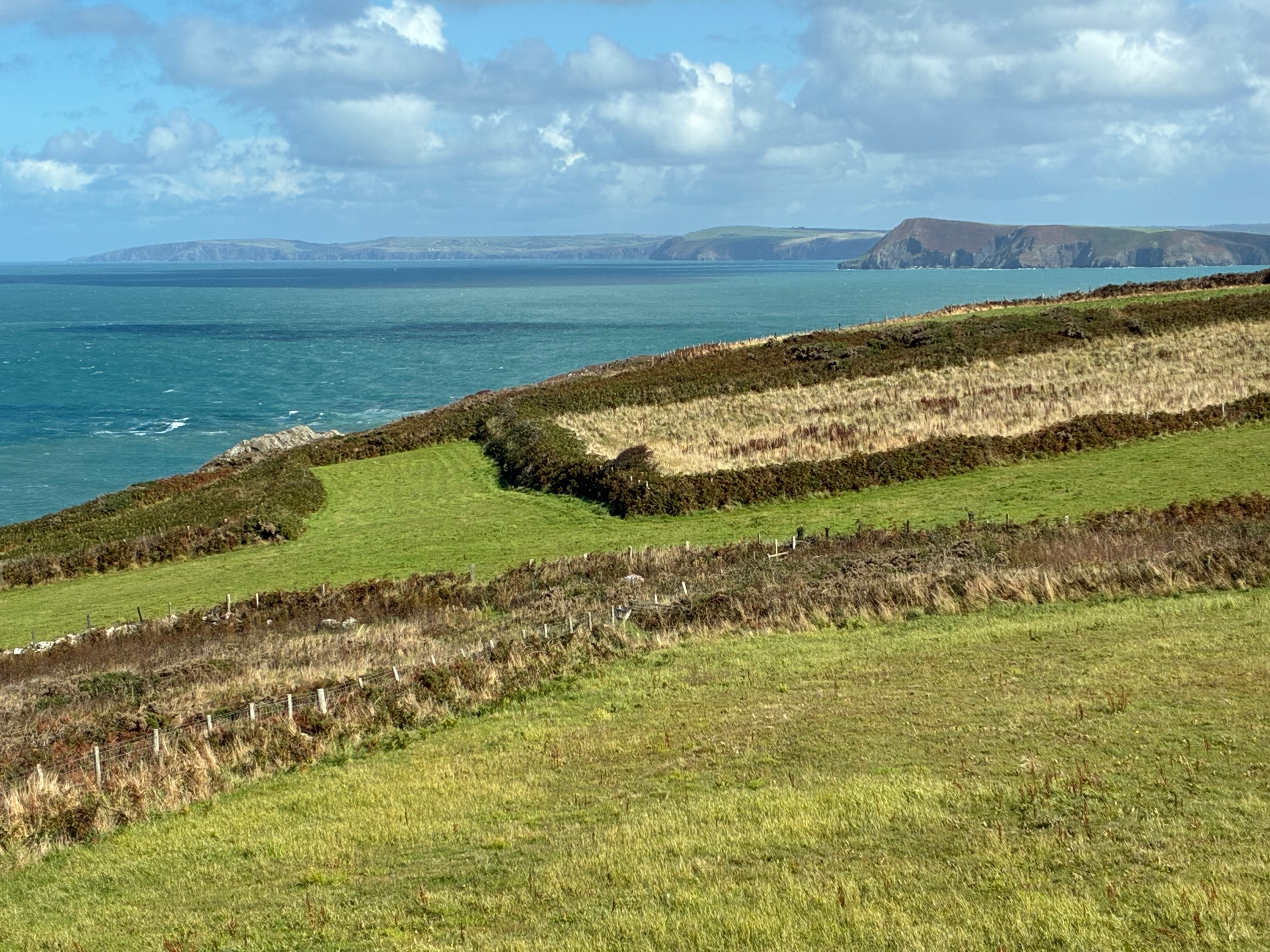
Fishguard from mouth of its bay/harbor:
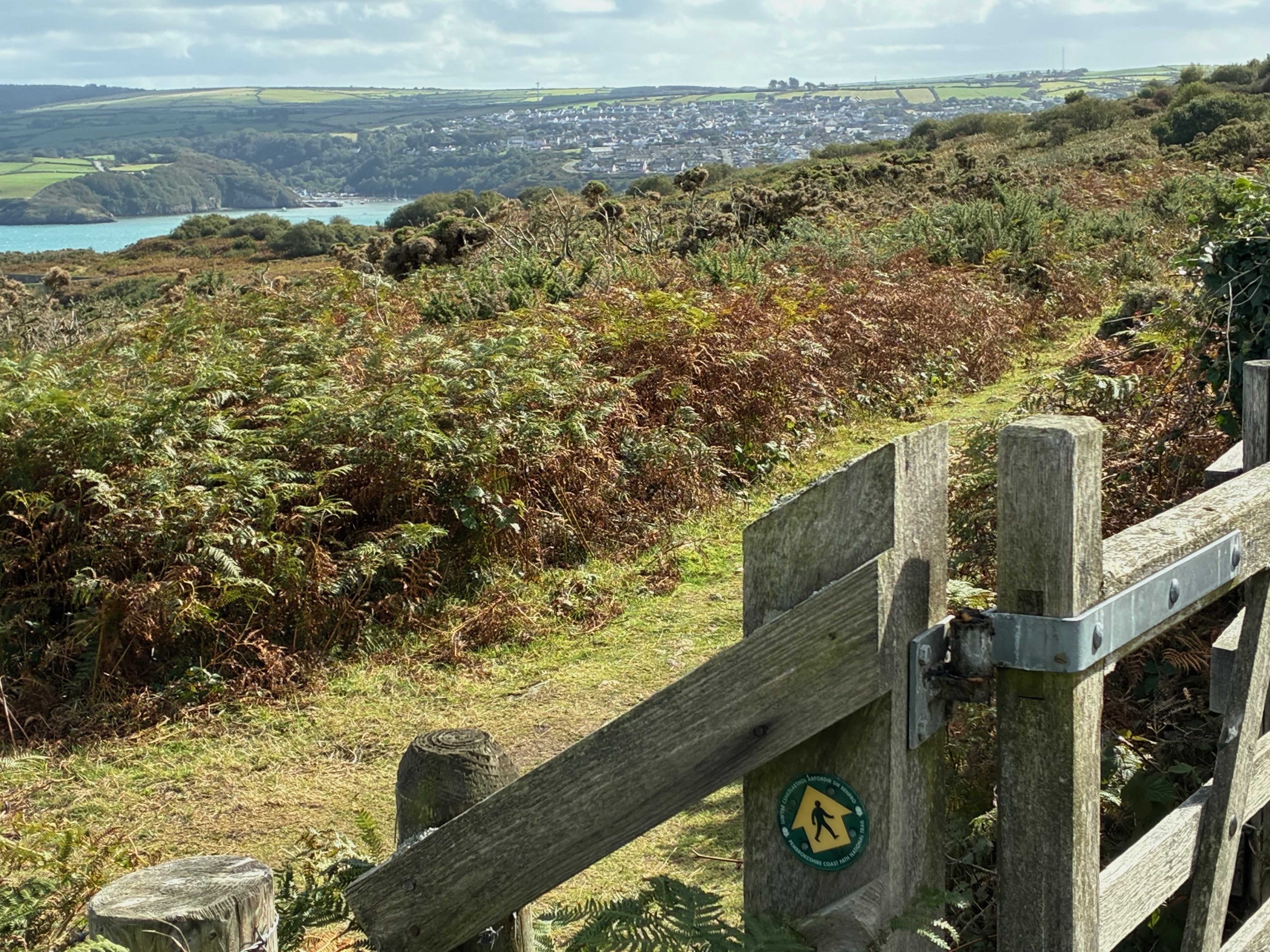
Sure enough, we found Dolphin Fish and Chips and had a feast sitting down by the water on a concrete ramp, sheltered from a strong wind, enjoying the beautiful ocean scenery: rolling hills leading down to sheer cliffs, plus wind and waves and gulls hoping in vain for a snack. Because tomorrow's forecast was universally horrible (steady rain, thunderstorms, and high winds), we're planning on spending the whole day indoors, possibly helping out Mike and Christine in their barn so we could spend more time talking with them about what they were doing with the farm. But because going out won't be an attractive option, we also picked up three meat pies from Dolphin, then beer at the Tesco grocery just down the road. They'll be our evening dinner tomorrow.
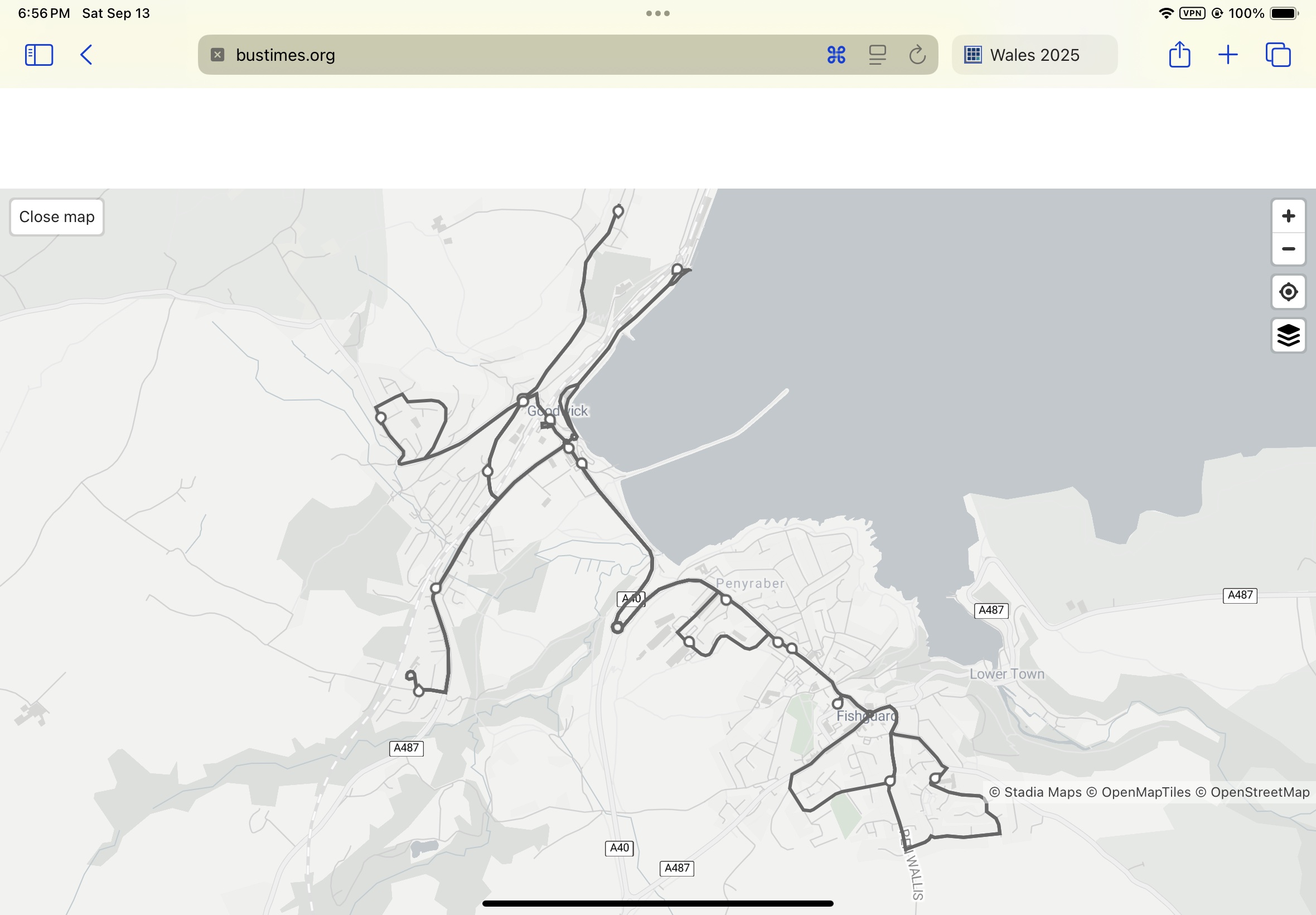
We wandered around near the coast for a while, as we were waiting for a specific bus that would take us most of the distance up the 300-foot hill where the B&B was located. Shoshanna's a genius for figuring out complex itineraries, but this particular one almost ended her win streak. Here's the bus route that shows why, though it doesn't show the helpful timing details of "some time before 5:15":
Signs (zoom in if necessary) that not everyone is Wales is lovely all the time:
Anyway, she found what appeared to be the right route and right bus and the right stop, and while we were waiting for the bus, a guy came out of the B&B across the street, and noticing that we were waiting at the bus stop, decided to take us under his wing and explain to us how the local bus system worked, which was very reassuring because it confirmed Shoshanna's belief about where we should be waiting. Some of the weirdness of the route picture can be explained by the fact that the bus goes only a certain distance up some paths and then returns along the same path, and possibly only stops if you flag down the driver. Our good Samaritan even offered to pay our bus fare, but we had the necessary coins and thanked him but said no. This has been a general trend: all the Welsh we've interacted with have been friendly and helpful.
The bus took us about 270 of the 300 feet uphill, which was a godsend because we were quite tired by the time we got to the bus stop. We're doing one more load of laundry while we can, and once Shoshanna's out of the shower, we'll have a cuppa (tea) and then early to bed.
Our goal had originally been to spend the day sea kayaking, but the weather continued to look awful, so the tour company cancelled our tour, though not without some pressure from Shoshanna; I think they were hoping for a dramatic last-minute change to good weather, which did not happen. Instead, we stayed cozily at home, then spent a bit of time with our hosts, who spent yesterday chopping and piling wood for the winter. We volunteered to help with the splitting phase. I wanted to find out more about the farm and what they're doing with it. Also, Mike appears to be a writer or writer coach, so I'd be interested leaning what he does. We writers flock together! (In the end, he had nothing to say about that, but his wife took his place. See below!)
For breakfast, Shoshanna scrambled up some eggs produced by the farm (including some with blue tints), plus some beautiful light brown mushrooms (Shoshanna saw similar ones at the market called "chestnut mushrooms"?) and pork/apple sausages from local suppliers. All delicious with the robust local bread and homemade jelly. The weather wasn't initially terrible, but the wind grew fiercer as the day went by, with strong gusts punctuated with periods of "only strong" wind. No thunderstorms, but periodic bouts of rain that made things quite damp. Possibly walking weather, but not along the coastal cliffs (winds would have made it unsafe) and it wouldn't have been fun on most of the local rural roads, so we stayed home and dry until our host Mike came by to say he was starting work in the barn.
Previously, Mike had cut downed trees and branches into roughly foot-long round bolts. We spent late morning to about 2 PM helping him split the bolts with a motorized log-splitter. While Mike operated the splitter, Shoshanna and I took turns passing him bolts of wood to be split and tossing the split wood into large heavy-duty bags so we could drag off the bags and pile the split wood for subsequent stacking. In between, I took wheelbarrow trips out to the pile of roundwood outside the barn to replenish the stock of wood to be split. We filled six or seven bags (about 1 foot by 2 foot by 3 foot) sufficiently full they were difficult to move, and piled them by the barn doors. Mike and Christine are going to be building a loft in the barn to make more room for storage, and they needed to split all the wood to make room for the building materials, which will be arriving this week. While we worked on the wood, their son Aneurin harvested windfall apples, which he stored in a ventilated wood frame with multiple shelves. They grow several varieties. The lower-quality ones will be processed by Christine into a bunch of products, presumably including apple sauce and cider.
Mike invited us to tea, so we moved from the barn into their house to warm up and socialize. The part we saw was lovely; they'd stripped off some bad 1970s renovation work to reveal the beautiful bones of the part of the building attached to our cottage (see photos earlier in the blog), with lovely mortared fieldstone walls and an impressive collection of cast iron and enameled cast iron pots (think Le Creuset and you'll get the idea). Also an enormous open arch in the wall that formerly housed an equally enormous fireplace centuries ago (about 2.5 to 3 m wide by 1 m deep) and now housed their stove.
We got distracted with conversation, and never did discuss details of the farm. Shoshanna and I sipped tea and explained what we do for a living. Mike was fairly quiet and apart from showing us his solarium/greenhouse, where he grows pineapples (!), cinnamon, and various tropical plants (including frangipani), didn't say much about what he used to do before farming. Christine (Willison) told us she's a writer and oral storyteller, and has published an introductory book on storytelling as well as a book on local (Pembrokeshire) Welsh folk tales. They invited us to lunch or dinner, but that seemed like overstaying our welcome, so we politely declined and returned to our cottage.
We had another cup of tea, and I napped a bit, and now it's almost 6 and time to start thinking about dinner. Meat pies and leftover fries are on the menu, washed down by local beer. No late photos today, as the weather wasn't suitable for outdoor exploration and it always feels a bit odd photographing people who are hosting you but otherwise not friends or colleagues, not to mention their homes. More photos tomorrow!
Today was consumed by travel by bus to Aberystwyth, where our plan was to stay 3 nights at the gwesTY Guest House. Speaking of consumed, last night's meal was surprisingly good: a beef and onion pie, a chicken and mushroom pie, and a Cornish pasty (beef and potato) that we'd brought back from the seaside fish and chips restaurant mentioned earlier. Much better than "not bad", if not actually "fresh from the oven" good. The beer was also take-out: Brewdog's cleverly (not!) named "Cold Beer". Shoshanna suggested that it reminded her of illicit highschool beer, which is a fair appraisal; "tastes like teen spirit" (cunning Nirvana reference!) would be too charitable. But it was indeed cold and beery, so it sufficed.
Next morning, we said farewell to Mike, who had another long day ahead of him again, and Christine drove us into town to meet the bus. Farewells took longer than expected, as Mike is a font of interesting information that he's eager to share, such as which side of the bus to sit on to get the best sea views and Christine is a slow and careful driver. We made it to the bus stop in plenty of time, hugged Christine, and waited less than about 15 minutes for the bus to leave.
Today initially looked to be fairly nasty weather, with high winds (gusting up to 50 km/h) and thunderstorms, so a good day to be sightseeing on a bus for several hours rather than outdoors getting soaked. In the event, the forecast got the wind right, but apart from ominous clouds, there was no significant rain. The wind was strong enough you could hear it howling around the bus' windscreen and door, trying to get in. The winds remained strong the whole trip.
The driving was, as usual, ocassionally white-knuckle driving, particularly when our bus had to pass a large truck such as a fuel tanker or car carrier coming from the other direction, with the tight quarters often complicated by equally tight turns (leaving little or no room to maneuver) and road repairs, which a couple times forced our driver to park in the middle of the turn, leave the bus, and reposition one or more road signs to let the bus fit through. Yet despite being intimidating to the uninitiated (i.e., us), there were no truly close calls with the driving. Welsh drivers seem highly skilled at working around tight spaces and sharing the road.
We got to Aberystwyth by around 2 PM and set out for our hotel down by the beach, pushing against a stiff wind the whole way. The task was made even harder by our large backpacks (think "sailboat"). Unfortunately, nobody was at the desk at the gwesTY and nobody came in response to the door buzzer in the lobby. After several tries, we gave up and Shoshanna called the hotel's phone to see if anyone was paying attention to the phone.
The hotel's phone number on Booking.com turned out to be the manager's personal cell phone. He had no record of our reservation and the hotel was now full. After an initial moment of panic, we took a deep breath and set about remedying the situation. Shoshanna, who is our logistics genius, called Booking.com to ask what had happened, and got through in less than 5 minutes to a very helpful agent. No more than five minutes later, they had e-mailed us a list of four alternative hotels for which they would pay the additional cost, if any, compared to our original reservation. We chose the Richmond Hotel, a 15-minute walk from the gwesTY and closer to the oceean (across a street from the beach), and a couple clicks later, we were registered and on our way to the new hotel. Great customer service!
We walked to the hotel easily enough, despite the wind, and found it amidst a long, sweeping, continuous row of four-story Victorian seaside buildngs, multicolored, about 50 meters from the water. The beach was being pummeled by the surf. The wind picked up even more once we were unprotected by streets of tall buildings. A friendly desk clerk checked us in, and suggested that as the hotel was nearly full, we should both book a table in advance (a common thing) if we wanted to eat at the hotal and to pre-order dinner (an uncommon thing). We checked the menu posted in the lobby, and it was full of yummy things, so we decided to eat here rather than going out to eat. Details to follow in a few paragraphs after we've eaten.
Beach hotels:
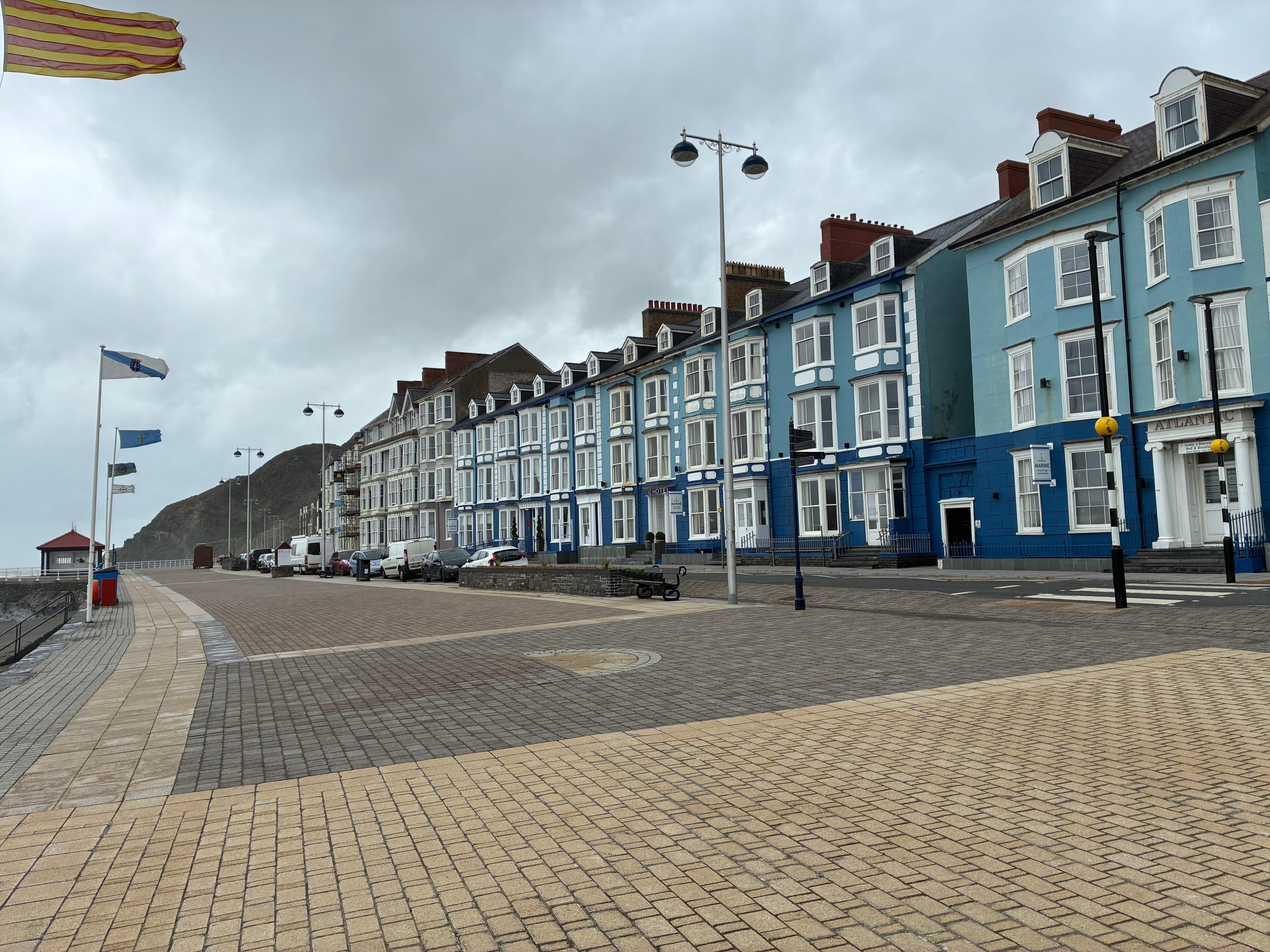
I wouldn't call the hotel swank, particularly given the cost, but the room's large and comfortable, with a great view of the sea right across the street. We're on the first floor (in British-speak, the first floor above ground level), which is a good thing: if the waves get any larger, they'll start coming ashore and knocking on our front door. We dumped our bags, got out our coats, and went off to walk for an hour or so. First stop was a store operated by a Canadian company, "Trespass", that we'd noticed along the way and that was having a going-out-of-business sale. Shoshanna needed a rain cover for her big pack, new rain pants, and a new daypack, as her old one was saggy and starting to wear through. She found all three at decent prices with the help of a very cheerful and helpful clerk.
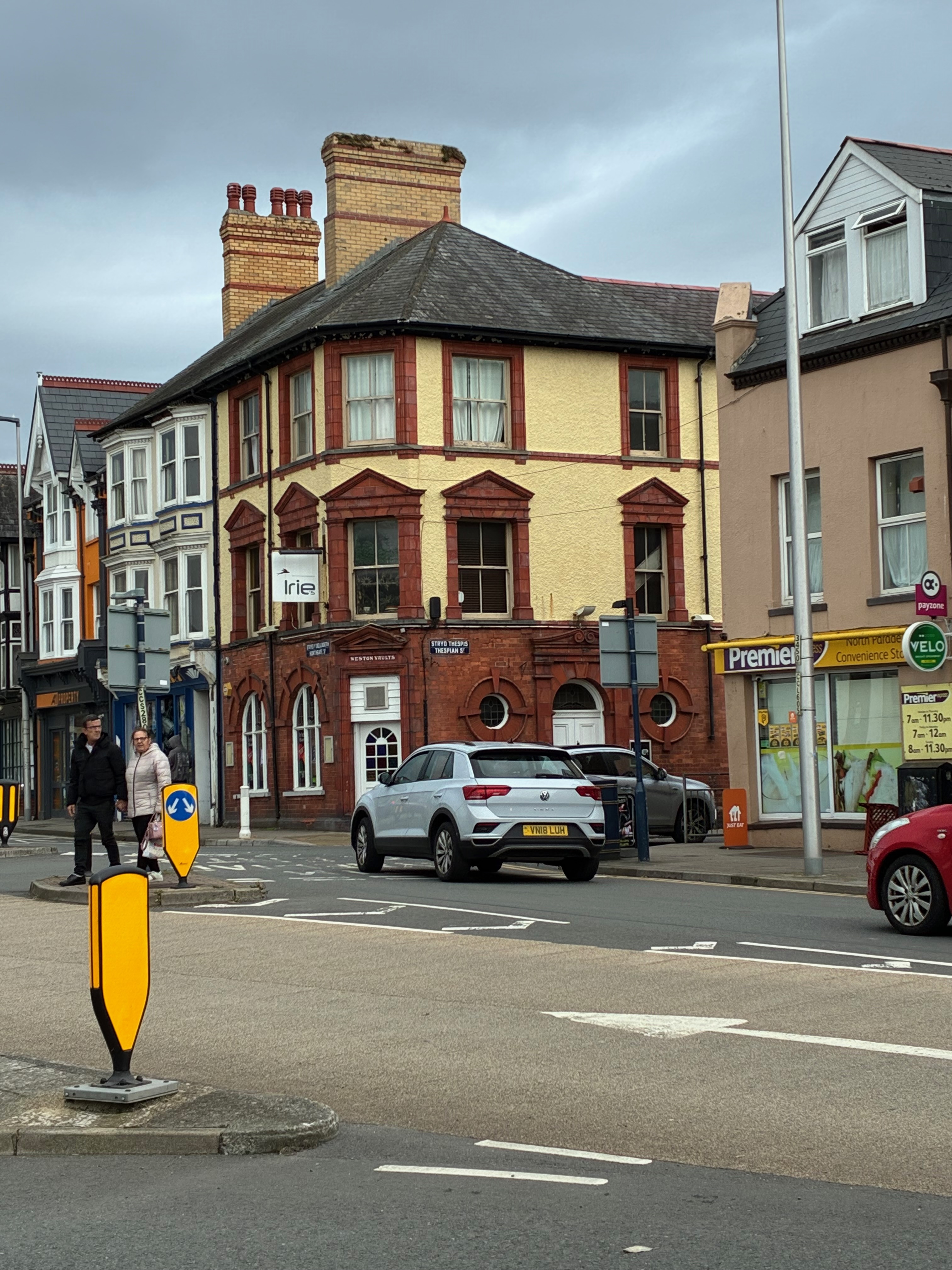
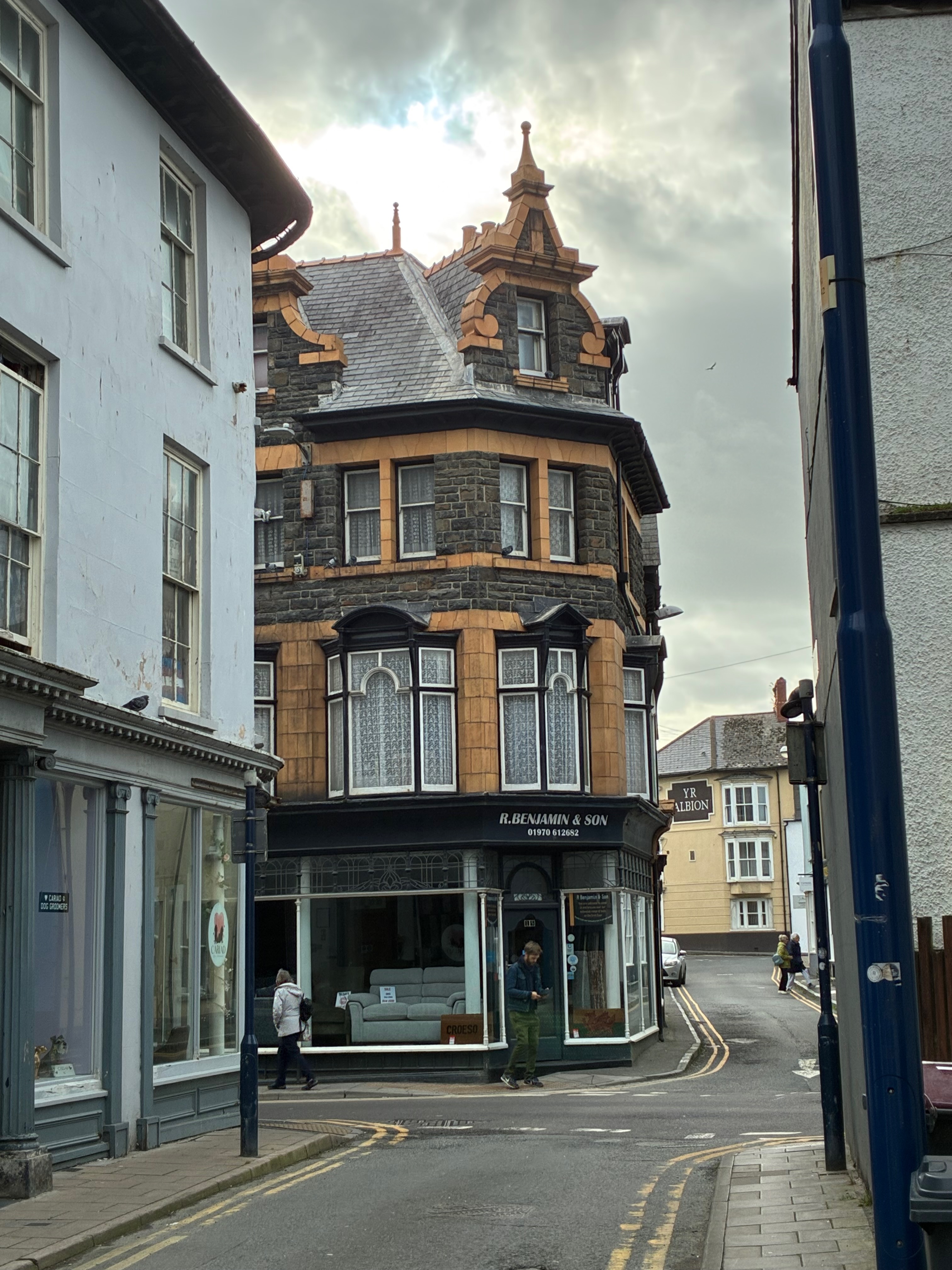
Next stop was a wander through our part of town, stretching our legs after sitting so long and getting a feel for the town—the first big city we'd spent any time in since arriving in Wales. It's a pretty town, with lots of colorful old buildings, but also a large number of charity shops (places where you buy donated castoffs to fund an organization such as the Red Cross) and many stores seemingly going out of business.
Typical Aberystwyth streets:
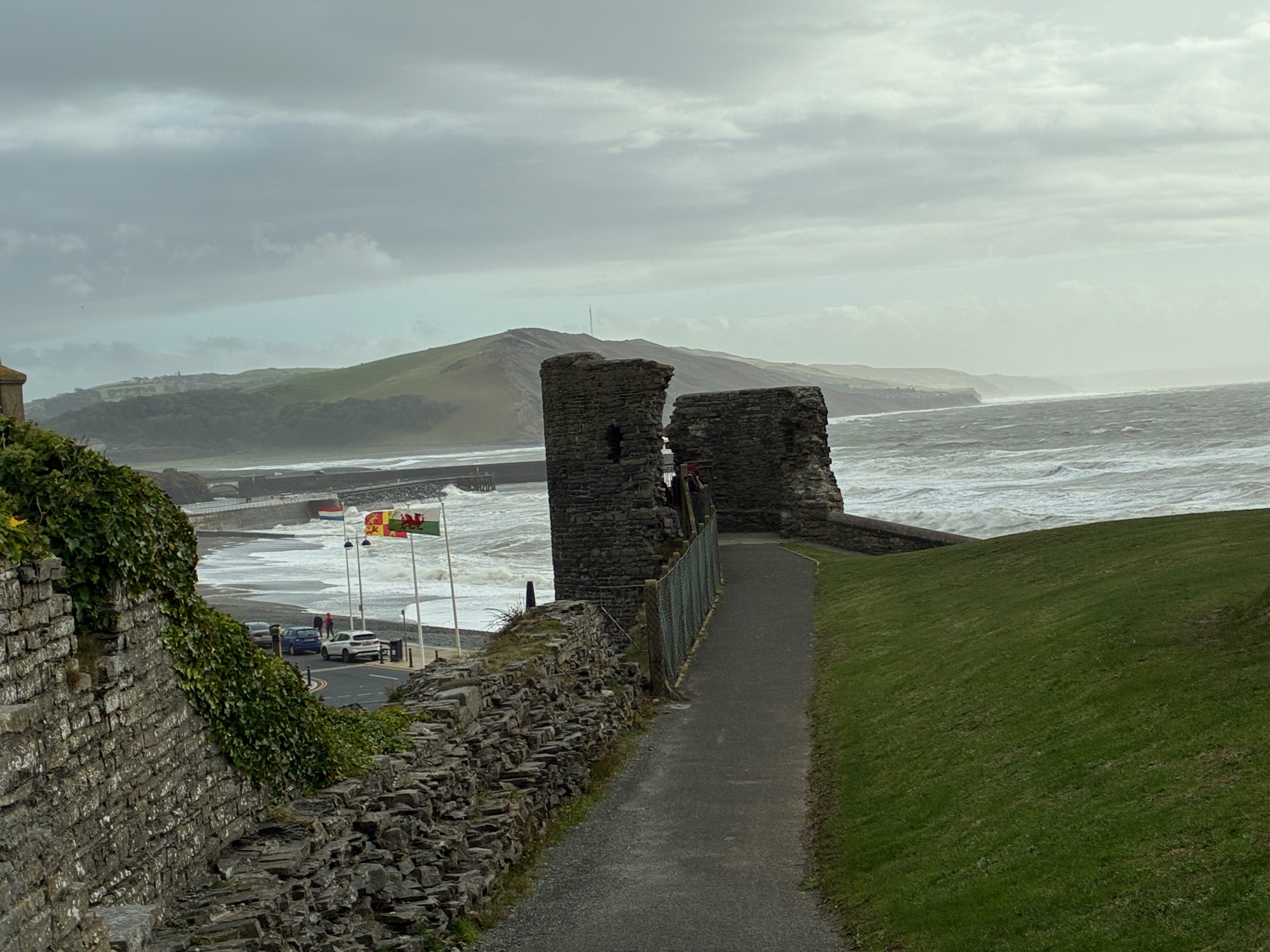
Our last stop before heading home to prepare for dinner were the ruins of Aberystwyth Castle, which were definitely ruined. Still, an impressive structure.
Castle ruins:
Dinner was only okay. I started with a roast red pepper soup whose taste was overwhelmed by tomato, and Shoshanna had corn fritters that were okay, but a bit gluey. Main courses, which we shared, were lamb cawl (a basic lamb stew) that showed promise, but was oversalted, and a decent roasted lamb shank with good gravy, mashed potatoes, and roasted new potatoes. Dessert was an apple–blackberry crumble, which was decent but served in a short crust pastry bowl rather than mixed in with roasted oats. Overall, I'd rate the restaurant disappointing but not terrible. I expected better from an expensive beachfront hotel, so we probably won't come back for dinner. (Breakfast is included with the room.) I'm not sure what it is, but something about the dining room, the people in it, and the muzak playing (mercifully) softly in the background all added up to a sense of déjà vu that Shoshanna didn't share. All I can think is that it's a memory from many years of watching British sitcoms, including Fawlty Towers and Monty Python sketches. Weird.
Aberystwyth is a university town whose students return in 2 days, the day after we leave for home. As Mike noted while we were getting ready to leave, it's in the middle of nowhere yet somehow feels like a kind of center of gravity of Wales. The first part is clear, but we'll see if we detect the other part during our stay.
And now, off to bed, lulled by the waves crashing on the shore outside our windows.
I'm writing this in bed at the hotel after a tiring day of hiking. The waves continue to crash upon the shore just below us, and from our windows, the angle of the light is perfect for making the water look like liquid glass in the seconds before the wave collapses into a mashed potato pile of foam. Further out, the sea surface is like burnished silver. As I'm writing, the reflection from the wave is getting steadily brighter—enough so I'm going to need to draw the curtains. Lovely, and the rhythmic noise of the waves is very soothing!
Our goal for today was to fit in more coastal hiking, as we only have 2 days left in Wales and tomorrow's forecast is looking pretty grim for outdoor activities (heavy rain all day and still windy). If that's how the weather turns, then we'll stay in Aberystwyth and do social/cultural things like visiting the national library and looking for other historical stuff. It might be nice to visit the local university, but when I looked at the tourist map, the locations of various university campuses looks like a Jackon Pollock painting, with dribs and drabs scattered everywhere amidst the other buildings.
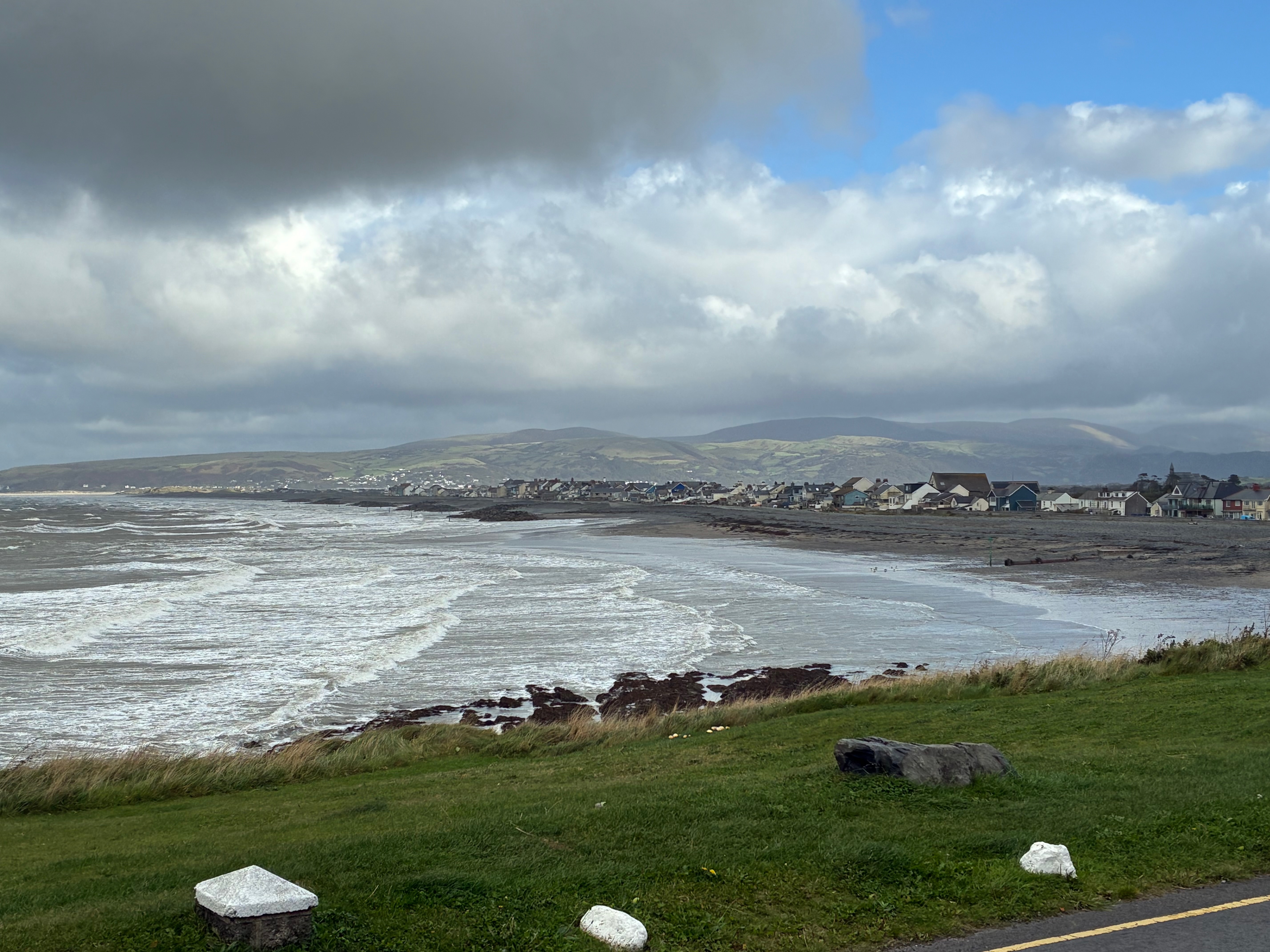
Today's forecast looked excellent for walking, so we decided to go ahead with our hike. Rather than doing a full circular route ("there and back again"), which would have taken at least 6 grueling hours, with a wearying amount of up and down, we took a bus to Borth, several kilometres north of Aberystwyth, where one of the coastal hikes began. From Borth, we walked south along the coast. We started our walk at a Royal National Lifeboat Institution station. They're the charitable volunteer service that does search and rescue operations 24/7 in coastal areas—sort of like a marine volunteer fire department. When the weather started looking iffy, we armored up in our waterproofs and covered our packs with wraparound bags that keep out the rain. The rain came only briefly, and thereafter it was perfect weather for a long hike, with the stiff breeze returning to keep us from overheating and occasional flashes of sun and blue sky. For me, that is; Shoshanna prefers warmer weather, particularly since the wind bothers her ears.
The coast at Borth when we started walking:
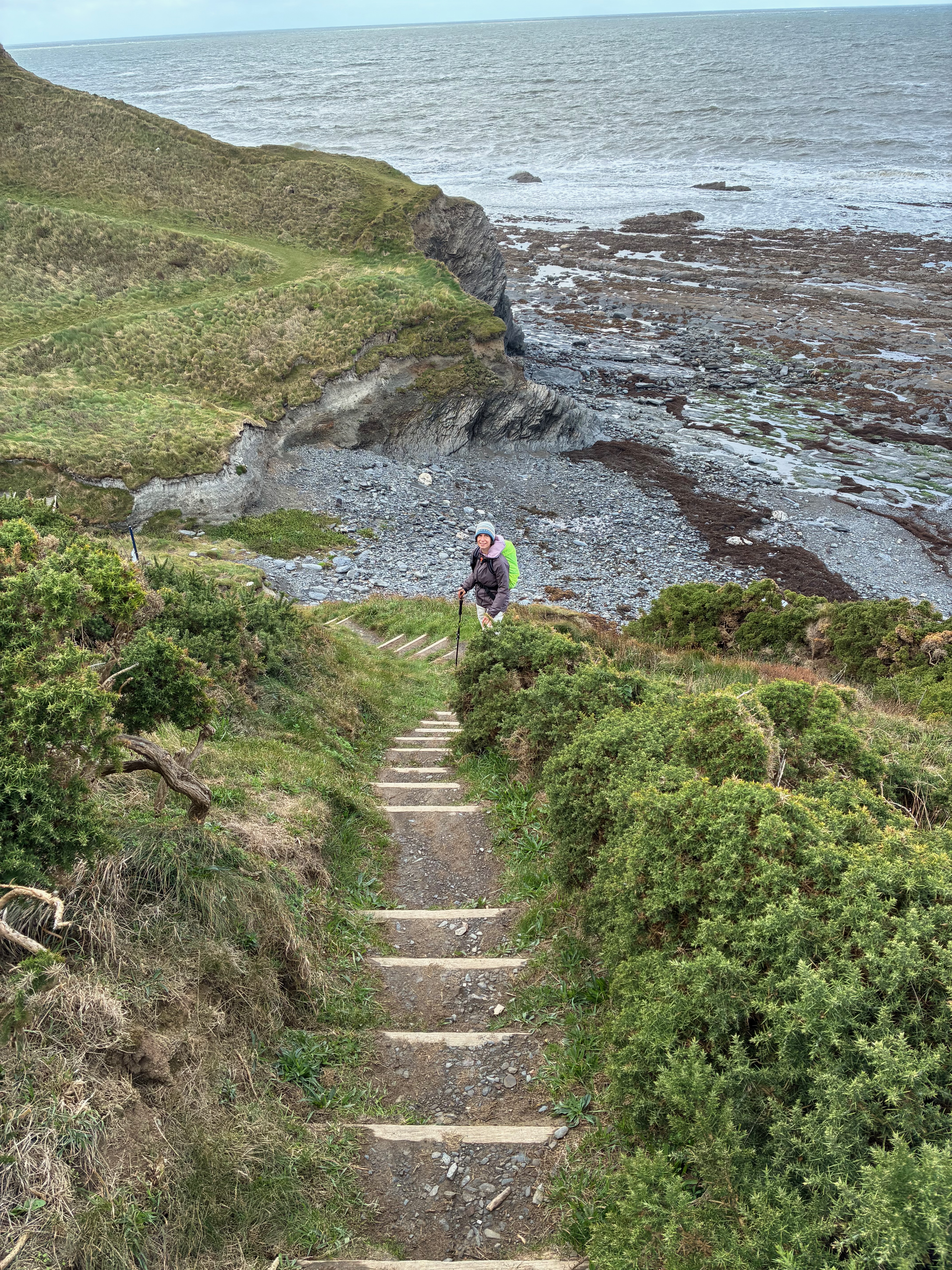
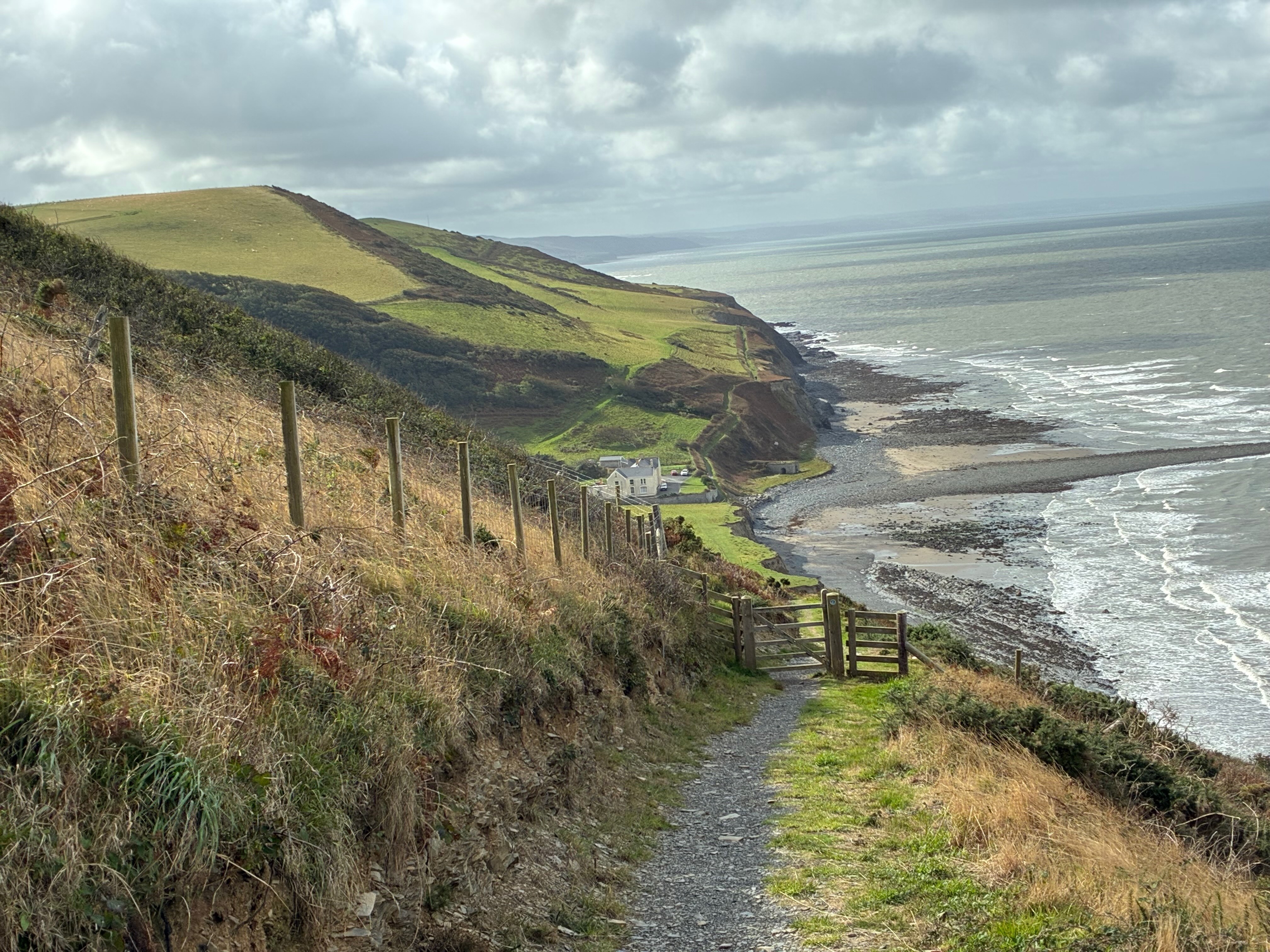
The coastal path is planned for safety, so the trail keeps you a safe distance from where a steep descent or even a cliff starts, with periodic sign-post warnings not to get any closer to the edge, since many places feature overhangs that could easily collapse. There are occasional stretches that are uncomfortably close to the edge, but with a little care, it's not dangerous. An additional safety measure is sometimes provided by the strong winds, such as today's winds, which mostly originate from the ocean and push you away from the edge. Which is a good thing, since gusts were sometimes strong enough to unbalance us, and that could have been dangerous if they pushed us towards the edge. Although the trails are pretty safe, you do have to keep your wits about you during steep descents.
For example, a couple steep slopes near Borth:
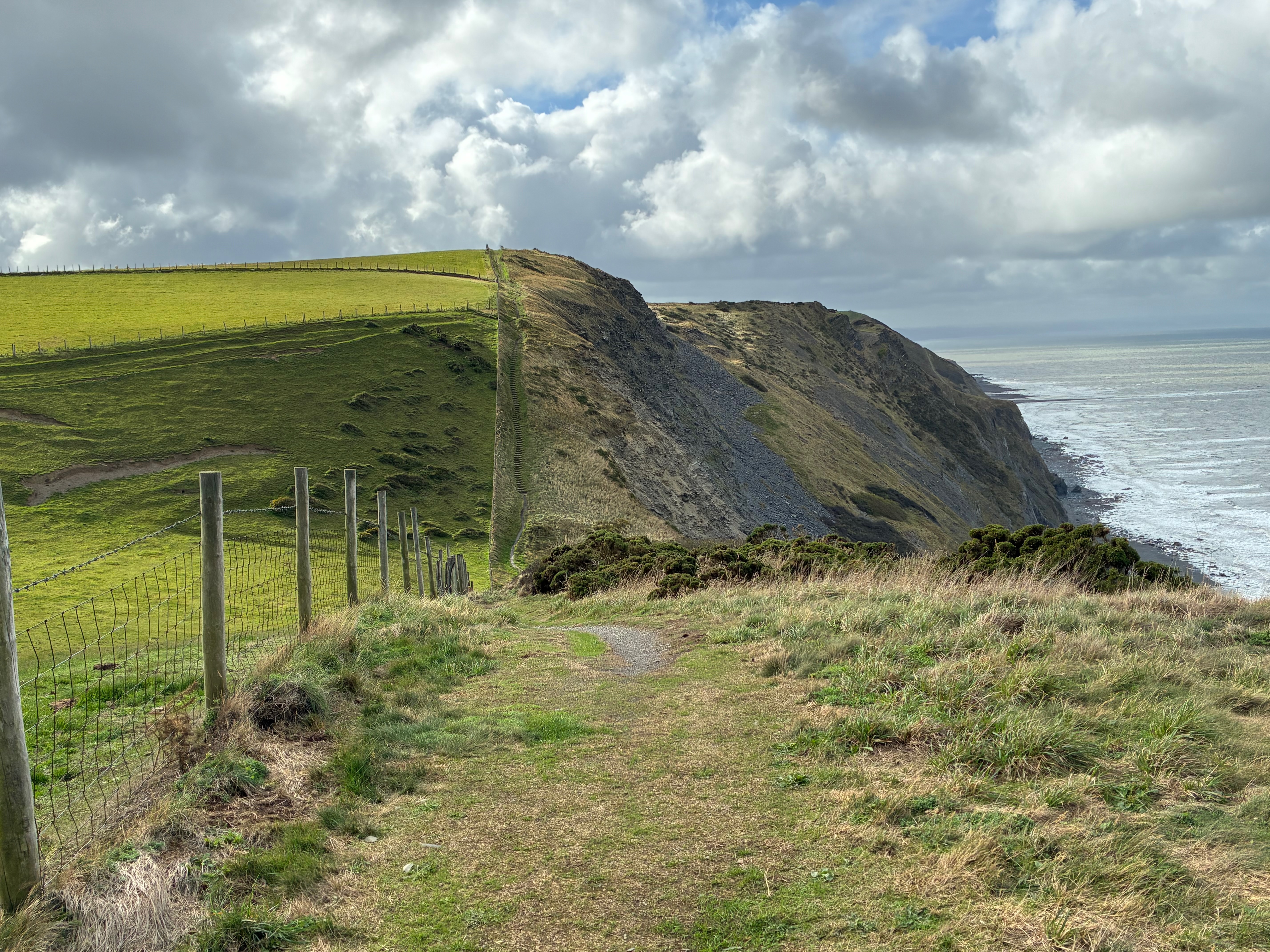
We stopped a couple times for water and to refuel (trail mix with a ton of fruit and nuts), and loved the views and ocean all along the way. The ever-changing light means that nothing looks exactly the same twice. The wave-polished rocks and angles of the strata were fascinating. And the light and color are just spectacular sometimes:
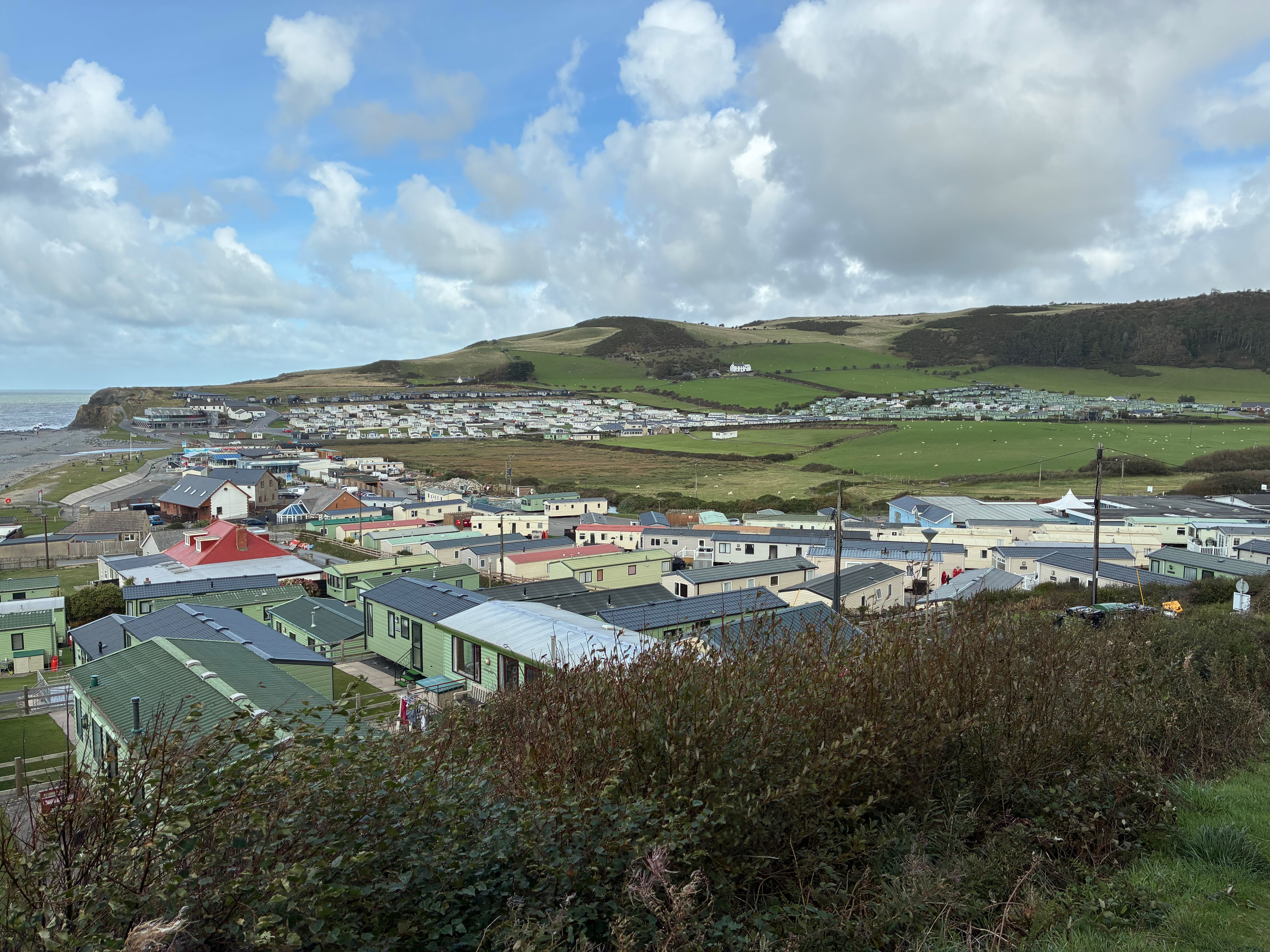
One interesting thing that we saw previously, but that I didn't comment on, was what initially looked like trailer parks, but are actually called "vacation caravans". They're basically small prefab trailer-transported homes, but used for vacation get-aways rather than a permanent residence. The agglomeration of ticky-tacky boxes isn't particularly esthetic, but it's a good way to escape the city and live inexpensively in a beautiful rural area. The trail led us through one such community on our way home, and it included a small amusement park, with bumper cars and other things to entertain children. Lots of people out walking dogs, of course.
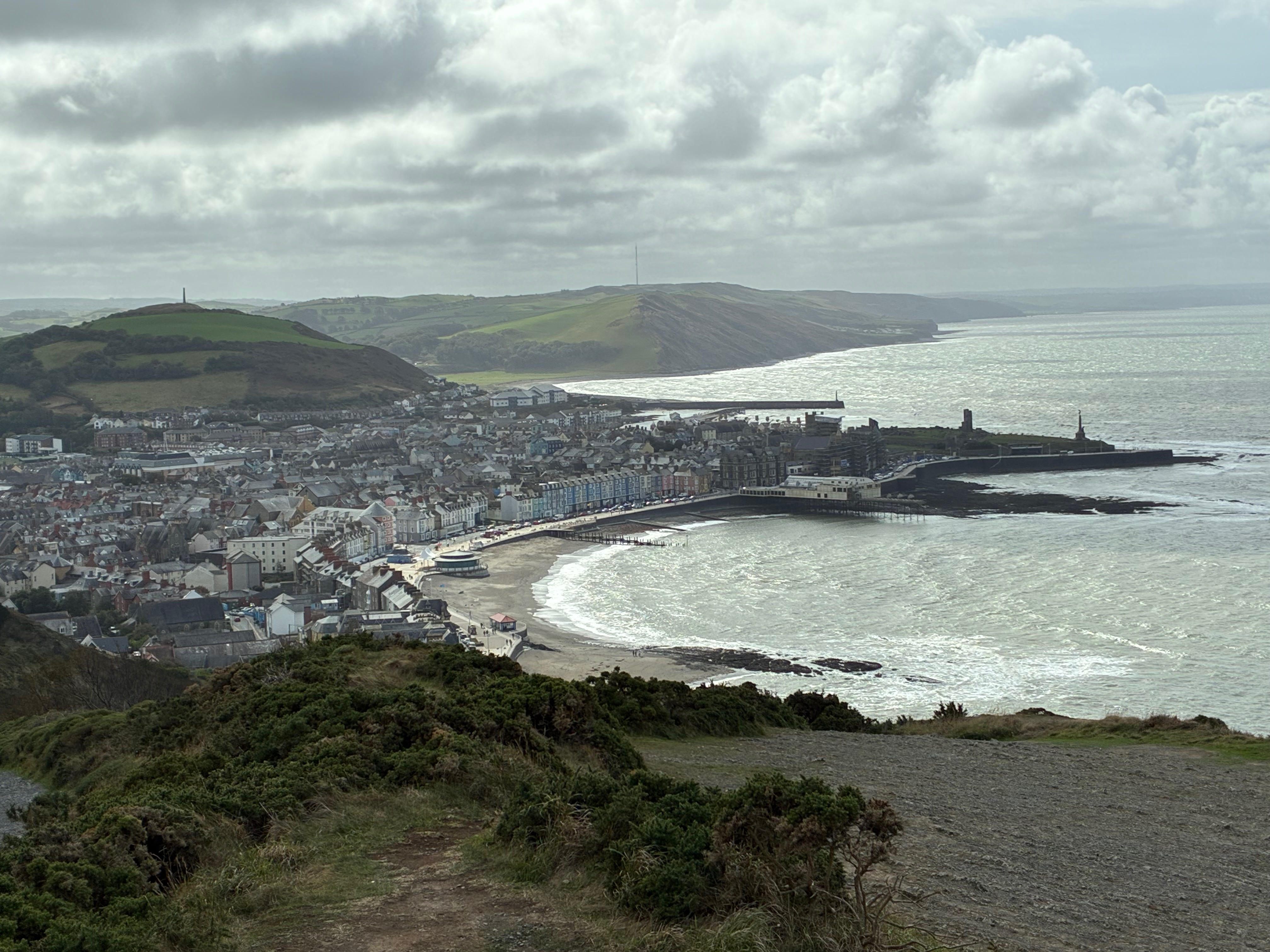
We climbed and then descended the mountain that forms the northern boundary of Aberystwyth. We did this on foot, despite the temptation of taking the funicular that runs up and down the mountain. We still had a little more energy left in our legs, and didn't think it worthwhile to spend £15 just to spare us a little effort. Plus, we had time to take some photos of our temporary home from above:
There are nominally grey seals on some beaches at this time of year, but we didn't see any except for one poor dead seal on the beach down the road from our hotel. Not much in the way of wildlife, though we stopped several times to watch birds (including at least one kestrel) hovering almost completely motionless, supported only by the wind. Shoshanna also spotted a dead vole (kinda like a short-tailed or tail-less mouse). Seagulls everywhere, of course, but nothing special about them.
Because we're getting older and more fragile, we take longer than most to complete challenging hikes. Partly it's because we don't rush down slopes and risk turning an ankle or slipping and breaking something. We also like to take frequent breaks to enjoy the scenery more than just taking a casual glance, particularly since it's not a good survival strategy to sightsee without watching where you're putting your feet when you're next to a cliff. (Literature citation needed to support that claim.) So we do a lot more stopping to gaze and take pictures to share when we get home. Today, rather than taking a predicted 3 hours, we took 4 hours. But well worth the time.
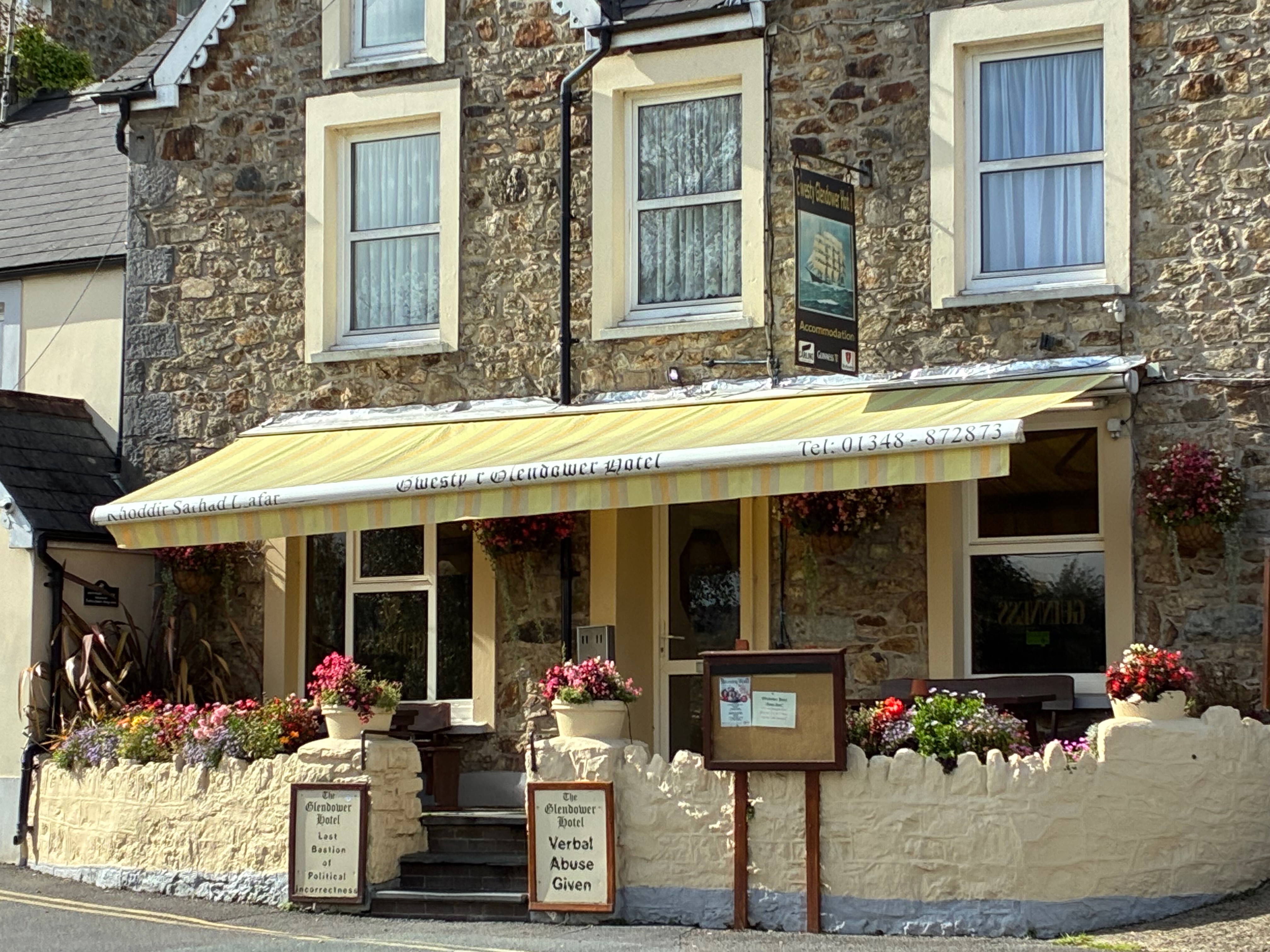
Dinner tonight will be at a restaurant called "The Glengower", which our hotel receptionist recommended. It gets very good ratings online, and conveniently, it's only a 5-minute walk from our hotel. Details later or tomorrow. We're eating early (6 PM) because we're planning to go to a place called the "Bank Vault", which is a local club that has nightly live music. Tonight, they host local musicians from the Aberystwyth Folk Club for an open-mike night. I'm hoping it will be like the drop-in trad music sessions we saw while in Ireland a few years back. I admit that another attraction is the large variety of locally brewed beers on tap. I'll probably post details tomorrow morning. Stay tuned!
Dinner last night at The Glengower was good enough that we reserved a table at the restaurant again for tonight. I had a thick and hearty bowl of potato–leek soup to start and simple but excellent burger, and although the fries were good, the onion rings added as a garnish were disappointing (more batter than onion). Shoshanna had an entree of corn–squash fritters with sweet chili dipping sauce and a sea bream filet, with cabbage and fennel salad and roasted potatoes. Both the entrees and the mains were delicious.
After dinner, we walked to the Bank Vault club for an evening of open-microphone music from local musicians. No cover charge, and no contribution jar to support the musicians. The quality of the music ranged from mediocre to excellent, as is usually the case at such events. Except for one woman who played an accordian, it was more gutar-centered folk and blues than traditional Welsh music, but it was a pleasant night out nonetheless. Live music is always fun. And the bar had 14 beer varities on tap. Given our weak constitutions, it wouldn't be possible to try them all, so we focused on Welsh beers. We ordered (spread over the evening as half pints) two pints of Welsh beers: we enjoyed a Wrexham lager, a Tenby Mor Ddu stout (twice), and a Kyra IPA. I preferred the lager, and Shoshanna preferred the stout. We also tried out a couple tastes of several other beers—just to be fair to other parts of the U.K. We thanked the bartender for his patience by buying him a drink, which seemed to be appreciated.
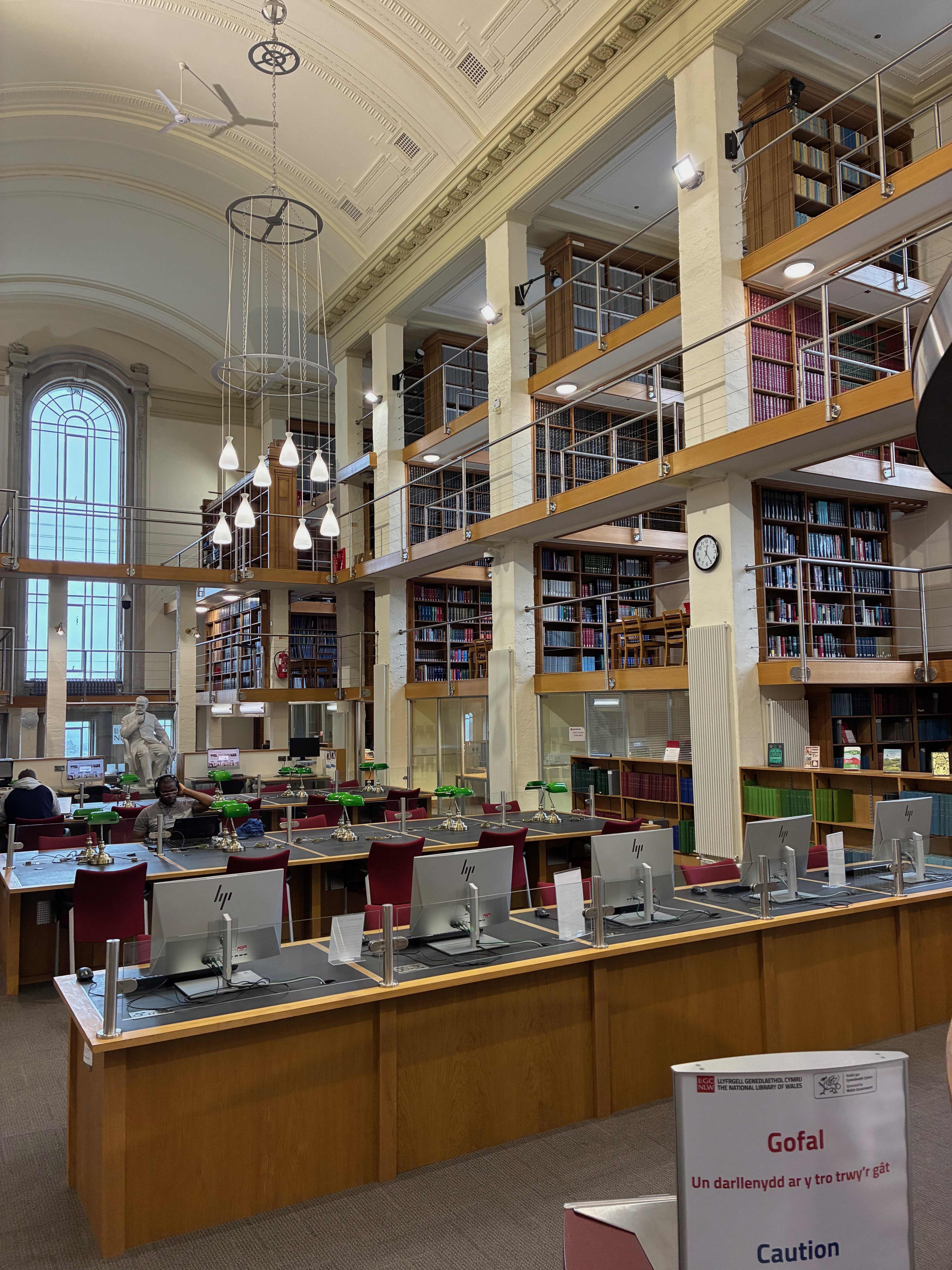
Today's forecast was for continuous rain, which suggested a long hike wasn't a good plan and that we should instead stick closer to home. So we wandered up and down the downtown streets, checking out the thrift/charity shops in search of bargains. In the end, it only really rained during the morning, so we kept walking. We visited the Welsh National Library, which is a steep hike up the mountainside on the east end of the city. The Aberytswyth site for the library was chosen because one of the donors promised to donate his large collection of books if they chose Aberystwyth, and opened in 1951. It serves as a national repository for all publications, and reports that they receive 4000 publications per week for its collection!
The library itself has many things going on, including research support through its large collection, meetings and events (including weddings), beautifully open and airy reading rooms, and special collections like the map room. It's a pleasant new facility set within an old stone shell. We checked out several of the galleries, and particularly one that commemorated the displacement of Welsh farmers from their valley home to allow creation of a reservoir that would feed Liverpool. The compensation provided to the farmers seems to have been fair and the time provided adequate, but the government didn't seem willing to accept "no" for an answer. As a result, its actions attracted considerable opposition, and the event seems to still be remembered angrily by the Welsh.
A pleasant reading room:
One nice thing about the library is that it offers a beautiful downslope view of Aberystwyth and its coast:
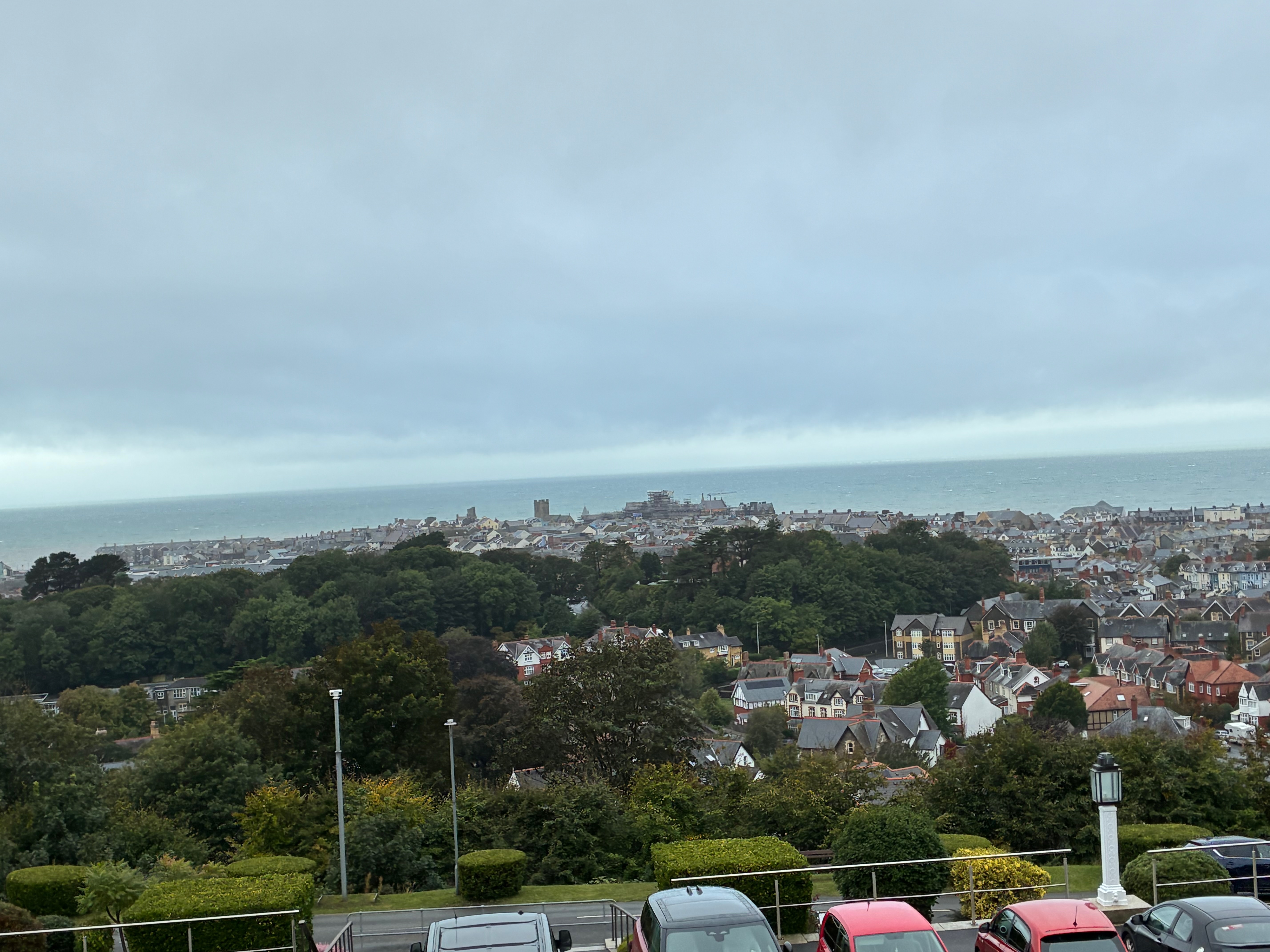
From the National Library, we walked west to the base of a high mountain south of the city on the coast. That's where the southern coastal trail began, but we couldn't bring ourselves to face the 600-metre ascent to the mountain's top. Instead, we stayed at a short distance above sea level, passing through a cemetary, a park, and the residential community at the southern end of Aberystwyth, which we hadn't seen before. Nothing special to report—your basic suburb—but we did see the first cat we've seen in Wales, which is very much a doggy city.
We ended our walking day by threading our waythrough a huge arcade of electronic games and standbys such as shuffleboard that resembled nothing so much as a casino. It's installed, along with a fish and chips restaurat, on the modern pier that stretches about 100 metres into the ocean, towards the south end of the row of hotels that includes our hotel. The enormous arcade nominally gave access to the far end of the pier, where a cleverly named "pier" garden was located to serve refreshments, but it was closed when we finally reached the end of the arcade.
However, there's an older pier that forms half a dozen descending platforms (distinct levels connected by staircases) on its way downwards from the promenade to the water. It only stretches about 30 m into the sea. Since it was open, we went down a couple of levels so we could watch the waves from up close. The flooring of each level is made from expanded plastic mesh, and as the tide rose, the lowest of the levels were increasingly submerged. With each wave, water oozed up through the mesh floor until it came together to form a solid surface, which then surged upwards, the water sometimes shooting up above the floor. We stayed until Shoshanna almost got soaked by an upsurge of water from the level below the one we were standing on.
I'm writing this at the end of the day, with the surf still pounding strongly on the shore. Where the incoming waves hit the water from the previous wave that's returning downhill across the beach, the collision creates an eruption of roiling white foam that's currently rising some 3 to 4 feet above the beach. The rip tide must be ferocious.
No plans tonight other than a good dinner and packing so that we're ready to leave tomorrow morning. We need to be at the train by 9:30 so that we can catch a followup train that will take us to our last stay in the U.K. before returning home. Where did the 2 weeks go?
More tomorrow night.
For our final day in Wales, we aimed to stay close enough to London and Heathrow airport that there'd be little fear of missing our flight due to a railway glitch (worst-case scenario being to hire a taxi), yet without staying right next to the airport so we could avoid airport price markups, get in one last day of wandering around maybe, and enjoy a small patch of England before returning home. Shoshanna found a suitably located place: the Leonardo Hotel in Watford Junction. But we probably won't do much roaming around; it's very urban and busy and not particularly pretty.
Nothing special to report about today's travel: we made it to our first train and its connection to the train that will take us to Watford with time to spare, so basically a stress-free day. Nothing particularly fascinating to report, so today's entry is shorter than usual. We'll e-mail everyone once we're home and have e-mail access again.
Our last day in England began with a bus to Heathrow. Because our flight was scheduled to arrive in Montreal uncomfortably close to the time when the last train of the day would leave for Kingston, we opted to spend the night in the Dorval Holiday Inn, just up the road from the airport which is, in turn, just up the road from the train station.
Breakfast with Mom, who came to get us at the Holiday Inn and drove us to the restaurant and then to the station. She also brought bagels, which is one of the Montreal things we miss in Kingston.
An uneventful trip home, with one surprise at the end: Our contractor had made good progress on the mudroom and porch, but had neglected a way for us to re-enter our home:
Fortunately, the metal fence wasn't embedded in the ground, and we were able to push it enough to create an opening by the lilic (on the right side of the right photo). Having vanquished the fence, we unloaded our bags and began the process of re-entering our daily lives.
Until next year's vacation...
©2004–2026 Geoffrey Hart. All rights reserved.